How big is too big? or, Is there a too big?

Go as big as you want!
Prescribe the values.
Apply the physics.
Be accurate and practice perfectly and
you can accomplish alot. Is the net gain worth the expenditure? plug in your own variables.

But miscalculate and loose a life at worst and damage property at best.

I think the question needs to be further refined and leaves alot open for confusion and argument.

Easy answer to the questions is too big is the safety factor applied to the winkest link and yes there is too big.
 
it's not about how big or small it's about the optimum size for the tree and situation ie how skilled is the guy running the ropes? how much space you got to rig the stuff into? are there any obvious structural defects?

there are many factors that dictate the size of rigged branches and timber.

The idea of going as big as you want is stupid advice for obvious reasons, if you dont know what these reasons are then you should be thinking about working with some experienced people before you kill yourself or someone else......however it's also stupid to go really small when rigging.

One things for damn sure, you can't learn rigging sitting in front of a computer.
 
Truly spoken Tim experience will surely play a part is what size pieces you take. On a live structurally sound tree where there are very good places to set multiple blocks and the LZ is sizeable as well as having competent groundies running the ropes would be a favorable time to cut large sections. But that is an ideal setting which I personally don't encounter very often. Most times I am taking out defective trees that are questionable where I don't like rigging stuff off of far less big pieces. Therefore I take smaller manageable pieces with little shock loading and work the tree in a balanced style i.e a bit off one side counteractin with a bit off the other, saving the centre leader for the final step. Slower and more climbing but with a far lesser risk of the tree doing something funny. I like adding a little $.02, as I have done a few not so nice trees.
 
[ QUOTE ]

One things for damn sure, you can't learn rigging sitting in front of a computer.

[/ QUOTE ]

Then I guess I'd better take back the old rigging lines I found in the trash then.
 
I'm surprised it hasn't been mentioned that...

given the example (1/2" double braid, etc.) "how big a piece would you cut?"...

it is essential to consider whether it will be staticly or dynamicly loaded.

It seems to me anyone who is trying to be 'safe' would not load anything much beyond the 'safe' working load limit.

i'm sure somebody somewhere worked very hard at determining it.

all of this is, of course, with confidence that the tree can withstand the force of example.
 
I agree with swing. Most of the trees I end up removing are because they have some sort of defect. I rarely remove totally healthy trees and honestly I don't really want to. If the tree isn't a hazard I would prefer it stays there. That being said, of course there is a too big. Too big is the point at which a part of your system fails, whether it is equipment, rigging points in the tree or your LZ. Never go beyond what you are comfortable rigging out. You are the one in the tree with your on the line. As you gain more experience you may decide to take bigger pieces in certain situations and smaller pieces in others. I've found there are very few hard and fast rules in tree care, there are guidelines which will help you make the correct decision for a given situation. Do as much research as you can so that you can make a truly educated decision. There are too many tree guys out there who know the rules and guidelines by rote but have no understanding of the principles behind them. That being said, good luck and stick with it, from your later comments in this thread it sounds like your head is not up your and you are doing good work.
 
[ QUOTE ]

Your use of 'boyscout' in a pejorative way is offensive.

My Dad was a Scout, my parents were troop leaders for eight years when they first got married, I made it to Star and part way to Life Scout.

Name-calling is a way for bully to browbeat anyone who threatens up to them in a real or imaginary way.

[/ QUOTE ]

if the shoe fits.. wear it...
 
just like in hazardous tree assessment, we consider the amount of risk in any rigging scenario (chances of failure), and the cost of failure, in relation to each other. If you are rigging to protect the lawn or some forsythia, or an old shrub the client would just as soon see removed, then you can operate with a lot more latitude...

So working over valuable property changes your options. The more valuable the property the less tolerance for risk, with your own life being the highest value.

When working from the bucket its rare to have the op at risk. I often have a lot of room to work with in the LZ and many times rig just to protect the lawn. In those cases, I tend to push the limits a bit, which has been a good way of learning.

I was taking some weight off a large leaning oak's lower branches, from the bucket. I had all the rigging set to reduce shock loads, good ground man etc, and was 99+% certain that the tree could handle it. However there was no way to be sure the root system wasn't compromised. In order to make the cut, I had to boom under another large leaning limb. If the roots gave I was dead...

I ended up booming over the higher limb and reaching down with a power pruner to trip the cut.. 99+% is not enough when your life is on the line.

Understanding of rigging principles, tree strengths by species, recognition of defects etc does not come easy... It takes education and experience.. Not too many have the whole package... If you don't.. stay small.. but don't think it can't be done safely... Sometimes its safer to go big..
 
Im with Murph on this one. Know your limits personally, use your experience. I also puch the limits when Im protecting somethign that seems to have a lesser value, shrub, fence, lawn etc. When its a house I stay a wee bit more conservative. I also am all about taking big peices, using the skidsteer or winch to make them go to the chipper. If Im in the bucket rigging large branches and I can tip tie them, I will an, d they wont ever hit the ground, the winch will suck em right in. As the foreman I am always trying to save my boys on the ground, as long as it can be done safely and efficiently. True blue is my rope of choice also, the stretch makes it work. On another note, I hate rigging wood, so if I do I get the biggest rope out and let huge peices fly, usually with a control rope besides the rigging line.
 
Bigness is a vague term. In this context, it could be weight, length or spatial volume. Throughout a removal each figures in to the calculation with priority given to one which will be the limiting factor in relation to all the other factors outlined below.

I'd summarize what has been discussed as those factors considered first.

1. Company values as represented to the client in the initial consultations, proposals and contract. In effect how the job was sold to this particular client. It was at those points of contact and negotiation that the parameters for the work were established. Foremost in them are the risk tolerance levels of the stakeholders in the job. Stakeholders being the contracting party, owners of the work zone such as neighbors, utility companies, the contracted tree service and the climber and crew.

2. The load bearing capacity of the tree to be used for rigging. That would be determined by it's species, structure, structural integrity, health, root system.

3. The work zone as defined by the landing or drop zone, air space surrounding the tree, landscape elements both hard and soft that are within the zone, built forms in proximity, utility services either underground or aloft, access, terrain and weather conditions. Some of the soft landscape elements cannot be damaged whatsoever while others can be and repaired after the fact.

4. Climber and crew capacity determined by the size of the crew, experience, training, skill, aptitude and attitude that day. This is all in context of the first 3 factors.

5. Ground equipment in use, chainsaws, material movers and their capacities within the constraints of the above 4 factors.

6. Rigging equipment, its condition and configuration. Based on all 5 aforementioned factors, the WLL and duty cycles experienced. If the equipment has been constantly worked at or near it's WLL then the number of duty cycles to failure are diminished.

For each piece rigged there will be an optimal "size" that is informed by all of the above. As a climber it is incumbent on you to be able to efficiently assess the situation and make the call to be able to work as productively and safely as the factors allow.

A note on experience. It would appear to be a key element by the number of references to it in previous posts. What is that experience? Many years of the first year repeated over and again or, multiple years of learning and applying the knowledge and skills acquired?

I hope this summarizes the discussions thus far.
 
[ QUOTE ]
What size pieces are too big to rig? I know size is dictated by landing zone usually, but weight wise is there too big? How much do you think are some of your pieces weighing? I'm not talking WLL I'm asking how big do you go? Thanks.

[/ QUOTE ]

Too big is when you break something or come close to breaking something or is scary.

I've never broken a rigging line, unless it was intentional for testing.

On a BIG removal, with fairly sound tree, most limb peices are probably only 300 lbs. Max whole limbs EVER done.... probably 1800 lbs. Most logs only 1,500 lbs, max log ever.... 4,000 lbs? (but you better be able to run the rope right to the ground and bump the ground on a 3 to 4,000lb log, or multiple ropes)

Really, really, heavy stuff, often takes too much rigging set up to be worth it. I'm talking 3,000 to 4,000 is not usually worth the set up, unless it's a whole tree maybe with one cut made.

Most of my rigging is done with 3/4" bull rope and I've learned over the years that, that is kind of odd, too big for most people to like working with. I have jumped down to 5/8" a little more these past two years I think. But if it's a big tree, where we can do big swings and/or tip tying very long limbs, I'll use 3/4".

The key to doing big stuff if you want to, is put the time into your rigging set-up, don't just do a single block in your system.

Direct those forces down the tree and make the system work with the trees shape. Also strengthen your top limb with a sling or rope back up if you can.

But who has the money to spend on 5 arborist blocks? Not everyone.

Time to think outside the block.

(A plug and hint toward a new product being revealed to the arborist industry).

Back to the subject....

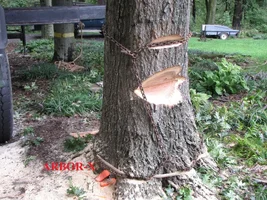
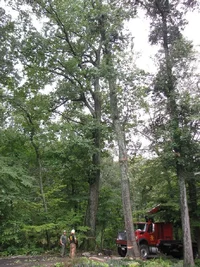
This thread makes me think of a job where I went too big. It was 2011 after weeks of huricane Irene damage, I was physically and mentally exhausted. Got a call about an oak that was uprooting more and more every day.

Got there late in the day, rainy, wet. Started taking off limbs with the k-boom. Tree was tall and could not do the top with the k-boom. Rigged one or two down. Then one big limb, couldn't rig down easily, as it was directly over another tree.

I said heck with this, this is taking too long, we have other trees.... I'll set up multiple lines and blocks with the k-boom to get me around, notch the thing and lower the whole thing to the ground.

It was a dense heavy Red Oak. Probably 15,000 to 22,000 lbs left.

I was mentally exhausted, but still smart enough to chain the butt to the stump, as it might break away from the hinge 1/2 way through the lowering. I should have moved the k-boom for it's protection, but I was tired and wanted the truck there to remove the rigging after the tree was down and the truck was already set up.

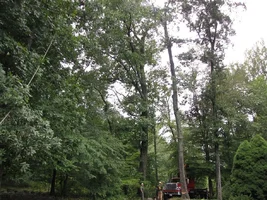
I had the hobbs on one tree, with 3/4". GRCS with alum bollard on another with 3/4". Both of them with high blocks. Large porty with 5/8" on a low point. Chipper winch to stimulate the pull, then help hold around half way in the lowering, another 5/8". So, four ropes.

About half way through the lowering, there was a pause from a slight hold up on other trees, then a little tiny bounce which sent the hobbs sliding up a trunk about 25 feet and the GRCS slid up it's trunk about 10 feet too.

The trunk rolled off it's stump and tried to shoot back, but the chain stopped it after a little distance.

Then, after looking everything over, we lowered it slowly to the ground.

THAT was too big.

My guys said, "yeah, but you did it and nothing damaged or broken".

I appreciate their support, but NO. That wasn't good, things were too close to something bad happening I think.

Things were probably close to being maxed out. Red oak was extremely heavy that year, heaviest I've ever seen it; that I didn't know at the time, until several deliveries to the mill.

If the trunk rolled the other way and then the chain broke, it could have struck my outrigger on the k-boom.

Weeks of storm work, sucks. A tired person is not good doing tree work.

Most of that tree is on video. Looks like I have just a couple still photos.
 
Wow Driver you are one badazz, but you nearly got a terrible surprise. Glad it worked out and no one hurt or equipment damaged. Lesson learned I am sure. Show the clips dude.
 
Thanks X that's what I was asking. I don't think anyone would max out their system just because they could, people still have an internal threshold for what they are comfortable with. I should have thought my question out better but, oh well...
 
[ QUOTE ]
Wow Driver you are one badazz, but you nearly got a terrible surprise. Glad it worked out and no one hurt or equipment damaged. Lesson learned I am sure. Show the clips dude.

[/ QUOTE ]

No one was ever in danger, ever. Just to clarify. Could have had blacktop dented and/or some of our equipment damaged and broken ropes.

So many videos to choose from in editing, that one isn't in the top of my list I don't think.

On that subject. Videos of other jobs will be shown soon, I've already scheduled the first one to be released, Monday the 29th.
 
only 5 still photos, I'll post em.

see attachments.
339755-ChainButt.jpg
 

Attachments

  • 339755-ChainButt.webp
    339755-ChainButt.webp
    334.1 KB · Views: 47

New threads New posts

Back
Top Bottom