Hitch Hiker and Removals

chris_girard

Branched out member
Location
Gilmanton, N.H.
So we did a nasty removal last Fri. on a White Oak that was killed due to excessive fill along a side slope allowing fungus to take hold and kill the tree.

This was the perfect site to use multiple safety techniques to remove it safely. Luckily for me, there was a taller larger White Oak right in back of the removal tree that I could setup a backup safety SRT line in.

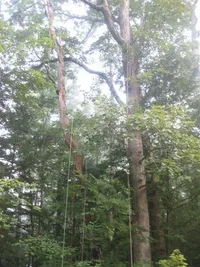
I used the Big Shot and set a line around 65’ feet. I was a little further out on the branch than I wanted to be, so instead of using a Basal Anchoring System, I used a Running Bowline with a backup safety knot and throwline tied on for retrieval from the ground afterwards. Having a Canopy Anchoring System allowed me to greatly reduce the force on my PSP (Primary Suspension Point).

Another nice thing about having the Hitch Hiker SRT line in the other tree so high, is that it would allow me to keep the majority of my bodyweight off of the leaning rotten Oak.

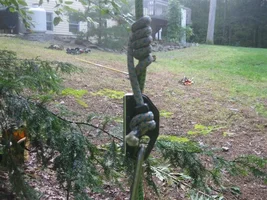
So here’s the first pic.
 

Attachments

  • 335740-HHRigging1.webp
    335740-HHRigging1.webp
    51.5 KB · Views: 386
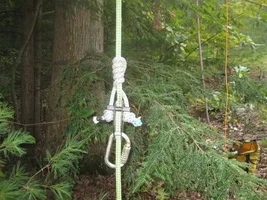
Here are a couple pics of my Hitch Hiker climbing setup. The cord is 10 mm bee line (not the piece that you sent me Paul), tied with a “V” (Valdotain, or French Prussic) and wrapped on 7/16” Tachyon.
 

Attachments

  • 335741-hhsetup.webp
    335741-hhsetup.webp
    83.8 KB · Views: 391
Notice in this picture of the HH on the right hand side how the cover tail has unraveled. I made sure that before I tied my Double Overhand Stopper Knot for the first time using this cord when it was new, that I lock stitched the inner and outer cord together. As Paul has said though, the ends of the cord needs to be whip-locked. Obviously from my tail, the outer cover will just unravel instead of staying together, and this was only after climbing on this hitch about a dozen times. In the future, I will only use the Yale Whip-Lock on the ends of the HH cord.
 

Attachments

  • 335742-HHRigging6.webp
    335742-HHRigging6.webp
    76.3 KB · Views: 338
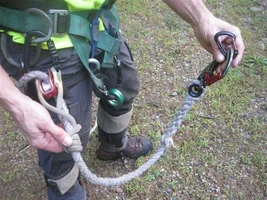
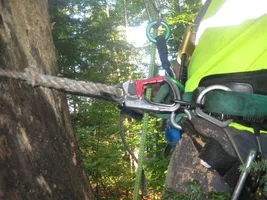
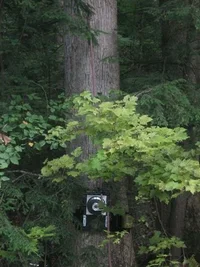
Another safety feature that I incorporated was the use of a breakaway lanyard. I used a piece of 3 strand that I spliced a snap onto one end and didn’t use a stopper knot on the other end. I attached a small Black Diamond biner (non-rated to around 200 lbs) to my rope snap and tested it out first off the ground at around 5’.
 

Attachments

  • 335743-3strandsafety.webp
    335743-3strandsafety.webp
    84.7 KB · Views: 326
I also wanted to back up the dead tree, so I set a rigging line over a large sturdy branch in the big Oak in back of me and we planned on guying the tree back to give it more stability. With the GRCS mounted to the base of the big Oak, we could safely hold the tree in place, applying just enough tension without over tensioning it.
 

Attachments

  • 335745-HHRigging.webp
    335745-HHRigging.webp
    38.9 KB · Views: 258
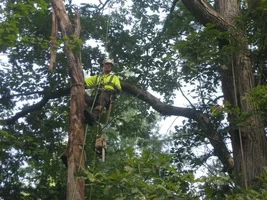
The HH worked awesome as my backup safety line. Here in this picture, you can see where I’ve set the red rigging guy line and I’m proceeding to go further up the tree to top it out and chunk it down.
 

Attachments

  • 335746-HHRigging2.webp
    335746-HHRigging2.webp
    94 KB · Views: 297
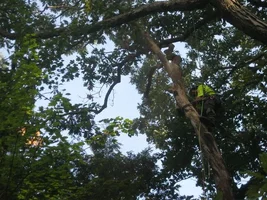
This is the last picture. I reached a point where I felt that it just wasn't safe to go higher, and where I decided to top it, it also wouldn’t be long enough to cartwheel back and hit me as I knew that some of the tips were going to hit the adjacent Hemlocks in front of me.

As you can see in the pic, I’m making my face cut. A couple of things to notice. First, look how my HH and SRT line are almost vertical next to me. This gave me a great position to cut from, so actually having my line (PSP) set out a little further in the big Oak worked pretty good. The second thing to notice is that as I’m making my face cut. I have two lanyards wrapped around the trunk. I wanted to limit the time that I was going to be attached to my break away, so I kept my wire core lanyard attached until the face cut (notch) was made. I then detached the wire cord and just had the break away and HH SRT line.

Everything went well and after I topped the tree out, I was able to fell 6’-8’ pieces until I reached the guy line. Then I just rappelled out of the tree and we fell the tree along the edge of the slope.
 

Attachments

  • 335747-HHRigging8.webp
    335747-HHRigging8.webp
    90.2 KB · Views: 340
That sucker sure looked dead, nice to have the security of a nice big live one besides it......

So you are using the new beeline , I would be interested to see what you feel its performance is compared to the old stuff that I sent you. I havent had chance to try the new stuff yet.
 
Paul, to me the new beeline at first felt too stiff, but has broken in nicely. The beeline that you sent me has a more supple feeling to it when new…I think that I prefer the older stuff, but haven't tried it out yet.
 
[ QUOTE ]
That sucker sure looked dead, nice to have the security of a nice big live one besides it......

[/ QUOTE ]

Oh yeah that’s for sure. That Oak was loaded with Armillaria (shoestring) root rot. When I would peel back what little bark was remaining, the stuff was just everywhere.

I also meant to point out in the fourth picture where I’m showing my 3-strand break away lanyard, that I have two DMM rings on my bridge. This allows me to use the end of my climbing line (which has a spliced eye in it) to setup a DdRT with the HH still attached, though I didn’t feel the need to do that on this job…maybe the next crane job.
 
Hey Chris,
Thanks so much for posting that story. I really enjoy seeing how others work, and having a story line with the pictures is great and I hope more people do that.

It's great to hear about the HH too, I really can't wait to get one.

Those small non-rated biners, I have never seen them used as a breakaway. Is that something that is tried and true, or a better-than-nothing solution?

Thanks!
 
Nice set up chris! what is that biner made out of? is it a hard plastick?

I'm looking to make a new brake away as it seem like I have been getting myself into this situation a lot more lately.

I love srt for trees like this!
 
Thanks for sharing this Chris. This is a good reminder, and illustration of the use of the break-away lanyard. I remember reading about it a while back, and put it into deep storage.

I'm excited about this hitch hiker device. I just noticed the other thread about it. It looks like a promising tool.
 
I have broken a breakaway saw lanyard when my saw was caught in the kerf. I promptly bought another one.
ahhhhh.gif
 
[ QUOTE ]
I'd like someone to break a breakaway while attached to their body ... or a dynomometer.

[/ QUOTE ]

Yeah I'm not convinced some of these break-away lanyards are safe. Seems like there are two dangers. First, the lanyard may break away too easily and send you for an unnecessary and perhaps dangerous swing (possibly while running a chainsaw). Second, the lanyard may not break away under as light a load as you want. Some of them don't look like they'd break before the human body would, which, of course, defeats the purpose. Some enterprising person on here may already be in the midst of testing a marketable product for this purpose. If not, someone else will. The way I see it, the more threads there are about the subject, the sooner a break-away lanyard will show up in a Sherrill catalog.
 
I doubt anybody is going to sell a break away lanyard, I have used snap bails to make them but life support components have to be rated at 5000lbs so if you sell something that doesnt meet that criteria and somebody gets hurt you are done IMO
 
Just some thoughts:

A case could be made that a "break-a-way-lanyard" or "quick-release-lanyard" is NOT life support! It could (should) be simply viewed and used as a positioning aid. The real life support would have to be in the main climb line secured to a known safe object; another tree, a sound part of the same tree, crane, etc.

I believe there's a very real need for the development of safer techniques and products for work positioning in or near hazardous trees/branches. And, proper training is needed on how to plan a safe escape (swing) if things go south.

There appears to be a lot of potentially unsafe, untested 'folk-lore' on what works and what doesn't work. It's time for systems, products and training to be developed to make working hazardous trees safer.

Probably deserves it own thread/forum ...
 

New threads New posts

Kask Stihl NORTHEASTERN Arborists Wesspur TreeStuff.com Teufelberger Westminster X-Rigging Teufelberger
Back
Top Bottom