Help with a National Champion

ATH

Been here much more than a while
Location
Findlay, Ohio
94" DBH Hackberry has been dropping some limbs. I deadwooded the tree in 2018. There are a few dead branches now, but its lost some live branches. Took out a privacy fence (owners aren't too exited about that). If it goes, it will take out 3 phase power & a bunch of communication wires, probably a detached garage or three, parked cars, and maybe reach some apartments with enough force to cause some damage.

I was asked to provide an assessment/make recommendations. @macrocarpa and I discussed a little. Thought I'd post here too to get some more input. I have some thoughts, but will hold those for a day or two just to see what we get here based on pictures.

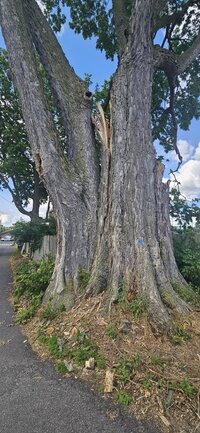
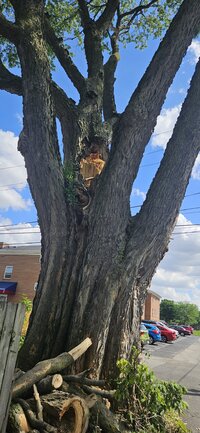
At some point this was 2 trunks that grew into one - probably never truly grafted. A codominate leader from one of the trunks broke out leaving a split between the two trunks. That's what brought up the immediate concern.

Whole tree:
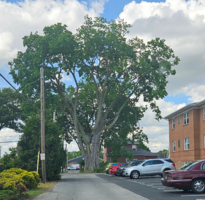
20240603_154322 (2024-06-04T03_53_54.214).png


Split from south side:
20240603_154746.jpg


Break out from the north side:
20240603_154457.jpg

Whole tree (most of it, anyhow) from the north:
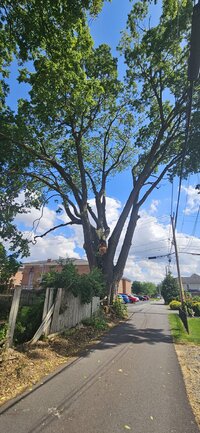
20240603_155410.jpg

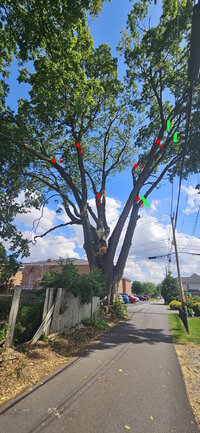
This is looking from the NW - west-most limb. Honey bees in yellow circled area. Visible hollow circled green. Relatively new stubs from cuts where there is no visible cavity (very near bee hole) with red lines pointing to them:
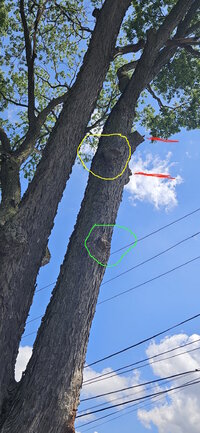
20240603_154839 markedup.jpg

From the east - that break out also happened since 2018.
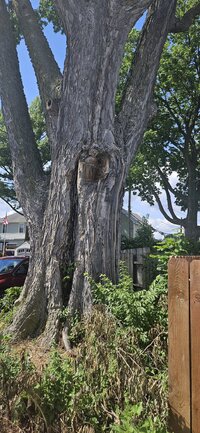
20240603_155013.jpg


Back to the south side...when I tap with a mallet, it sounds - well, like a drum between the white lines:
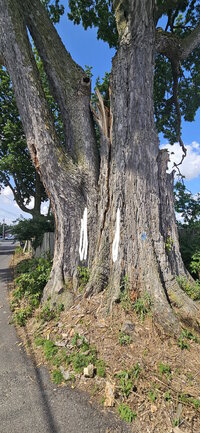
20240603_160537 hollow area.jpg


I didn't have the resistograph with me today. Honestly, not sure how helpful that will be. Not even sure sonic tomography would be great here since it is 2 separate trunks. I'm sure it would show separation there, so I'm not sure it could give a good pic of what's really going on in this beast.
 
Is the "owner" an individual who's really proud of this venerable tree? or does it fall under some property management Co. If you go with some reductions and bracing; cabling, the lead with the bees can be worked on, just assume that there is a huge column of comb in there, I would attempt to target above or below said comb. Mint water mist and or bee smoker will subdue the bees but I would def be veiled up anywhere in the flight path during work. It would be very hard to remove the queen as deep as that goes I'd imagine. somehow I've been keeping bees for awhile now. If those leads are removed or reduced, You can salvage the log with bees in it if you have a place to put it.
 
How does that species do with hard dormant retrenchment?
The other side of that term . . . .
My vote is for lots of rod and cable to try and save the tree - it looks magnificent and should be honoured. My 2 cents
 
Owner is private individual...but property is rented. So it's not like "this was Grandpa's favorite tree" situation.

He did specifically say he'd prefer to keep it. I think that's both a "I wanna keep it" and doesn't want to pay to remove it. But also doesn't want to keep it so much that he's will to take on significant risk.
 
I wonder how long a hackberry can live. I thought they were on the shorter end of the scale in tree terms. 2-300 years?

Is removal of a champion tree qualify as a tree cutting credential?
 
Owner is private individual...but property is rented. So it's not like "this was Grandpa's favorite tree" situation.

He did specifically say he'd prefer to keep it. I think that's both a "I wanna keep it" and doesn't want to pay to remove it. But also doesn't want to keep it so much that he's will to take on significant risk.
I guess that’s it in a nutshell
What kind of money do you want to shell out to preserve this beast?
Base your recommendation on that. A cable or two on the cheap
Some reduction pruning, etc
 
  • Like
Reactions: ATH
I'd get a real tasty small cut reduction going on around this sucker. Maybe 1 or 2 inch cuts roughly? Pgr? I'd be worried to put rods or cables in it but maybe it's a good idea. Or just cut it down? National champ is just a construct, every dog has it's day. :) I didn't read the other replies...
 
After letting it cook for a few days, here's what I'm thinking. Would love criticism, feedback, alternatives, etc...

using ISA's protocols:
"Probable" likelihood of failure as it is.
Its gonna take out 3 phase and hit some detached garages ("high" likelihood of impact).
With 2 sets of 3 phase power, the relatively widespread outage that could cause probably makes it "significant" impact (I don't think I'd call it "minor").
This puts it at a "high" risk tree.

Arguing with myself, I could put it at a "possible" likelihood of failure. I 'think' that crack is from the portion that split out, not the 2 trunks starting to separate. That makes it a "moderate" risk. It's been a lot like this for a long time, so that doesn't scare me too much to call it that. But it may be "probable"...

Mitigation options. I don't know that "retrenchment" is the right pruning here. It's vitality is good. The goal is to reduce the load on the west-most trunk. I think removing a couple of branches entirely and installing cables would reduce the probably of failure to "Improbable" - making it a low risk tree.

Pic - cut at green (well, branch collar cuts, not leaving big stubs). 3 cables; A-B C-D and E-F. Don't love that C-D is a little low, but looks like the strongest wood.
20240603_155410 proposal.jpg
 
Suggestion: If at all possible, I had suggested using rods as well to stabilize the breaks - winch branches together, drill and put in large rods/ washers/ nuts and peen rod ends. ISA/ANSI BMP etc. have the info. for rods and bit sizes. I have found this stabilizes cracks and such better than just cable up top, and it's been amazing when you come back in a few years what the tree has done to regain strength in the failed/ cracked area of the stem sometimes. We've had weeping, cracked stems that after both cable and brace have sealed up and look to be on their merry way once again. Cheers
 
I agree...rods would also help.

I'll have to go back and measure the individual trunks before writing that recommendation. 40" diameter with split says at least 4 rods at 7/8".

I would refer the work to another company - mostly for the pruning with lines nearby - so probably let them do the support system as well. Wonder if they have the big for that. I don't. Looks like $250 to buy a bit I might not use again.
 
Rods for sure. And if there are substantial cavities down low and your wall integrity/thickness is in question, you can opt to go oversize diameter on the washers to spread force and reduce stress at brace attachment points. If you do go oversize, double up on thickness to compensate for the wider diameter, or get some extra thick (.25") dock washers.
 
Sorry @ATH, there was one more thing I thought I'd bring up. @ghostice had mentioned winching to pull the pieces back together some. If you feel the gap needs closing, then I would agree. But there is a catch though. This would no longer be the standard old "put a rod in before it ultimately splits scenario", where the wood still has strength of it's own to maintain closure, AND you are not trying to shrink a gap. In the latter, you would just torque down to reasonable value, wood never splits, and brace never sees a spike in the force. In a gap closure scenario, meaning winching it, the catch is that when you winch it closed then upon release of the winch, the rod/washer/nut is going to take that load and see a much larger force than it might in the standard scenario, and the effective torque on the nuts is going to skyrocket. The torque will effectively be whatever torque would be required to just turn the nuts until the gap closed. For that reason, I might consider running some educated guesses and upping the rod diameter to compensate. The ISA standard doesn't really talk about closing gaps with rods, but people do it all the time on construction sites. I know in cabling we typically winch together the tips to preload the cable to prevent slack development during winds, but those forces are likely WAY lower than closing gaps down low. Just food for thought.
 
Winch was probably the wrong word. I usually use a comealong up top (Masdam or pulleys) to pull everything together across whatever part of the stem we're putting a rod into/ across - if that doesn't work to close the stem crack up, then we can add ratchet straps across the split/ break and sometimes even put a wear plate of a small plywood piece on the bark and then use wooden or felling wedges to get the strap even tighter. Haven't had anything we haven't been able to close, yet. Just use heavy duty strap(s) so you don't pop one - they'd go off like a rocket and take off somebody's noggin! The wedges also make it easier to undo said ratchet strap after the operation by just banging them out if the wood relaxes a bit.

Also start drilling with a small size bit and then a large size half way and then a small one further with an extension on it so you can come out the other side. For bits and extensions Amazon can be your friend. Also beware of knots when you're drilling as with long bits they can send your bit off course to somewhere you don't want to exit out of. Oversized rods and nuts and washers are a good idea as above and try and get galvanized so they'll last in the outdoors for years and years. As an aside on one tree we also had a guy come by (community center) and paint up the washers and nuts with a grey and white mix of Rustoleum so they blended into the tree bark. Can't see them sometimes even if you give a good look - the guy did an amazing job (arty like). Cheers.


Addenda: Just noticed this at Treestuff - the Mother of all Drillbits ! Wouldn't want to get it stuck/ bound up though !
 
Last edited:
I don't think we need to pull the gap together. I'm still not sure that split is a separation of trunks but rather a peel out from when the other piece broke off. But all good advice!

Would you cable then brace or brace then cable if doing both?
 
Winch was probably the wrong word. I usually use a comealong up top (Masdam or pulleys) to pull everything together across whatever part of the stem we're putting a rod into/ across - if that doesn't work to close the stem crack up, then we can add ratchet straps across the split/ break and sometimes even put a wear plate of a small plywood piece on the bark and then use wooden or felling wedges to get the strap even tighter. Haven't had anything we haven't been able to close, yet. Just use heavy duty strap(s) so you don't pop one - they'd go off like a rocket and take off somebody's noggin! The wedges also make it easier to undo said ratchet strap after the operation by just banging them out if the wood relaxes a bit.
Naw, I'm with you. I'd try to close it too if it needed it. I closed one last year on a codominant elm about 3 feet off the ground using a combination of load binders, and just torquing the nuts. All I could think of when I was tightening them was "I really don't think this was covered in the standard" and "thank goodness for the cables going in up top" :ROFLMAO: I got the cables in before I released the lower load binder I used setting the braces. The standard called for 5/8" rod, but I used 3/4", and ended setting the torque on the upper rod around 200-ish ft-lb. Shear luck that I thought to bring the 3/4" cause I had no idea I was going to have to crank that hard.

 

New threads New posts

Kask Stihl NORTHEASTERN Arborists Wesspur TreeStuff.com Teufelberger Westminster X-Rigging Teufelberger
Back
Top Bottom