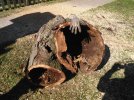
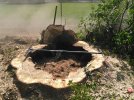
Today I was hired by the NEW owner of a house I use to own, to fell a hollowed out tree that, when I was living there, was a concern for me as well. "Is this tree sound? Does it have enough healing around its edges to make up for the insect devastation in its center?" I know there is a GIANT redwood tree somewhere in CA with a huge hollow in its center... with a 2 lane road built thru it! So I understand that the pith and the heartwood represent only a portion of the functional, structural elements integral to the support of a healthy tree.
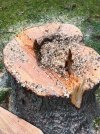
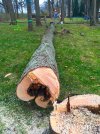
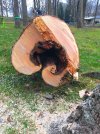
This particular silver maple I felled today had a host of ants running up and down it, both inside and outside, when I moved into the place in 2006. At one point I put a measuring tape up that gap and it went up 18' before it stopped!! Eighteen feet!! I lived there for 10 years, and during that time (within the 1st few years) I mixed some cement and poured it thru the slit into the bottom portion of the trunk. You can't see the cement cause I didn't have a means to blow the sawdust out of the stump, but probably an inch under that sawdust is concrete. Also there were bats living up in there for a few years and in addition to the frass there was a fair amount of guano falling down. Is that TMI?? LOL
Before I did that I read a few conflicting things re: to fill, or not to fill, a tree's hollow. But all I saw was a ton of frass, completely filling up the bottom portion of the trunk below the tree's opening, and SWARMING carpenter ants everywhere. And I thought to myself, "adding some kind of impediment to keep these insects from freely moving up and down between the earth and the inside of this tree... it's gotta do this tree some good." F'fwd more than a decade, and perhaps I made a good decision pouring in concrete. Now that it's down per the homeowner's request, the sapwood looks like it was doing OK.
What I tell homeowners, time and again, is "I can't tell you with any real degree of certainty that your partially hollowed-out tree is NOT going to fail in average storm conditions for this area. You really need a tree surgeon, or a certified arborist who really knows his/her biology, for assurances like that. But a hollowed portion in the center of a tree does not necessarily mean it's got to go."
I'm not looking for a cheap-fix, one-size-fits-all answer here. But if there are real tree science pros out there with common sense advice about hollow trees, I'd like to hear it. Of course I always look for heaving, fungus... I'm not a certified arborist but I've learned a few things too. Thank you in advance.
This particular silver maple I felled today had a host of ants running up and down it, both inside and outside, when I moved into the place in 2006. At one point I put a measuring tape up that gap and it went up 18' before it stopped!! Eighteen feet!! I lived there for 10 years, and during that time (within the 1st few years) I mixed some cement and poured it thru the slit into the bottom portion of the trunk. You can't see the cement cause I didn't have a means to blow the sawdust out of the stump, but probably an inch under that sawdust is concrete. Also there were bats living up in there for a few years and in addition to the frass there was a fair amount of guano falling down. Is that TMI?? LOL
Before I did that I read a few conflicting things re: to fill, or not to fill, a tree's hollow. But all I saw was a ton of frass, completely filling up the bottom portion of the trunk below the tree's opening, and SWARMING carpenter ants everywhere. And I thought to myself, "adding some kind of impediment to keep these insects from freely moving up and down between the earth and the inside of this tree... it's gotta do this tree some good." F'fwd more than a decade, and perhaps I made a good decision pouring in concrete. Now that it's down per the homeowner's request, the sapwood looks like it was doing OK.
What I tell homeowners, time and again, is "I can't tell you with any real degree of certainty that your partially hollowed-out tree is NOT going to fail in average storm conditions for this area. You really need a tree surgeon, or a certified arborist who really knows his/her biology, for assurances like that. But a hollowed portion in the center of a tree does not necessarily mean it's got to go."
I'm not looking for a cheap-fix, one-size-fits-all answer here. But if there are real tree science pros out there with common sense advice about hollow trees, I'd like to hear it. Of course I always look for heaving, fungus... I'm not a certified arborist but I've learned a few things too. Thank you in advance.
Attachments
Last edited: