Guy rope angle for side lean pull over

I have been using a secondary rope tied maybe a third of the way up the trunk when felling (pulling over) side leaning trees with questionable hingewood quality.

Does anyone have a formula or guideline of the best placement of height and angle when you have a side lean on a tree or spar that has questionable hinge wood?

My concern being when I have a target in the direction of the side but also I don't want to swerve the tree too far in the other direction where I'm going to say, damage other trees or targets.

So some variables would be :

height of the tree/ spar

height of the guy line

distance from the tree to the guy line anchor,

angle of the guy line line anchor to tie point on tree

angle of guy line anchor to tree to intended felling direction (horizontal)

angle of intended felling direction to tree to direction of lean (horizontal)

angle of tree's lean to vertical (plumb)

tension of guy rope

strength / elacsticity of guy rope

I tried searching for this topic, but the search engine disregarded the word guy as being too common/general Ha. Ha.

Thanks!

Paul


.
 
Here are a couple I found using yahoo instead of the search bar. Google doesn’t work for treebuzz but does for treehouse for whatever reason?? Doesn’t need to be super high but the angle will have a large effect if not 90deg etc


So some variables would be :
Here are five variables that are good to think about:

1. height the guy line is attached to the falling tree: Higher = more control.

2. distance from the tree to the guy line anchor: Farther = more control.

3. tension of guy rope: Tension should equal the leaning force of the tree in the direction exactly opposite the direction of the guy rope. (Add tension until it barely starts to move the tree.)

4. angle of guy line anchor to tree to intended falling direction (horizontal): MUST be 90 degrees (assuming height of guy line anchor is same as height of falling cut, see next)

5. very important! relative height of guy line anchor to height of falling cut:
-----a) the more the falling cut is higher than the guy line anchor, the more the falling tree will be allowed to drift away from the anchor (more than 90 degrees);
-----b) and the more the guy line anchor is higher than the falling cut, the more the falling tree will be pulled toward the anchor (less than 90 degrees)
-----c) if the anchor is close to the tree, this variable matters a lot; the farther the anchor is from the tree, the more this variable can be ignored.

So it seems to me.
Dan
 
Last edited:
Here are five variables that are good to think about:

1. height the guy line is attached to the falling tree: Higher = more control.

2. distance from the tree to the guy line anchor: Farther = more control.

3. tension of guy rope: Tension should equal the leaning force of the tree in the direction exactly opposite the direction of the guy rope. (Add tension until it barely starts to move the tree.)

4. angle of guy line anchor to tree to intended falling direction (horizontal): MUST be 90 degrees (assuming height of guy line anchor is same as height of falling cut, see next)

5. very important! relative height of guy line anchor to height of falling cut:
-----a) the more the falling cut is higher than the guy line anchor, the more the falling tree will be allowed to drift away from the anchor (more than 90 degrees);
-----b) and the more the guy line anchor is higher than the falling cut, the more the falling tree will be pulled toward the anchor (less than 90 degrees)
-----c) if the anchor is close to the tree, this variable matters a lot; the farther the anchor is from the tree, the more this variable can be ignored.

So it seems to me.
Dan
it would also be cool to be able to compensate when your guy anchor is not 90° from the intended felling direction. So like you said, maybe you could have the notch higher or lower in relation to that guy anchor height to compensate for a different angle than 90° maybe?
 
The equation(s) you are seeking is another example of 3D vector resolution. No matter how many ropes are attached, the combination can be resolved with the same math used to solve the resultant force on a freshman physics force table experiment.

Offsetting a lean to “aid” the hinge means the pull needs to be maintained through a good portion of the fall. That’s tough unless the pull is directly opposite of the lean. If the offset line breaks during the fall, that potential energy may rip the hinge early.

There are many dynamics to be considered when pulling a tree. I think the most trouble people have is grasping how often “less is more” when doing tree work. The balance between internal hinge mechanics and external pulls takes time to appreciate.

I look forward to seeing how this thread develops.
 
The equation(s) you are seeking is another example of 3D vector resolution. No matter how many ropes are attached, the combination can be resolved with the same math used to solve the resultant force on a freshman physics force table experiment.

Offsetting a lean to “aid” the hinge means the pull needs to be maintained through a good portion of the fall. That’s tough unless the pull is directly opposite of the lean. If the offset line breaks during the fall, that potential energy may rip the hinge early.

There are many dynamics to be considered when pulling a tree. I think the most trouble people have is grasping how often “less is more” when doing tree work. The balance between internal hinge mechanics and external pulls takes time to appreciate.

I look forward to seeing how this thread develops.
I never took physics ha ha I was headed to music school.

But wouldn't it be cool if the tension could be maintained with a pulley at the guy and anothet pulley at a high spot maybe another tree on the uphill side of the lean of the tree we are felling. and then back to where the original guy rope is tied to the tree so it would be a triangle of rope I guess. I guess what I'm saying is some way for the falling tree to be taking up the slack on its own sideline, or would kind of be like on a 2 dimensional triangle shaped zip line.

or some other configuration, where the falling tree would be taking up its own slack on the guideline.

But the main reason for the guy line would be if the hinge broke -the tree is now hanging on that line as it falls. what does the arc look like and where does the anchor need to be for the tree to end up where you want it? assuming there is no hinge, that the tree is completely severed at the cut. like I said in the original post, I also want to make sure it doesn't swing past the drop zone.
 
it would also be cool to be able to compensate when your guy anchor is not 90° from the intended felling direction
The principle is simple, but the application may not be generally practical.
1. For every one degree that the guy line anchor is LESS than 90 degrees from the intended lay,
the guy line anchor would need to be one degree HIGHER than the hinge to compensate.
2. For every one degree that the guy line anchor is MORE than 90 degrees from the intended lay,
the guy line anchor would need to be one degree LOWER than the hinge to compensate.

To my way of thinking, imagining an open umbrella really helps.

Imagine pointing an open umbrella as follows:
---- a) handle of umbrella is at the guy line anchor point
---- b) shaft of umbrella points toward or goes through the hinge
---- c) the upper edge of the umbrella is where the guy line is attached to the tree
To predict exactly where the the guy line will try to direct the point where it is attached to the tree, visualize it moving along the outer edge of the umbrella.
The outer edge of the umbrella is where the guy line will try to hold the tree as it falls.
The only path where the guy line pressure will remain the same on the tree is along the circle of the umbrella.
 
Last edited:
Easy answer: what Dan said:)

All I can add is think of your school geometry plastic triangles protractor etc set and visualize that you want the solid right triangle fitted from your anchor point, straight across to the hinge and then up the trunk to your rope attachment point. You will get your felling lay with steady rope tension/length if you fell at 90 degrees to the base of the triangle. Picture your rope as the top edge of a big plastic triangle pivoting on its bottom edge.

If you miss your 90 deg felling lay you can see the rope loosen or tighten.
If its not a 90 degree triangle - well, you gotta swing/hinge the tree all weird but with a level-base-inline-direction hinge again visualizing it as a solid triangular brace rather than a rope.
You can place your fictitious solid triangle concept on a hill side too just be aware of the altered "direction" of gravity.

Rock'nroll geometry :)

Happy Easter
 
Jerry Beranek covers this in The Working Climber DVDs, can't remember which one.

I like that idea with the triangle rope setup, need to be able to take the slack in at the same speed as the tree is moving. That's a tough assignment but it sure would be slick.
 
Last edited:
Addenda = for complete directional control i.e. broken hinge, cut low so the trunk falling off the stump doesn't introduce as much slack in the guy lines and 3 lines - pull plus two uncompromised 90 to the side/lay guy lines.

I turned down a crispy maple because of practical impossibility of spooling/maintiaining tension on two way off 90 guy lines and no-go on any pretension scheme.
 
Isn't that when you just check the cost of the nearest crane with the desired capacity, factor it into the bid, give them whatever crazy number, and let them decide it its worth hiring you? I have had one of those result in one of my highest netting jobs ever. Not with a crane, but a rented lift.
 
The principle is simple, but the application may not be generally practical.
1. For every one degree that the guy line anchor is less than 90 degrees from the intended lay, the guy line anchor would need to be one degree higher than the hinge to compensate.
2. For every one degree that the guy line anchor is more than 90 degrees from the intended lay, the guy line anchor would need to be one degree lower than the hinge to compensate.

To my way of thinking, imagining an open umbrella really helps.

Imagine pointing an open umbrella as follows:
---- a) handle of umbrella is at the guy line anchor point
---- b) shaft of umbrella points toward or goes through the hinge
---- c) the upper edge of the umbrella is where the guy line is attached to the tree
To predict exactly where the the guy line will try to direct the point where it is attached to the tree, visualize it moving along the outer edge of the umbrella.
The outer edge of the umbrella is where the guy line will try to hold the tree as it falls.
The only path where the guy line pressure will remain the same on the tree is along the circle of the umbrella.
cool, that is helpful
Isn't that when you just check the cost of the nearest crane with the desired capacity, factor it into the bid, give them whatever crazy number, and let them decide it its worth hiring you? I have had one of those result in one of my highest netting jobs ever. Not with a crane, but a rented lift.
sure there's always so many options of course. Here's an example I'll try to post a video: a smaller tree but on a cliff like hill over a road. I think I ended up charging them 200 versus bringing a crane in.
 
In high school a music university tried to recruit me for a jazz degree. Two of my friends did go. There's some reading in MDVaden's bought a guitar again after 40 years thread on the cough -other- website. Round here we play both kinds of music - Country and Western :) Git em up get em out raw hide....

edit - went to check on the thread seems to be gone, was sort of online guitar lessons info:(
 
Last edited:
Photos:

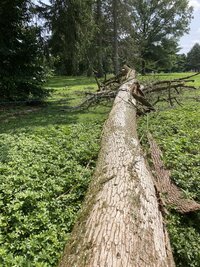
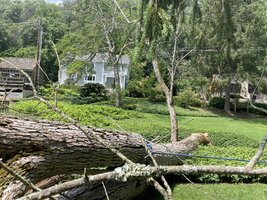
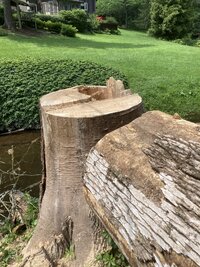
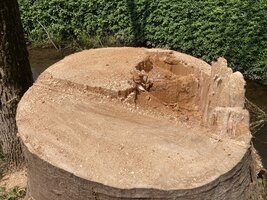
Here is a very large dead ash that had a side lean towards the little bridge/ building/ electric line. I almost didn't take the job because of the potential for disaster, but I found I had a suitable anchor for a side rope so I did it. Notched the tree, and the wood looked totally hard and sound which it was but just behind the notch was a big pocket of punk on the opposite (bad) side of the lean. I could not see it so started my back cut ( Too big for my 28" bar so I cut the down lean side first, which was sound wood) I barely started the other side (holding wood I thought) and immediately heard a large pop/ crack sound and felt the tree shift- I ran tightened up the side rope ( a few more cranks on the rope jack) and ran to my vehicle and pulled it over. the side rope (blue) was very taught after the tree landed it was anchored at about 90 degrees to my notch/ direction of pull.

I am convinced that without that beefy side rope that tree would've smashed through those targets.

So it worked out great I just want to dial-in this technique to make it optimum.

Hilarious but typical for ash around here that all the wood was solid and hard except the crucial up-lean side of the hinge.

click this for a Pano showing layout best.


IMG_1087.jpegIMG_1089.jpegIMG_1091.jpegIMG_1083.jpg
 
Last edited:
There's a set of threads about rope pulling angles, height up the trunk, distance to anchor that basically mathematically confirm one's intuition. There's no magic value, just reasonable tradeoffs and diminishing returns. Worth a read IMO if you haven't already.
 
To me, all is geometry of rigid force displacing against other.
>>distance displaced against freespace, after displacing against forces matched. Can force hinge stronger in time before commits, by making fold earlier/thicker, as like training stronger like running w/50# backpack, to the release for real race/fight as more prepared for active part of fall, and in each case artificial/faked load is relieved.
.
Visualize where the CoG is that is the total tree force, all else as weightless extensions of varying rigidity to 'communicate' to the CoG with/and back.

>>as with CoG of metal donut, tree CoG might not be on the framework
>>but must be within the perimeter that CoG totally controls
>>tree framework is just how your input addresses the CoG and it back to you.
The most compressed part of the hinge is the fulcrum/pivot.
The tree framework is the lever, dictating if your added pull(s) have leverage over the CoG or the reverse etc. Also, leverage from hinge pivot AND direction of pull from the axis across face from whole hinge run.
.
But higher you go the less rigid the lever position.
>> some spring can be good if still has rigidity over the CoG, and then the spring can relieve also as starts moving.
.
i like a stump in target zone to redirect thru, and not change pull position as backup, this also works with truck pull, so doesn't pull upwards on truck to reduce traction as pull...
.
Must consider the pulls to target axis by the CoG and to the cross axis of the hinge pivot even fold forward, neutralize cross axis with Tapered Hinge if can in rear of hinge pivot, opposite of cross ways pull, and can also maintain leverage with better alignment from taper to CoG for best control, ballasting as much of sideforce as possible. If solid faces may sprinkle in some dutching on lean side, actually want to slam into this rather than the slo'mo of normal Tapered. The slam gives more output force like bouncing ball harder against wall, to attempt correction serving to target. Dutchman is most dangerous way, it invokes speedSQUARED where wedge, Tapered do not. This is very powerful and can 'over run the constitution of the spar, containing competing forces of massive lunge forward and massive sudden stop. The is works things in 2 parts not 1 monolith; and goes to as like 2 badazzes in the 'ring' neither one been beat before, to split decision.. Combined w/Tapered Hinge and reach of hinge point of Tapered shortened, removing most leveraged part of anti-swing, allowing Dutch and Tapered to work in tandem targeting a more pronounced swing around as swing Dutchman.
.
i pretty much look at wedge or rope should serve to target, not angle to offset side pull in slow graceful falls. In slam to ground where sidepull countered and goes to high speed fall, that is already inline for with the rope sidepull as works sometimes.


There is theory of extending out to side with rope fiber farther than
Tapered could reach for about same effect if pre-tightened that Daniel has shown a few times, but is for display purposes only for me; and if don't call it all right, can be very volatile and even deadly-ier than most of our other risks. Another theory i have not gone with would be to over steer hinge to 1o'clock from an 11o'clock lean to serve to noon (Tim Ard?).
 

New threads New posts

Kask Stihl NORTHEASTERN Arborists Wesspur TreeStuff.com Teufelberger Westminster X-Rigging Teufelberger
Back
Top Bottom