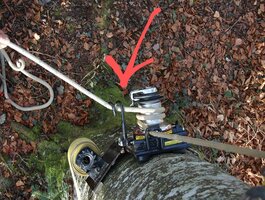
GRCS Winch

chris_girard

Branched out member
Location
Gilmanton, N.H.
I had one of the original GRCS models from many years ago and the winch always jump wraps whenever I had more than 1 turn on it and locked up on us, whenever we tried to let pieces run.

Does this happen with the newer models? What Harkin winch does the newer models use?
 
In 2012 they switched to a Harken 46. It added height to the drum and a larger self tailer.

I haven't had the wraps jump yet, but like any fixed bollard they can jump if you're running the rope at a flat angle to the drum. The rope needs to bend at the fairlead ( i.e. the pigtail) to keep from jumping wraps.
 
Thanks for the info Muggs. I have always harped on my guys to run whatever lowering device they are using with a fairlead, so I know that it's not a fairlead issue.

David Driver (X-MAN) used to have the same problem with the old GRCS model.

I wonder if that is why Greg switched to a different model?
 
Yeah I remember David having issues with it too. I've had my big Stein get locked up and when I looked at the video, sure enough it was my ground guy standing perpendicular to the drum...
 
I thought the issue of “jumping wraps”happened from the operator improperly removing wraps from the drum (to reduce friction) prior to lowering (after lifting).
 
they can jump if you're running the rope at a flat angle to the drum


That was a lesson I learned when the bollard or rigging device of choice was the trunk of a tree. Keeping the spirals fair to each otherwas so important. If wraps needed to be added or lost the groundie would walk around not try to make the change like you would do with a dog leash.

THis method of adding or losing wraps is the same with a bollard
 
it’s been years since I used a OG grcs. I think we had a wrap jump off once, that was likely influenced by straight up negative rigging without preload and the wrong amount of wraps.

In my experience the control end of the line can’t have a slack belly in it like a porty can. As that belly gets taken up it can create a jump. Even with the pigtails if the operator is standing more than a few degrees out is less than ideal and can negate the pigtail. I think of the pigtails as a loose guide vs a hard redirect. Not unlike the top fairlead where a heavy load can easily bend the fingers if used to deflect the line too much. The correct number of wraps and the control line held snug, even taking up the little bit of slack as the load starts tipping is key. That and less margins of error with shock loading can occur, keeping the rope slightly on the inward side of the pigtail helps too.

As for wraps jumping over themselves locking up, the angle of the mounting plays a part in that. Drum level to slightly downwards lessens the chance. Drum tipped skyward can cause the wraps to walk over themselves.
 
My company runs the GRCS for any jobs that require anything more than a couple rigs and are very experienced with it. They taught me that any lowering must be done through the pigtails and that anything 3 wraps and over will jump unless lowered extremely slowly. Really only applies to massive picks, but I made the mistake of thinking very slowly meant just slowly, no, it has to be like a crawl, it can jump and bind with huge pieces on 3 wraps veeeery easily.
 
My company runs the GRCS for any jobs that require anything more than a couple rigs and are very experienced with it. They taught me that any lowering must be done through the pigtails and that anything 3 wraps and over will jump unless lowered extremely slowly. Really only applies to massive picks, but I made the mistake of thinking very slowly meant just slowly, no, it has to be like a crawl, it can jump and bind with huge pieces on 3 wraps veeeery easily.
I’ve never experienced this. In my mind I feel like the rate of speed lowering shouldn’t have an affect as long as the pigtail is used, and the tension in the system is consistent? Are you talking a negative rig that has been pre tensioned with the winch?
 
To be clear, I'm not talking about pigtail vs. no pigtail. I'm talking about the position of the rope guy relative to the device. If you are standing straight to the side of a fixed bollard, so that the rope doesn't bend around the fairlead before going onto the drum, then it can jump over itself and cause problems. The rope has to take a good bend at the fairlead to go true onto the drum. None of this is an issue with a porta-wrap style device, because they self-align to the rope, it's only an issue with fixed bollards.

The definition of a rope fairlead, as I understand it, is something that takes an incoming line from an unfavorable angle, and changes it to a more favorable angle. So even though you may have the rope through the pigtail, it's not operating as a fairlead at all unless it's changing the direction of the line. And it's that change of direction right at the bollard that keeps the wraps running true.

 
Last edited:
I don't know what you're talking about at all. If the Goods were that difficult, nobody would use it for anything.
I'm interested to learn this isn't other people's experiences, but in my mind, less than 1% of pieces even require 3 wraps to lower anyway, so to me it made sense this was an uncommon thing to even have to worry about.
 
I’ve never experienced this. In my mind I feel like the rate of speed lowering shouldn’t have an affect as long as the pigtail is used, and the tension in the system is consistent? Are you talking a negative rig that has been pre tensioned with the winch?
I've only had to use 3 wraps while lowering huge hardwood logs after having pretensioned them with the winch. This is from one summer's experience rigging every day with the GRCS, most of my career has been just portawrap and crane, so I'm relatively new to it myself. My company has the rule of very slow lowering on 3 wraps and has been running the GRCS for as long and frequently as anyone so I trust it, I couldn't speak to the mechanics behind it, sorry.
 
To be clear, I'm not talking about pigtail vs. no pigtail. I'm talking about the position of the rope guy relative to the device. If you are standing straight to the side of a fixed bollard, so that the rope doesn't bend around the fairlead before going onto the drum, then it can jump over itself and cause problems. The rope has to take a good bend at the fairlead to go true onto the drum. None of this is an issue with a porta-wrap style device, because they self-align to the rope, it's only an issue with fixed bollards.

The definition of a rope fairlead, as I understand it, is something that takes an incoming line from an unfavorable angle, and changes it to a more favorable angle. So even though you may have the rope through the pigtail, it's not operating as a fairlead at all unless it's changing the direction of the line. And it's that change of direction right at the bollard that keeps the wraps running true.

I can be slow to understand so bear with me (or don't, that's fine too lol) but by this definition are the pig tails and the two prongs just above the winch not the fairleads in this situation? Both of those parts keep the rope angle entering and exiting the winch drum consistent for every rig anyway so I've never worried about my position (on the ground, rigging) relative to the bollard or pigtails, but you're saying this is important and it's not actually consistent unless you are also standing at a 90 from the bollard?
 
I think I get what @Maplegeddon213 is going at.

Big wood = thicker rope = less wraps possible

The pig tails can accommodate a 1” or more pretty easily

If you pile on wraps the tension flattens the rope closes to the tree the most, spreading out the diameter of the rope. Couple this with the pigtail fairlead having some ‘slop’ and the rope can jump.

Now 3 wraps with 3/4” line can handle crazy wood and anything more would lock up pretty easy.

I’ve never found myself needing to winch with anything more than 3 wraps to then let it run. Just in a pretension situation.
For heavy winching I’ll max the drum - 1 wrap and if I need to lower I’ll carefully drop wraps until I get to the sweet spot. To lock off I’ll put the wraps back on, cut and repeat.
Such as when whole tree lowering
 

New threads New posts

Kask Stihl NORTHEASTERN Arborists Wesspur TreeStuff.com Teufelberger Westminster X-Rigging Teufelberger
Back
Top Bottom