Gold Spotted Oak Borer Rampage in SoCal

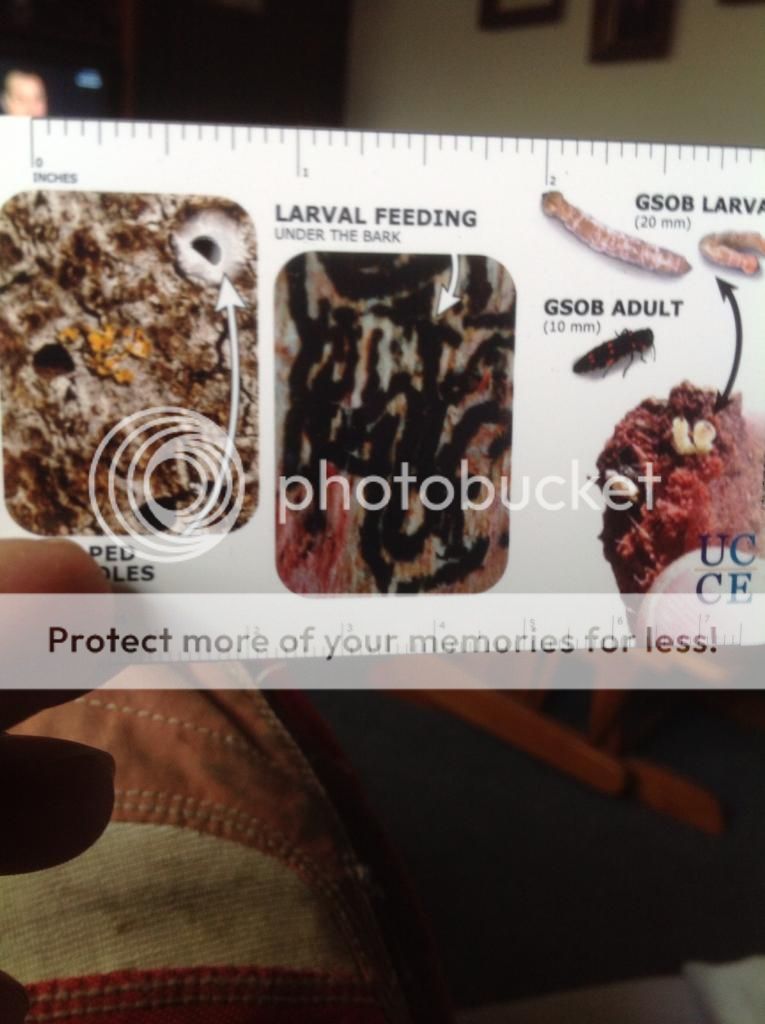
Found an unusual wound entrance hole on the trunk of a friend's Live Oak.

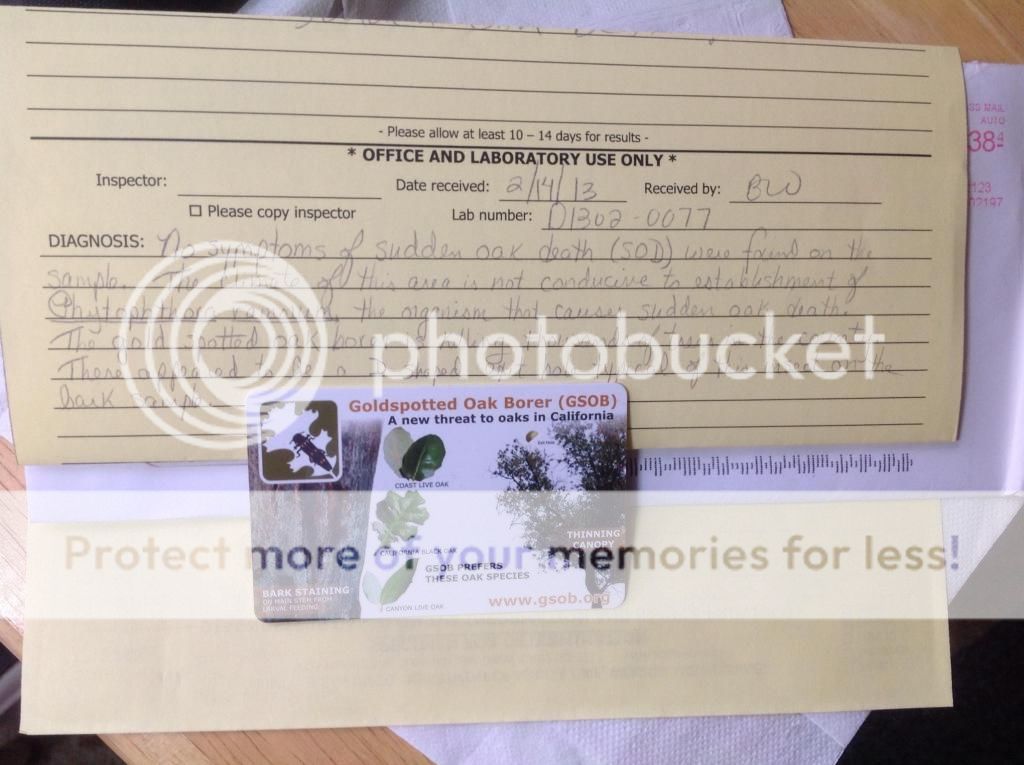
So I excised it, put it in a baggy and took it to the county pathology lab for analysis.

Got the results today. Tested positive for Gold Spotted Borer infestation. According to the tech there these borers have killed tens of thousands of live oaks in SanDiego county and beyond. They can also kill Black Oaks.

http://www.fs.usda.gov/detail/cleveland/home/?cid=stelprdb5279813

I'd like to try my burlap carbaryl impregnated trunk wrapping beetle killer treatment on this tree which is still alive and green, but the runoff watercourse won't allow for it.

Gonna be a lot more dead coastal live oaks in SoCal by the time this year's up.

A true tragedy unfolding in my neighborhood that I can do little to prevent.

Kinda ticks me off.

jomoco
 
It would be legal however to replace the Carbaryl Sevin powder with ground tobacco dust and wrap that trunk wood in burlap strips with tobacco slurry against the bark.

Probably take 20 lbs of tobacco, so figure 200 bucks.

Tar Heel therapy?

jomoco
 
As long as we keep importing as much material as we do, and have insufficient, inept inspections we will continue to have this kind of thing. Look at the last 20 years, Asian Long Horned Beetle, Emerald Ash Borer, now this?? Soon we won't be in business.
 
These bugs are native to Arizona and central Mexico, pretty much making them indigenous natives migrating about.

Each of these bug invasions are only initially catastrophic followed by a tapering off as the native predators cotton on to the fact that a potential new food source has become available to them.

The Lerp Psyllid outbreak some 20 years ago being a prime example. Now that another foreign invader, the Argentine Ant, whose invasion into CA in their millions predates the Lerp invasion by a century or so, has cottoned onto how to pry those Lerp sugar caps off the red gum leaves, snatch that helpless grub into its jaws and take it back to the hive, the outbreak has moderated considerably.

Nature has a way of maintaining stasis or balance, it just takes longer than we're accustomed to.

Trees are the most noble plant on the planet, and it behooves us to understand them and nourish them as much as we humanly can IMO.

Bugs can't handle nicotine well at all.

jomoco
 
Gotta hand it to the pros at the San Diego County Plant Pathology Lab.

They provide an extremely valuable resource to both arborists and residents of the county, at no cost, zip, nunca, nada!

It's like going through a time warp back to the 60's or somethin!

image-42_zps7859d641.jpg


image-42_zpsa96dbfcc.jpg


Californy ain't so bad!

jomoco
 
I'm somewhat astonished and very pleased that I got a call from the calif state pesticide board this morning to inform me how to go about applying for a permit to treat GSOB infestations using my ground tobacco burlap wrapping technique on the trunks and major scaffolding of Q. Agrifolia.

Could the state be getting seriously pragmatic here?

I'm on the road to find out.

jomoco
 
they just want your money. tobacco is so heavily taxed, and with all the smokers dieing they need to the boost...
 
Actually each county and state authority I've had contact with regarding this gsob outbreak has been extremely helpful, all the way from the pathology lab to the state dept of pesticide regulation, and has not yet cost me more than a little gas in my truck.

The tree my original test sample came from is right on the bank of a stream that feeds a series of ponds and lakes, so no tobacco treatment on it. Although nicotine is slightly less toxic to fish and amphibians than carbaryl is, neither should be used right on a watershed stream.

That being said, this bug prefers to munch on large mature Live Oaks, and you can bet your boots there are lots of big infested trees in very low watershed runoff risk areas that can be safely treated with tobacco wraps.

True to their word, the state pesticide folks have provided the research permit application form. At the point I've located the ideally situated large infested tree, I'll be able to complete the application's treatment location site requirements.

Did I mention that I've already got rid of an Ipps beetle infestation in a little 6 foot pine between my old house and garage, using my old ground cigar butts? I know it can really mess up an Ipps beetle larvae!

I think 40 lbs of tobacco should be adequate to wrap the trunk of a large oak.

Another advantage of using raw tobacco over carbaryl for wrapping is that sunlight breaks down the active ingredient's efficacy using carbaryl quite quickly compared to raw tobacco whose nicotine gets slowly leached out by water applied to the wrap.

jomoco
 
Hey Jomoco, this reminds me of a farmer I worked with for a few years. We planted about 300 asparagus crowns one winter. The following spring/summer we noticed asparagus beetle larvae on all of the plants. We tried a few organic pestcides but eventually the only thing that worked was the farmers tobacco and chili pepper tea. Those larvae hated that stuff. It was kinda like putting salt on a slug.
 

New threads New posts

Back
Top Bottom