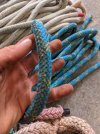
Glazed ropes

Flying~Squirrel

Participating member
Location
VT/NH
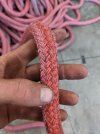
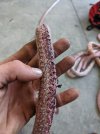
We're sitting here in the shop doing a routine gear inspection, and there is some debate about rope glazing and how it effects the condition of the rope. We have a couple brand new ropes that got brought out for a big negative rigging scenario and they became really glazed after running just a few big pieces. It seems crazy to think the rope might be retired after one day, but it also seems like the strength of the rope might be compromised. It also seems like the glaze might just break apart and turn into fuzz after a bit more use. How do you decide how much glazing is to much, and what do you do to help prevent it?
 

Attachments

  • PXL_20210910_180225914.jpg
    PXL_20210910_180225914.jpg
    407.4 KB · Views: 58
  • PXL_20210910_180153090.jpg
    PXL_20210910_180153090.jpg
    433 KB · Views: 56
  • PXL_20210910_180205888.jpg
    PXL_20210910_180205888.jpg
    503.9 KB · Views: 59
It really depends on what you intend to rig. It's really common to lightly glaze a bran new line. If I'm going to do a very large tree over a structure, I'll often get a new rope.
 
The middle is the only one I would be concerned about. The other two are good to go but if you feel iffy then down grade the lines to lesser duty. Tag lines or keep them as a burner line for natty crotch with moderate loads.
 
When you see a streak of glaze, look at how much fiber was nuked and then realize the braid structure and the possibility that every glazed fiber you see might actually be parallel in bearing the load. That would be on the mantle or outer braid depending on rope construction, but the important point is its not just a few spots mostly on one bundle of fiber. Sort of equivalent to having the glaze in a ring around the rope if repositioned by sliding the fiber bundles positions. Then it makes the strength loss more apparent.
 
When you see a streak of glaze, look at how much fiber was nuked and then realize the braid structure and the possibility that every glazed fiber you see might actually be parallel in bearing the load. That would be on the mantle or outer braid depending on rope construction, but the important point is its not just a few spots mostly on one bundle of fiber. Sort of equivalent to having the glaze in a ring around the rope if repositioned by sliding the fiber bundles positions. Then it makes the strength loss more apparent.
This is exactly what concerns me.
 
Middle one is the only one I'd think twice about. And I'd still use it personally.

Why did you have to take big pieces? Beating up rope is the price of rigging big
I suppose that's the skinny of it. You can get jobs done faster but at the cost of wearing out equipment. However, it would be nice to be able to understand ope wear and make decisions about what is acceptable for what uses.
 
and what do you do to help prevent it?
The larger the rope the better. 14mm is going to glaze with a 1k piece if you are rigging it simply. I’d break out 16mm or bigger for something of that ilk.

Or, If you employ double whip tackle for large stem pieces, you are going to incur roughly half the stress on your rope, so that can be a good trick up your sleeve and you can get away with sticking with a medium diameter rope (within reason).

If there are adjacent trees and you need to hold big fat wood for whatever reason, it’s usually also an improvement on production to add a second system on the top of the piece, going to a remote rigging point in a different tree. This will also reduce stress on your primary rigging system and also allow the groundies to drift the piece of wood into a more desirable location. (I tried to add a photo but it would not go through… but you probably get the gist)
Of course the best prevention for glazing is finding a way to send big wood down with a tag. Or using a crane. Or leaving a ‘habitat spar’.
 
Last edited:

New threads New posts

Kask Stihl NORTHEASTERN Arborists Wesspur TreeStuff.com Teufelberger Westminster X-Rigging Teufelberger
Back
Top Bottom