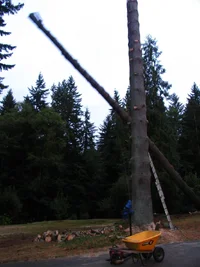
Gargantuan Fir

The guys that I am bidding against have a total of zero crane jobs to their credit and they also missed the fact that the tree is really hollow right at the ground.

 
[ QUOTE ]
If you're not sure if the top will hold together, get your strength down low and redirect higher to keep it balanced. If it breaks it will just tip over. That would be better than falling. BUT- remember that a tip over will shock the boom a bit so a higher safety factor needs to be applied.

[/ QUOTE ]


i get the fact of choking down low for stregnth and the potential for a swing....but i can't seem to visualize where a redirect would go in the upper canopy for balance. The redirect is attatched higher in the tree and then to what/where? Or ar you talking about running the slings through the canopy to the lower attachment? or how about a rough drawn sketch of this theory (i am a very visual learner) thanks
 
Phil- I'm thinking that ot would be a long sling run down the length of the piece and then some eithe short slings around the length run choker style with the original long sling through the eyes. Anyone?
 
Use a long sling and choke the piece down low then half hitch it where you would normally choke it or use several half hitches if it is that tiny or weak.
 
Sorry guys.

There are lots of ways. It depends on what types of slings you have available. Like Teti said, a long sling can be chicked down in the solid area and then 1/2 hitched or Marled upwards as many times as you'd like. You could use a longer sling down low and then attach a shorti with a clevis up high (nylon webbing). You could use a rope sling and attach a shorter balancer (prusik) to it.... The list goes on.

Good luck and get some pics Sew! /forum/images/graemlins/cool.gif
 
Mark, Teti,

I was thinking about it more...if you go with the marls/half hitches, isn't the majority of the weight going to be supported by the upper-most marl (where the wood is the weakest in this example) and less and less weight being supported by each successively lower marl, so does this method really help in the situation where the tip wood can't be trusted for a single choking point?

You guys I'm sure have used this method so maybe you can shed some light on it for me. Thanks.
 
Cory,

A lot of the force will be placed on the Marl, but the idea is that you use multiple Marls and keep them as close as necessary. If it does break (and I've yet to see one break) the next marl will catch the piece and so on. You'd be surprised how much weight a small or hollow section will hold vertically.

If you want less force, use the long sling and small slings w/ shackles technique.
 
Well the bids came in- I was a whopping 150% higher than the more "affordable" guys. I had a cordial conversation with the bid recipeints with regards to my opinion as far as the tree being unsafe to climb. They disagree and are going into what I feel like is an excessively risky situation that could be easily albeit expensive solution. They are going at it conventionally with a climber in the tree and the crane swinging pieces. I am worried a bit about the trees' ability to stand when it starts getting jostled around. These boys have picked a doozy of a crane job for their first- I have several dozen under my belt at this stage and this one was not at all routine. All the more unusual is the fact that these guys have refered trees to my before that were some what routine. I offerede my services as a technical consultant on the job(rate negotiable) but they respectfully declined.
I suppose they'll be heroes if all comes off as they hope but they still left alot of money on the table. I think I am going to try to go over and make the 80 mile drive on removal day and take some photos. I guess I am back on Siberian Elm detail for a bit. Thanks for all the input.
 
Too bad you didn't get the job, skew. You surely did your homework, and have the experience to determine what plan of attack would make the most sense and be safest.

I do hope you venture out and take pics, as it would be helpful for all of us, and you to see how things go.

Having not seen the tree, it is hard for us to say much. But, a couple observations come to mind. One, a 40 inch dbh tree and only 100 feet tall tells me the tree has quite a bit of taper, which is a good thing. And, if small pieces were being lifted off gently, the tree would only get lighter and would feel minimal shock loads. Also, is it possible to guy the tree against its lean?

Two years ago, AS member WileyP came across a similar situation, with a very hairy lightning split hemlock...someone else, I think it was Asplundh, did the tree, for much cheaper..but they damaged the landscape, and likely took way too much risk....
 
I don't think it would be possible to guy the tree. Although it would have beeen exciting to do the job I am at peace. I have never once beeen on a big pain in the butt dangerous job where I thought to my self-"gee I wish I was not charging so much". Interesting side note: after the bidding was over the forest service officer in charge of that district said to me that my price was too high and that they would as soon send out their fallers and detroy the bathroom and rebuild it. Here we have a government official that thinks money falls from the sky. It would cost over 100 grand in 2005 dollars to rebuild on of these sh**ers. Oh well like I said I must be getting old I don't really feel that slighted. Live to climb another day. Be smarter than the sticks. Oh and Roger the tree actually doesn't have much taper- she's pretty fat all the way up tp the biforkation.
 
Ah, skew, that sounds like some of the white/silver fir around here. We have a few Pacific Silver Fir in town that are 130-170 feet tall with very little taper, and some are well under 40" dbh even at that height.

This pic is falling 91 feet of a western white pine after I had dumped a 62 foot top. It scaled out at 2500 bf, the standing one at 2100, and a third at 1100, all within 20 feet of the home. Got dinged on the logs due to so many oversize knots.
 

Attachments

  • 35126-IMG_6378w.webp
    35126-IMG_6378w.webp
    115.5 KB · Views: 95
Mark,

I can imagine what the long sling and short slings with shackles technique is, but I'm not positive about it, could you elaborate?
 
What I mean is using a technique simialr to lead climbing. You setup short slings along the route towards the hook. Maybe every six feet or more if needed. Sometimes it could only need one or two slings and others that are really frail may need more points of support. Does that make sense?
 
Yes, that makes sense, thanks alot for the info.

Hopefully they all take up the slack evenly, right?
 
Gargantua is no more. I wasn't able to go watch(had to work) but I am buddies with the crane operator and I debriefed him at end o day.
It was wicked cold and windy with snow falling.They brought in the 240 ton crane and the climber tied into the ball and started stripping junk from the top down and knocking 3' chunks.
They decided to take the tree in 2 pieces since they had enough muscle with the big crane. Climber got his saw pinched and panicked a bit. Operator had to jimmy the piece a little to get it off but they got it. This is the part that I thought might make the tree fall.
Some of you guys from Atlanta area might Know this operator - his name is Vance and he is a riot- as well as an excellent operator. Any way he told me that the climber was fairly concerned(read:panick stricken).
Some guy sat there for 5 hours thinking he was getting this sweet saw log and then she comes down hollow as a drum.HA!
Well I am glad no one got hurt. They for sure benefitted from my ascertation that the 70 ton was not enough crane- Vance said they had over 150' of boom out. Maybe they were frightened enough to leave the crane work for those more comfortable with it. Or they are going to be a force to be reconned with. I prefer the frightened one. There you go - sorry no pics- hope to have that technology online soon.
So work safe boys and girls and remember to be smarter than the sticks!
 

New threads New posts

Back
Top Bottom