
Navigation
Install the app
How to install the app on iOS
Follow along with the video below to see how to install our site as a web app on your home screen.
Note: This feature may not be available in some browsers.
More options
You are using an out of date browser. It may not display this or other websites correctly.
You should upgrade or use an alternative browser.
You should upgrade or use an alternative browser.
Friction Managment
- Thread starter KevinS
- Start date

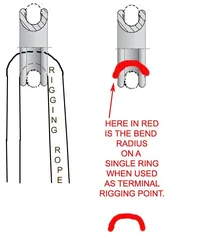
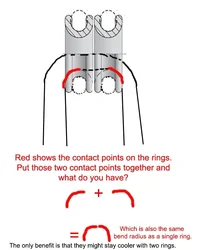
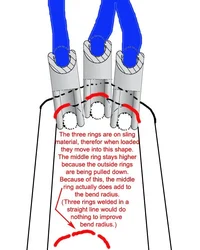
Those were my words years ago. "Three rings welded in a straight line" might not improve bend radius; but still likely improve strength by involving more rope fiber length.
What ever. I get tired of picky people arguing over vocabulary. (you guys are not, I'm talking about the past)
Take a Knife blade for instance. One blade can cut through a rope easily. 1000 blades packed next to each other (like a block of steel) won't cut a rope easily.
What ever it IS, multiple rings work.
three large rings (28x20 size) or two beast rings (38x28 size) and the rings will never be the location of a rope breaking if you tie a rope to your load.
Rings add some friction. Friction located UP IN the tree is beneficial, big time!
I'll never use blocks for LOWERING ever again; they just don't make sense.
I used to use the rings only for redirects years ago; that was before I learned of the benefits. Now ALL my lowering is done with rings and my groundperson does not have to be so perfect with his lowering skills.
The bigger the weights and more potentially violent the forces; the more the rings with some friction are important to keep things going smooth and non-violent.

What ever. I get tired of picky people arguing over vocabulary. (you guys are not, I'm talking about the past)
Take a Knife blade for instance. One blade can cut through a rope easily. 1000 blades packed next to each other (like a block of steel) won't cut a rope easily.
What ever it IS, multiple rings work.
three large rings (28x20 size) or two beast rings (38x28 size) and the rings will never be the location of a rope breaking if you tie a rope to your load.
Rings add some friction. Friction located UP IN the tree is beneficial, big time!
I'll never use blocks for LOWERING ever again; they just don't make sense.
I used to use the rings only for redirects years ago; that was before I learned of the benefits. Now ALL my lowering is done with rings and my groundperson does not have to be so perfect with his lowering skills.
The bigger the weights and more potentially violent the forces; the more the rings with some friction are important to keep things going smooth and non-violent.

here, I drew this up fast and sloppy
This is what people argue about. They say it's the SAME radius.
View attachment 28782
I guess with this picture length of bend to stretch over and bend radius are very different. That was a good way to clear that up.
I never doubted the rings. I have some and I think they're great. I've never used multiple slings stacked up with each other like I've seen you do in your videos. Originally I wondered if that was a bend radius thing or a sling swl thing, but the fibres stretching over a larger/ longer surface wasn't something I had though to take in to account. Makes some sense I was always told a bend 4x the diameter of the rope was optimal.
Now this is an aside but with your logic that's why people use bike tire rims on there clothes lines. The rim is 500x the diameter of that plastic coated wire but it works easy, smooth and with out a catch.
It's said with mechanical advantage a fiddle block set bigger than 7:1 has drag and becomes less effective but a rigging point if smooth should never be effected like that assuming there's enough weight to justify all that bend.
Sorry about that rant but that's how it works out in my head.
David do you have any numbers for how much each ring increases rope strength? For example at what sizes if ever would you put 3 beast rings or 4 at a rigging point instead of 2?
I like the slight smooth resistance xrrs give just the other day I had a double ring sling at the top rigging point and a redirect at the base instead of a porti taking out medium sized limbs no problem, if they were blocks I would've been across that yard at the speed of light no doubt.
I like the slight smooth resistance xrrs give just the other day I had a double ring sling at the top rigging point and a redirect at the base instead of a porti taking out medium sized limbs no problem, if they were blocks I would've been across that yard at the speed of light no doubt.

SRTsteve860
New member
- Location
- North West Connecticut
the whole idea of bend radius for a rope comes from the fact that a rope elongates under load, (duh) we all know that. as the loaded like moves up and over the pulley/carabiner/crotch the load transfers within the strands of the line. bend a piece of stiff rope in your hand making a tight eye, you can see that the outer-most strands are very tight while the inside strands are slackened or even expanded out. this shows that when a rope bends, half will be in tension while the other will be in compression, the issue comes when the load transfers to the outer strands, thus incorporating many fewer strands than a straight vertical load, as the strands elongate, more strands will be incorporated taking some load. this elongation and load sharing ratio continues until the load is balanced with the strands in tension, or until the outermost strands fail causing a zipper effect as the rest of the rope fails and snaps in half.
so a larger bend, will put the compression strands in "less" compression, making it easier for them to be available to accept load if the rope elongates enough to negate the initial compression.
My idea to understand bend radius helping retain rope strength, sorry if its confusing
so a larger bend, will put the compression strands in "less" compression, making it easier for them to be available to accept load if the rope elongates enough to negate the initial compression.
My idea to understand bend radius helping retain rope strength, sorry if its confusing
kevin, No, no numbers for "how much of each ring increases rope strength".
At the extremes, you will never need more than 3 of the "large ring" 28x20's and you will never need more than two of the beast 38x28's.
We take things to the Xtremes so that you don't have to. Just practice the safest methods and your rigging will always be optimal.
By the way, back to the original subject. Natural crotch rigging is possible and can be done correctly, but it has so many variables that a climber has to be extremely seasoned and skilled in natural crotches and diameters in order not to make mistakes. Using the same tools everyday verses a different tree every day has it's advantages of predictability. I choose the tools.
At the extremes, you will never need more than 3 of the "large ring" 28x20's and you will never need more than two of the beast 38x28's.
We take things to the Xtremes so that you don't have to. Just practice the safest methods and your rigging will always be optimal.
By the way, back to the original subject. Natural crotch rigging is possible and can be done correctly, but it has so many variables that a climber has to be extremely seasoned and skilled in natural crotches and diameters in order not to make mistakes. Using the same tools everyday verses a different tree every day has it's advantages of predictability. I choose the tools.

I agree with this. I've also come to steer away from any natural rigging at all, even for the light limbs here and there. We have a 1/2" line that's nice on the hands for the groundie, and it has a Dan House sleeve that lives on it 24/7.I can't imagine going back to natural crotch rigging for anything more than one branch here and there when I can just easily flip therigging lline exactly where it needs to be with little to no effort. Rigging hardware justsaves so much effort! Like it has already been pointed out, if the union is so large that smaller branches won't fall, you could do mmultiple branches at once......which means a rigging plate would be handy...and if you've got a rigging plate + biners, you've probably got a block. ..and if you've got a block you've probably got a porty...
modern hardware is awesome. Let's all take some time to be thankful for modern equipment.
When you're pulling up the line, the sleeve is knotted at the end coming up to you for easy install. It takes no extra time what so ever to use this for those quick rigs that may burn cambium. It also reduces friction enough that smaller limbs will go easier than over natural structure. It also retrieves with a stopper knot so for us, it's a no-brainer.
I'll use sleeves even in larger rig systems. Sometimes I may want to relocate a high rig point and the new rope path would require a redirect somewhere lower in the crown. The sleeves are great because a groundie can easily install and set it all from the ground.
For sure, the X-Rings are rad as can be. What I like about them most is the flexibility in usage, and the variety of available sizes. I also appreciate the work that David has put in to determine the best configurations for all the possible applications, and new ones are coming out often enough to keep it all exciting.

treehumper
Carpal tunnel level member
- Location
- Ridgefield, NJ
Hmmmmm….. late but I'll have to see if I can find any of the math behind this.
Treehumper, there is too many variables, makes it irritatingly too complicated to bother with making a chart or what ever.
The numerous rope sizes is what complicates things. Then the ring sizes.
The thing to keep in mind is, the bigger diameter the rope, the tighter bend a single ring is on the rope. Say a 1" rope. Yes the rope is a stronger rope, BUT if you take it to failure levels, it likely fails a the ring.
on the other hand, take a tiny diameter rope, say 1/4" and take it to failure level and it breaks at the tie.
I never wanted to hear that the rings were the point of rope failure; no matter how someone shock loaded massive weights. That's why I preached saftey with multple rings.
The numerous rope sizes is what complicates things. Then the ring sizes.
The thing to keep in mind is, the bigger diameter the rope, the tighter bend a single ring is on the rope. Say a 1" rope. Yes the rope is a stronger rope, BUT if you take it to failure levels, it likely fails a the ring.
on the other hand, take a tiny diameter rope, say 1/4" and take it to failure level and it breaks at the tie.
I never wanted to hear that the rings were the point of rope failure; no matter how someone shock loaded massive weights. That's why I preached saftey with multple rings.
That dan house sleeve is smart on that 1/2" line. Good idea!
How long does the sleeve usually last? Does it ever wear through?

TreeLogic
Branched out member
- Location
- Coastal SC
That's a badass pic X!
Haven't seen any wear other than enough heat buildup that compromised the soft rubber coating on the outside of the sleeve. Zero damage to rig line. Zero signs of wear on the sleeve conduit material.How long does the sleeve usually last? Does it ever wear through?
I would strongly advise against heavy loading until someone tests these out more, but I would also strongly recommend them for light applications.
thanks treelogic. some of the heaviest logs I've negative rigged. I took the largest red oak log (bigger than the one shown in picture) to be weighed. I thought it was going to be 4,500 lbs with it's size and crotch wood. but it was 3,670 lbs. Still a hefty log to be negative rigging. used our new double beast ring slings and double rigging. (hobbs on one side, grcs bollard on the other) Two, 1 inch diameter rigging ropes. So much easier and faster to set up than when I use to use blocks to do this type of stuff. Logs all lowered with a nice run and slowed to a stop ABOVE the ground. All captured on video of course; it will be coming.

Evo
Been here much more than a while
- Location
- My Island, WA
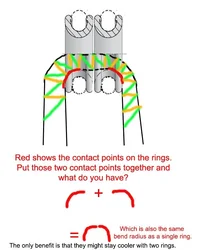
Ok sorry to bring the bend radius back up. I have a theory. As Mr X showed in his diagrams the bend radius is in fact the same when using two rings or one, perhaps slightly increased when using three. What is different is that the bend is divided in half and then the other half of the bend is moved over on the rigging line a distance to load different strands on the line. The strands spiral around the rope, perhaps one complete rotation every inch. So IF this is indeed the case the compression fibers are only compressed half as much then they travel through the second ring and become the tension fibers. So the rope is loaded more evenly though the bend of two rings vrs one.
This is backseat driving here, as I haven't worked with the rings, and only have held them once for a moment in a store.
This is backseat driving here, as I haven't worked with the rings, and only have held them once for a moment in a store.
Attachments
Last edited:

Treetopflyer
Been here much more than a while
- Location
- Coastal N.J
This thread has raised a lot of questions in my mind of where I want my friction managed and when to manage it with what ..figure that one out. I'm gonna try when I'm not so tired and thinking more clearly to add to that. 

JTree
Participating member
- Location
- East Texas
One of the more thought provoking threads posted in a while. Thanks for contributing, everyone.
New threads New posts
-
test
-
 Alternatives to standard asphalt around roots
- Started by southsoundtree
- Replies: 4
-
-

-

-
 For Sale: 2018 Vermeer BC1000XL Chipper | 918 Run Hours | Deutz Diesel
- Started by Blue Ribbon Tree
- Replies: 2
-


