Floating vs Fixed bollard lowering device

monkeylove

Been here much more than a while
Location
Roslyn, Pa.
If there is a thread about this just point me there please. But to keep brands out of the equation lets just pick Stein. Can someone tell me what makes one better than the other or is it really just personal choice. I am paraphrasing so ignore an incorrect specs.

I could get a Stein floating ballord rated at 2000lbs or I could get a Stein RC 2000 rated at the same weight. Why would I buy one over the other.

Thanks, I know this is probably a newbie question.

Edited: Don't give me flop factor unless that is really the only reason
 
Larger bend radius on the RC-2000, 4 fairleads instead of 2, slightly larger rope size capacity. That's probably not much, I realize. I've got the RC-1000 that I use with the Atlas, and plan to buy the RC-2000 for the 5/8" ropes. But then, as I said earlier, I'm rather anal about the whole bend radius thing. I like the Stein's design and construction... but my only other device is a worn out aluminum Buckingham, so I can't really compare them to anything else, without mentioning the dreaded flop issue.
 
Just figured I'd pass along the info fornthose who arent aware its ok to put a sling on top of the buck porty . It works well on there just use a rigging biner to secure it because the rope may rub it on occasion.
 
I usually tie the top just to stop flop. I will probably get the Stein RCW but it amazed me that when I Googled lowering devices the only few that came up were the porty or it's clones, the Hobbs and GRCS and of course Stein. Are there really that few devices in a fixed bollard.
 
FWIW my jobs usually involve a limb\limbs removal on wide spread canopy's, the flop from a floating friction device allows it to self align with the direction of the rigging line, keeps the rope running on the correct parts and preventing "side/cross loading"..... especially important since I welded up my own port-a-wrap knock offs.
 
Nice thread, TBH a fixed or floating depends on the job, my work is always domestic properties in the UK, which are not huge, but need control over buildings etc. we only use a floating one with a one maybe 3 wraps, the groundies are very strong chaps, so it's easy for them at 60kg impact drops.
 
FWIW my jobs usually involve a limb\limbs removal on wide spread canopy's, the flop from a floating friction device allows it to self align with the direction of the rigging line, keeps the rope running on the correct parts and preventing "side/cross loading"..... especially important since I welded up my own port-a-wrap knock offs.
I think in your situation Raj . I would set rigging up so the rope would be guided down the main stem through a redirect or series of, to keep it aligned . If I'm understanding your post correctly.
 
IMHO, it depends on the job at hand. I have reached for my porty over my bollard, and reached for my bollard over my porty. Really depends on what the job at hand is, and what precisely i want to accomplish.

Having said that, if the fixed bollard will work, i will choose the bollard over the porty probably 90% of the time. I find the no-flop a huge selling point. I feel like i run the rope more efficiently with it, and it is also much easier to mentor/coach a newer groundie on versus the porty.

But again, they each have their place. I dont think i would ever get rid of one or the other.
 
Thanks Shawn. I have a porty now but was thinking I would get a fixed bollard also if there was a good reason to own one. Of course I really want a GRCS or Hobbs but if Stein ever releases the RCW-3001 then I will probably get that.
 
My porty is a sherrill(i know, not my proudest purchase), and my bollard is of my own design that i had a good friend build years back in his fab shop.

Its about the same as any fixed bollard on the market, but cost me nothing as he was able to get all the materials for free and did the fab work for fun. But i have dropped some big stuff on it, way bigger than i would trust the porty with, and it just keeps smiling and laughing back at me. Honestly, and taking my last post into consideration, i trust my bollard way more than my porty.

And quite frankly, if you have the means or the time to set up a fairlead block above the bollard, it takes the rope entry angle out of the equation, ie, it doesnt matter at that point where the rope goes after it exits the bollard. I try to stick close to what the GRCS suggests, which i believe is no greater exit angle than 5* ( correct me if im wrong), and then use a fairlead block if its greater than that.

But there are situations where the ability to automatically fairlead to any angle makes the porty the better choice.

My next build is going to be a double barrel bollard, similar to the stein double. Just the ability to run two ropes when necessary would be very nice, instead of having to set up two devices and having a cluttered trunk space.
 
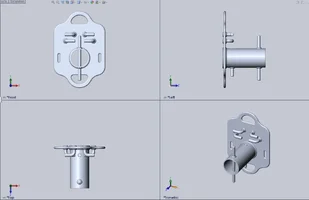
So if I made my own fixed light duty Bollard here is what I was thinking. Please feel free to beat me up, I am looking for thoughts. It has a 4.5 inch barrel, 3/4 inch fairleads and pins, and the back plate is 1/2 inch. All from aluminum making it weigh 12 lbs or steel at 33 lbs. Thoughts.
Lowering Bollard.webp
 
My porty is a sherrill(i know, not my proudest purchase), and my bollard is of my own design that i had a good friend build years back in his fab shop.

Its about the same as any fixed bollard on the market, but cost me nothing as he was able to get all the materials for free and did the fab work for fun. But i have dropped some big stuff on it, way bigger than i would trust the porty with, and it just keeps smiling and laughing back at me. Honestly, and taking my last post into consideration, i trust my bollard way more than my porty.

And quite frankly, if you have the means or the time to set up a fairlead block above the bollard, it takes the rope entry angle out of the equation, ie, it doesnt matter at that point where the rope goes after it exits the bollard. I try to stick close to what the GRCS suggests, which i believe is no greater exit angle than 5* ( correct me if im wrong), and then use a fairlead block if its greater than that.

But there are situations where the ability to automatically fairlead to any angle makes the porty the better choice.

My next build is going to be a double barrel bollard, similar to the stein double. Just the ability to run two ropes when necessary would be very nice, instead of having to set up two devices and having a cluttered trunk space.
15 degrees.
 

New threads New posts

Back
Top Bottom