TheTreeSpyder
Branched out member
- Location
- Florida>>> USA
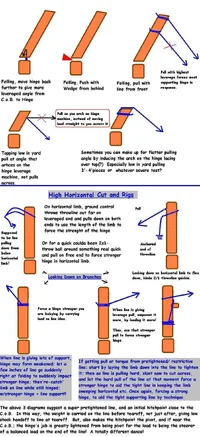
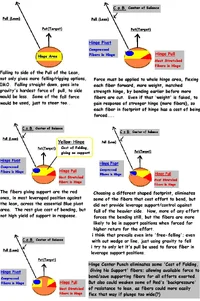
i think that a hinge's strength is set at it's FirstFlexxing; usually a second or so in the first movement. Pulls, Pushes and Cuts after that serve to weaken/speed the machine of the hinge, from slow/powerful setting of the machine powered by the C.o.B. falling IMLHO. Felling just with lean as power (no line or wedge) forces a hinge strength equal to the leverage of lean at FirstFolding (when no more cut is taken); but then in falling gains speed and more lean, to tax the strength of the hinge, that has been preset earlier. If at the FirstFolding, we 'fake' out the hinge with extra push(wedge) or pull (line), to make Nature 'think' the tree is heavier at FirstFolding than it is; then She will respond and match with a stronger hinge as equal and opposite reaction; that gives more support to the hinge to handle better the increasing forces of speed and leverage loading as the tree falls. A wide FaceCut with no dutchmans (with some exception...)taking the fullest advantage of this support offered.
i think that wedging is good in that it applies MA and arching leverages until movement ensues, then backs off (pressure is reduced as tree lifts to arc forward on the hinge). A rope can give high leverage quickly, but can be pulled too long too, making weaker hinge, pulling after the first flexing..
All the line pull before the tree is ready to go (that doesn't hold against backlean) is kinda a waste outside the preset to have force ready at FirstFolding. If you were to impact all that at jsut the right point and then back off; it would be at FirstFolding to force the strongest hinge. With a wide FaceCut, no Dutch, high wood strenght and flexability between this FirstFolding can force such a high strength hinge, the hinge fights you all the way to the ground pivoting on the hinge as you pull, connected all the way.
In rigging especially, i find forcing a more supporting hinge helpfull; especially as it only needs force at a certain small window of time to do so. i find forcing a stronger hinge in tandem with a tight supporting line to give superior strength and security.
Impacting at the right moment with high pressure to force a high strength hinge, with simple tools and settings in place is something that leveraging a tight line by bending does and lends itself to with key ingredients of high leverage for a short distance, to force quickly a super strong hinge at the right moment.
i think that wedging is good in that it applies MA and arching leverages until movement ensues, then backs off (pressure is reduced as tree lifts to arc forward on the hinge). A rope can give high leverage quickly, but can be pulled too long too, making weaker hinge, pulling after the first flexing..
All the line pull before the tree is ready to go (that doesn't hold against backlean) is kinda a waste outside the preset to have force ready at FirstFolding. If you were to impact all that at jsut the right point and then back off; it would be at FirstFolding to force the strongest hinge. With a wide FaceCut, no Dutch, high wood strenght and flexability between this FirstFolding can force such a high strength hinge, the hinge fights you all the way to the ground pivoting on the hinge as you pull, connected all the way.
In rigging especially, i find forcing a more supporting hinge helpfull; especially as it only needs force at a certain small window of time to do so. i find forcing a stronger hinge in tandem with a tight supporting line to give superior strength and security.
Impacting at the right moment with high pressure to force a high strength hinge, with simple tools and settings in place is something that leveraging a tight line by bending does and lends itself to with key ingredients of high leverage for a short distance, to force quickly a super strong hinge at the right moment.