
Navigation
Install the app
How to install the app on iOS
Follow along with the video below to see how to install our site as a web app on your home screen.
Note: This feature may not be available in some browsers.
More options
You are using an out of date browser. It may not display this or other websites correctly.
You should upgrade or use an alternative browser.
You should upgrade or use an alternative browser.
fiddle block
- Thread starter Arbor23
- Start date

TheTreeSpyder
Branched out member
- Location
- Florida>>> USA
They are bearinged; and purer inline; less rope rubbing/friction pulleys. It seems those are the right attribtes for high payoff; with extensive use of compression jigs.
Here is a link that shows how to get 4x effort and 8x effort (+bodyweight x 3or5 respectively)from a 3:1 and 5:1 jigs; respectively.
The purer inline, no rope rubbing firctions and bearings work jsut like the linked 2Handing; they all seek to conserve more of the forces already in the system; and bring them to target/work!
Here is a link that shows how to get 4x effort and 8x effort (+bodyweight x 3or5 respectively)from a 3:1 and 5:1 jigs; respectively.
The purer inline, no rope rubbing firctions and bearings work jsut like the linked 2Handing; they all seek to conserve more of the forces already in the system; and bring them to target/work!

- Location
- Ontario, Canada
I made a set with ISC rescue pulleys and 150ft. of Tree Master three strand.
Keep it all in a plastic pail ready to use.
Keep it all in a plastic pail ready to use.

- Location
- Longmont, CO
[ QUOTE ]
Im looking into buying a fiddle block.
[/ QUOTE ]
Start looking into buying a G.R.C.S. You will not be let down.
Don't let the price deter you from getting one either.
Im looking into buying a fiddle block.
[/ QUOTE ]
Start looking into buying a G.R.C.S. You will not be let down.
Don't let the price deter you from getting one either.
[ QUOTE ]
Im looking into buying a fiddle block. We have currently been using a 3 or 5 to 1 system with pullys and prusicks. If ne one has had good or bad experience with the fiddle please let me know.
[/ QUOTE ]
Choose an inline yachting type with efficient roller bearings.
Only don't leave them on the line to be shock loaded after tensioning.
These look good:
http://www.baileysonline.com/itemdetail.asp?item=FB+8315+01&catID=
Just be sure not to put sufficient force on the line to cause the rope grab to cut the line (one person pulls are fine).
Im looking into buying a fiddle block. We have currently been using a 3 or 5 to 1 system with pullys and prusicks. If ne one has had good or bad experience with the fiddle please let me know.
[/ QUOTE ]
Choose an inline yachting type with efficient roller bearings.
Only don't leave them on the line to be shock loaded after tensioning.
These look good:
http://www.baileysonline.com/itemdetail.asp?item=FB+8315+01&catID=
Just be sure not to put sufficient force on the line to cause the rope grab to cut the line (one person pulls are fine).

The rig on Bailies has a rope grab to attach to the pull line... is this a concern to any of you? I have thought about adding one to ours, but what about damaging the rope, or having it slip? We have a 5:1 and have damaged Tenex before from pulling too hard. We now use Ultra Tech to connect to connect to the pull line. I understand the problems of pulling so hard that you melt cordage, that was during our "learning curve". Anyway, I use a rope grab for climbing like the one pictured, and the info that came with it states that it slips at 4kN. I believe this is too low considering the applications fiddle blocks are used for. Thoughts or comments?

TheTresyder great presentation.I like the science behind the 10 and 20 times pull force, but at this point is time to beef up the pulleys. I know the average fiddle block has a rating of around 2500#.

- Location
- Retired in Minneapolis
My preference is to use a cord/webbing for connecting a handybilly as a piggyback system. After reading about these setups being used and tested in search and rescue scenarios I've come to the conclusion that the slip/grab ability of a soft connection is more desirable than how a mechanical works.
- Location
- Ontario, Canada
Depends on what you are doing at the time.
It only takes a couple of hundred pounds to tension or pull a tree.
I can disable the grab on the ISC and use a hitch if the loads are increased.
It only takes a couple of hundred pounds to tension or pull a tree.
I can disable the grab on the ISC and use a hitch if the loads are increased.
TheTreeSpyder
Branched out member
- Location
- Florida>>> USA
i'm going top agree with Tom; with 2 reservations:
A)Dirty or wet rescue etc. rope conditions
B)Rope constructions where the length of kernmantle 'jacket' grabbed by the prussik type strategy is thick enough to not let the pressure grab the real load carrying inner of the rope even by the bend created. Then i think the 'pinch thru' strategy of the cam to grab the 'jacket' and the load carrying inner core as one is better than the successive choke strategy of the prussik. A double braid, being more tolerant; because as you grab the outside of the rope, you are grabbing at least part of the load with prussik. But in kernmantle; you wouldn't really have a firm grab on anything; except the jacket. Our 16 strands work witht he prussik strategy; because you are grabbing the load; when not grabbing the core...
A)Dirty or wet rescue etc. rope conditions
B)Rope constructions where the length of kernmantle 'jacket' grabbed by the prussik type strategy is thick enough to not let the pressure grab the real load carrying inner of the rope even by the bend created. Then i think the 'pinch thru' strategy of the cam to grab the 'jacket' and the load carrying inner core as one is better than the successive choke strategy of the prussik. A double braid, being more tolerant; because as you grab the outside of the rope, you are grabbing at least part of the load with prussik. But in kernmantle; you wouldn't really have a firm grab on anything; except the jacket. Our 16 strands work witht he prussik strategy; because you are grabbing the load; when not grabbing the core...

- Location
- Haddonfield, nj
so if im reading this right, you fellas have had a problem with the cleating block servering the rigging line when too much load is applied (by too much load i mean too much pulling power)

- Location
- Bloomington, Indiana
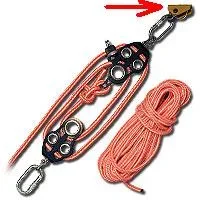
One of the fiddle blocks does have a cleat and could be called a 'cleating block', but this is not the problem. The problem is the ascender (red arrow--the photo in the attachment is from the link provided by Lararus2)which can shred, damage, or sever the rigging line.
Some of these cammed ascenders are said to slip at around 4 kN, but I still think that a split tail is safer. Why take the chance when a split tail is so easy to use and readily available.
Some of these cammed ascenders are said to slip at around 4 kN, but I still think that a split tail is safer. Why take the chance when a split tail is so easy to use and readily available.
Attachments
[ QUOTE ]
Depends on what you are doing at the time.
It only takes a couple of hundred pounds to tension or pull a tree.
I can disable the grab on the ISC and use a hitch if the loads are increased.
[/ QUOTE ]
My sentiments entirely Kevin - you just have to know your equipment and its compatibility.
I use the ISC clamp as it doesn't have a spring on the cam. This makes for easy tensioning and lowering without having to remove the device with one person tensioning through the blocks (efficient operations). Likely loads are only 400Kg.
Likewise, if more purchase is required I'd use a VT and GRCS or Tirfor or whatever - my fiddle blocks, karabiners and clamp are only rated to 600Kg WLL, so thats all they get used for.
Once again, its WLL and CTF that need to be compatible and respected, not matched ultimate strengths.
Depends on what you are doing at the time.
It only takes a couple of hundred pounds to tension or pull a tree.
I can disable the grab on the ISC and use a hitch if the loads are increased.
[/ QUOTE ]
My sentiments entirely Kevin - you just have to know your equipment and its compatibility.
I use the ISC clamp as it doesn't have a spring on the cam. This makes for easy tensioning and lowering without having to remove the device with one person tensioning through the blocks (efficient operations). Likely loads are only 400Kg.
Likewise, if more purchase is required I'd use a VT and GRCS or Tirfor or whatever - my fiddle blocks, karabiners and clamp are only rated to 600Kg WLL, so thats all they get used for.
Once again, its WLL and CTF that need to be compatible and respected, not matched ultimate strengths.

- Location
- Chapel Hill, NC
I'm using the one from Sherrills. It has a cleating block on end which is really handy. I have an 8mm beeline prussik to attach it to the load line.
The shackle pins needed locktite.
I like it, makes tightlining big trees easy and fairly predictable.
Tom,
I thought a handbilly was a pump; what are you talking about?
The shackle pins needed locktite.
I like it, makes tightlining big trees easy and fairly predictable.
Tom,
I thought a handbilly was a pump; what are you talking about?

- Location
- Morris,Illinois
Buckingham also makes a 5 to 1 pulley system. This is the one we have, quite a bit more expensive than the ones is Sherrill and Baileys. web page I see where the price has really gone up since we bought the one we have. It is very well made though and worth every penny, performed flawlessly when we we used it more. You will have to add some rigging biners to this set-up. Like has been mentioned earlier a GRCS is the way to go.
It is much better to use cords or webbing on the load line than a device like a rope cam. A rope cam will compress and fuse the fibers of a rope when you use a 5 to 1 pulley system on a rope creating a bad spot in the rope. This has just been my experience trying to find the best way to use a 5 to 1 and the acccessories to go with it.
Like has been said it is a must have tool if your in the tree biz. I don't think they are as powerful as a come along but if you don't need the extra pulling power a 5 to 1 is much faster to set-up and use and more versitile than a come along would be.
Larry
It is much better to use cords or webbing on the load line than a device like a rope cam. A rope cam will compress and fuse the fibers of a rope when you use a 5 to 1 pulley system on a rope creating a bad spot in the rope. This has just been my experience trying to find the best way to use a 5 to 1 and the acccessories to go with it.
Like has been said it is a must have tool if your in the tree biz. I don't think they are as powerful as a come along but if you don't need the extra pulling power a 5 to 1 is much faster to set-up and use and more versitile than a come along would be.
Larry

- Location
- Nationwide
these are usually just the main sheet system for sailboats. look online at West Marine, or look up Lewmar or any other sailing rigging supplier. you can save a lot of money by shopping at a marine salvage or chandlery. there is a huge yacht salvage shop called Minnie's in Newport, CA. Just a thought.
New threads New posts
-
test
-

-
What's on your mind? TCI Magazine wants to know
- Started by Tree Care Industry Assoc.
- Replies: 12
-
 Apr 09 (Free CEUs) & May 07 - 'Urban Forestry Today' Webcasts @ Noon (Eastern)
- Started by UFT
- Replies: 0
-

-
-


