









Falling Madrones….

Zebco Kid

Branched out member
Location
Ashland, Oregon
Hello all,

I hope the winter is treating everyone well.

This year I moved to Ashland, OR. Some time back I inquired about recreationally climbing these beautiful trees. I did not, as the consensus seemed to be that they might be stout trees, but their bark…or the lack thereof makes them sensitive to rope…regardless of a cambium saver.

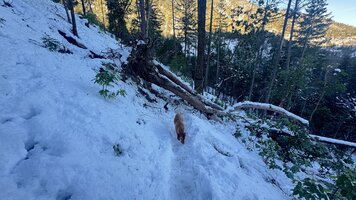
So…we just had our first snow storm. It was a good one: 18”. Lots of Madrones are falling. When I examine the riot structure, it seems quite small. I’m not sure if this is normal, the result of drought, or a disease.

I’m curious if anyone has thoughts on what I am witnessing?

Thank you.

David IMG_4037.jpeg
 
I remember that climbing thread, and of course I'm also in the land of madrones. Two things come to mind right away for me: #1 is that I hardly ever see uprooted madrones, even though they often grow at extreme angles, and sometimes even completely horizontal. #2 is a time I was working together with an excavation company on a removal (I climbed, they cleaned up), and the equipment operator made a remark about how he never understood how they stay standing, because the stumps/rootball "are like an onion," as in they pretty much always lack the wide rootflare we are used to seeing/expecting on most trees. And this was an old-timer, I bet he'd dug thousands of madrone stumps in his days, live and dead trees.

So I don't have any answers, but that photo doesn't surprise me personally. That and I've never been able to predict what madrones are likely to uproot and which ones aren't.
 
  • Like
Reactions: evo
I remember that climbing thread, and of course I'm also in the land of madrones. Two things come to mind right away for me: #1 is that I hardly ever see uprooted madrones, even though they often grow at extreme angles, and sometimes even completely horizontal. #2 is a time I was working together with an excavation company on a removal (I climbed, they cleaned up), and the equipment operator made a remark about how he never understood how they stay standing, because the stumps/rootball "are like an onion," as in they pretty much always lack the wide rootflare we are used to seeing/expecting on most trees. And this was an old-timer, I bet he'd dug thousands of madrone stumps in his days, live and dead trees.

So I don't have any answers, but that photo doesn't surprise me personally. That and I've never been able to predict what madrones are likely to uproot and which ones aren't.
Thanks for the perspective. Around here we have very compact glacial soils. The drier sites without a high water or underground seeps is where they prefer to grow.
I too very rarely see madrone uproot unless it’s long dead, the few I do see rarely don’t have root decay so I always associate the two co occurring.

They are very hard to transplant mostly due their juvenile root structure, where one or two bigger lateral roots just shoot way off the side after a certain depth, essentially to dig one means to cut off their entire root system. Not unlike an oaks taproot going straight down, or even holly.

Now I’m really curious if that is partly due to our vast differences in soil or just because I haven’t seen one dug up of any substantial size.
 

New threads New posts

Kask Stihl NORTHEASTERN Arborists Wesspur TreeStuff.com Teufelberger Westminster X-Rigging Teufelberger
Back
Top Bottom












