Face cuts/Notch cuts

Location
Hawaii
What are the difference in these cuts?Do you use these in certain situations and different angles of the tree leaning? Does it matter what notch/face cut to use? Is there a link that I could read about it?

Example:
__\ straight bottom, angle from top to down

__ straight top, angle from bottom to top
/

> angle top and angle bottom
 
Some people are say some great educational details that will be worth more than I say, but based off what I've read and learned, this is how I usually use them:
/_ is what I use 90% of the time cause for me it's the easiest to cut.
< is what I use to use the most hinge. the hinge won't break as soon because the notch won't close as soon
The last (Humboldt) is what I'll use if I'm not cutting at the ground and trying to land a stem flat/ keep it landing as close to the stump at possible
 
/_ i use for almost everything, blowing a top out, dropping loggs, and felling
< haning tops and logs, depending on the type of tree i will use it to angle a branch or lead away from an obsticle
The humbolt I rarely use normally when I want to save as much log as possible for the mill.
 
I've been using this technique I picked up from Reg's video here. I find it extremely effective. This is what I use when cutting from the ground most of the time. The wider the notch/facecut,the longer you have control of the tree
 
And for the back cut. Is it better to have it line up with the face cut that's going straight in or do you back cut a little higher?
 
And for the back cut. Is it better to have it line up with the face cut that's going straight in or do you back cut a little higher?

Oh ho! Now there a question. Final cut I'll be level, but thats only to save time on recutting the stump, yes there are arguments on is it safe to cut from the knee. But I'm in the tree business I'm used to bending over.
In the air I go a little higher then level helps to snap and still have enough rotation for the log to land flat. (Depending on, size, temperature and type of tree, in other words I make an educational guess from unreliable information)
 
What are the difference in these cuts?Do you use these in certain situations and different angles of the tree leaning? Does it matter what notch/face cut to use? Is there a link that I could read about it?

Example:
__\ straight bottom, angle from top to down

__ straight top, angle from bottom to top
/

> angle top and angle bottom

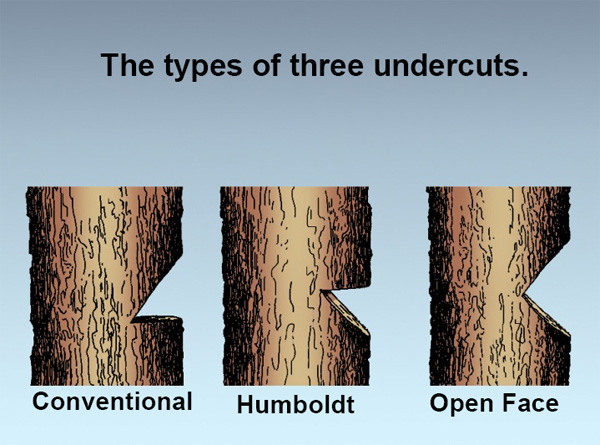
I'll leave you with this here:
undercuts.jpg


Conventional versus humbolt will produce largely the same effect ; the humbolt has a tendancy to let the piece "pop" off, while the conventional will let it lay down closer to the stump.

One can be easier to make than the other depending on your relative position to the trunk (on the ground, in the air, branches vs tops, etc)

The open face allows more initial rotation; used on the ground, it's good for heavy leaners with tag lines to keep the hinge wood holding until the tree gets to the ground.

In the tree, it's a much more delicate cut to use because you end up shock-loading the stem a bit more with it (with tops). With branches, it just makes them hold up longer before they break.

Use the search tool, with the respective cut names, and you'll find a lot of information on these notches already posted.
 
In addition to what others have said, the conventional notch is great when you are lowering a chunk because it is more textile friendly. The Humboldt is good if you are topping and think the top might get lodged in another tree. Instead of getting stuck on the ledge the butt end will slide off. Warning! this useful trick can cause the top to flip back on the climber. Open face is great for felling down hill or when you suspect a barberchair.
 
Oh yeah, thought of another for the open face. If there are flowers or bushes around the trunk that you don't want to crush and the particular tree you are cutting has good hinge holding fiber...
 

New threads New posts

Back
Top Bottom