Face cut in dead trees

Face cut should be considered mandatory, what one need to keep in mind felling dead trees is that the wood might be brittle or at least don´t act the same way as sound wood. This makes the hinge weaker and it is not likely to function as good as on a live tree.
Svein
 
[ QUOTE ]
I tink I hav speling isues.

[/ QUOTE ]

We all do Graeme!
grin.gif


I can really see the validity in a hollow "shell" type tree like Jerry mentions. This type of tree has little or no fiber and hence would not be "steered" or held by a hinge- there wouldn't be one.

Now for a dead tree, I believe that I always would choose a face cut, but might use a thinner hinge. I find thicker hinges to breaker quicker than a thin one in dead trees.
 
The responses have been more than I expected...thanks!

When I see the fellow I'll share the feedback.

When I've felled dead or weak stemmed trees I'll adjust the depth or height of the face. My biggest fear whenever I make a felling cut, the same holds true for felling limbs too, is the loss of control from a barber chair or ripping cut. Without a face cut of some size the butt jumps and rolls.
 
Maybe two dozen times in the past twenty years I've come upon trees so rotten or hollow that no face cut could be made. In those cases I've set a rope and under no rope tension made a back cut to weaken the tree, got away from the tree, and then used the rope to 'bust' the tree off and down.
 
[ QUOTE ]
My biggest fear whenever I make a felling cut, the same holds true for felling limbs too, is the loss of control from a barber chair or ripping cut. Without a face cut of some size the butt jumps and rolls.

[/ QUOTE ]

Tom, this is definitely a big concern of mine too, though I tend to use the bore cut alot which can help minimize the barber chairing. I never use the bore cut on snags or rotten trees though. Just not enough good wood there.

Chris
 
Had a tradgedy here not so long ago, when a tree was "crippled" and pushed over with a 25ton excavator. The faller and operator were fine but another worker on site came into range of the tree(unseen), put his back to the felling operation to sharpen a saw.

The tree hit and killed him. The employer was charged with failing to use a wedge, failing to provide a safe workplace and I think failing to put in a scarf(face cut). The "expert" witness for "WorkSafe" had little falling experiance and refered only to the learning guide for faller training.

We need to be careful of how we determine what an expert is I guess.


Graeme
 
Technical competence of 'Expert' witnesses is something I've been banging on about for years. Good to hear it mentioned by someone of your credibility Graeme. It is important, because the ramifications of ill decisions are prescriptions or precedents for work practices that effect the industry at large.

As for facing dead trees, all you can rely on is natural lean; I see no hardship in placing a face to encourage the fall to that direction. After that, its down to gravity.

I have had success with step cuts and a pull rope though. I suppose step cuts and a couple of wedges could also work?
 
[ QUOTE ]

I have had success with step cuts and a pull rope though. I suppose step cuts and a couple of wedges could also work?

[/ QUOTE ]

I'm genuinely surprised you said that Laz.

With a step cut you have no directional control.

Think about it, what happens when a step cut has been made.
Then apply pressure to the back of the tree or pull it.

The two circular faces at the front cut begin to meet each other hence no directional control.
 
Depends on the type of 'Dead' tree - My Austrian friends have a better explanation. They call them 'dry'.

Some recently dead trees (pinus spp a good exampe) can have a lot of chewy timber strength when dead. In which case, standard variations of falling techniques apply.

My comments are for 'Dry', brittle, dead trees.

There is little 'control' with such dry dead trees. You create the direction with force, then let gravity take it over.

Then there are soft, rotten, dead trees...

Never kid yourself its a safe operation just because there is a face and a hinge - the tree will fall the way its forced (gravity, additional pull or push).

A lot depends on the weight and dimensions of the tree also (height over diameter ratio).

 
[ QUOTE ]

Never kid yourself its a safe operation just because there is a face and a hinge - the tree will fall the way its forced (gravity, additional pull or push).


[/ QUOTE ]

Excellent advice!

I once felled a 6oft pole straight dead fir with the usual notch and back cut....

I was feeling pretty confident I could land it in a 10ft gap in the garden between some ornamental shrubs.....

Made backcut..

It went flying off to the left hand side narrowly missing an ornamental wall..

The reason for this......there was decay of differing strength across the hinge.

One good side and one badly decayed side.

I was shocked to say the least!

It looked like the easiest fell ever!
 
Lazarus2

May be it is cause for another thread, but I would be interested in what other industry people think the appropriate pedigree for an expert witness should be?

The first "drafting gate" would be, do you want acidemics to comment on behalf of industry on this matter, or should it be left for the practitioners.

One of the problems that seems to occur here, is that training providers endorse their own training packages on behalf of industry. Their level of practical knowledge and experiance seems limited to entry level competancies and falls well short of the transfere to the daily grind of practical tree work.

If "expert" witnesses were selected from a similar process I see there always being an expensive clash created in court. The other unfortunate fallout would be the precidents that may be set, by the outcomes of such proceedings. It should not be that the argument with the most money wins.

Graeme McMahon
 
Would it have happened to be this case Graeme?

http://66.102.7.104/search?q=cache:b02vt...712400101B1C%3F

"· felling trees using only a back-cut, which results in less control over the direction of the fall;
· not removing rot from the tree prior to felling;
· felling against the lean and crown weight of the tree;
· not enforcing the personnel exclusion zone (two times the height of the tree);
· not undertaking a job safety analysis or risk assessment for each individual tree;
· tree stumps and unfelled trees in the fall zone creating a risk of the tree not falling as intended."


Also, in this one a Tasmanian man was fined for hurting himself.

http://abc.net.au/northtas/news/200407/s1149513.htm

And here a company gets fined $5000 when a worker is seen not wearing a harness at over 2m high.

http://www.worksafe.vic.gov.au/wps/wcm/c...to+%245000+fine

And in this link to a PDF the first case is where Abigroup were fined for workers not wearing a harness when working on a new bridge.

"The court heard that the company had systems in place but failed to provide supervision or monitor and review the effectiveness of workers' safety on this occasion."

http://www.dir.qld.gov.au/pdf/global/prosecution_news_august2003.pdf

So as you can see, the Tasmanian's fined the worker who injured himself.

In Queensland they fined the company for not having some-one stand guard and watch all day long.

And in Victoria, in a much more serious accident resulting in death, they fined the company for not going by the book.

What a shemozzle. Workers even if supplied with the gear and told to do it simply dont on the day then you the boss will cop it ... unless perhaps you are in Tasmania.

Does anyone sell Government Liability insurance? You know, an insurance to cover you against the workplace insurance company fining you for making a claim.
 
There is an age old trick on those dead/hollow trees to help prevent the thing from exploding at the base or barber chairing.A simple binding wrap or two with a high strength chain ,using chain binders and a bore cut.

I personaly would use some type of wedge/directional cut.Suffice it to say that caution is the key word in dealing with a situation such as this.
 
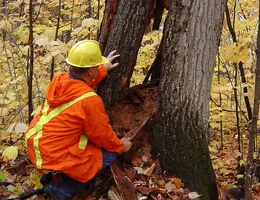
Occassionally you can avoid putting in a face when there is already a face there. Boy, that's rocket science. Often fires will burn out part of the base, we call it a cat face. If the cat face is big enough and it matches the lean acceptably, do your size up, clear everything out needed for escape and safety zone and just put in a back cut. Sometimes we'll just put in small face cuts on one or both sides of a cat face and that'll be just fine.

If you have dry dead wood you have can have a very low risk of barber chair. Some species can make me eat those words, understood. If you have rotten wood across the stem, no risk of barber chair in the area of the rotten wood. Placing bindings chains will do nothing for a rotten stem.

Al57:
Would suggest that bore cutting on rotten wood is not a good idea. Can have the saw set down on a bar that you cannot free with wedges.
 
I can't see a hollow or decayed tree splitting out into a barber chair without any stress in the middle of it.
What you can do is get down into the bottom of the trunk where the wood is sound.
 

Attachments

  • 64792-Pete'splace.webp
    64792-Pete'splace.webp
    123.5 KB · Views: 40
dead or alive fresh or dry when felling a tree/stem with any accuarsy at all me common cents says use a notch and go as low as possable leaving room 4 error if any.(meening u can make ur notch else were upon inspection. think twice and move once. dead trees suck. by the way was this tree in the attached hit by lightning? looks like some kind of critter is livin in there.i thout a cat face was a term loggers use4 identing old sealed over branch scars on a mill log. cat face ??? no spell check edder
crazy.gif
 
[ QUOTE ]
dead or alive fresh or dry when felling a tree/stem with any accuarsy at all me common cents says use a notch and go as low as possable leaving room 4 error if any.(meening u can make ur notch else were upon inspection. think twice and move once. dead trees suck. by the way was this tree in the attached hit by lightning? looks like some kind of critter is livin in there.i thout a cat face was a term loggers use4 identing old sealed over branch scars on a mill log. cat face ??? no spell check edder
crazy.gif


[/ QUOTE ]

Your browser doesn't have built-in spell-checking?
 

Attachments

  • 64904-window.webp
    64904-window.webp
    33.9 KB · Views: 39

New threads New posts

Kask Stihl NORTHEASTERN Arborists Wesspur TreeStuff.com Teufelberger Westminster X-Rigging Teufelberger
Back
Top Bottom