
Dyneema "Deadeye" for sailing (and tree work?)

dmonn

Branched out member
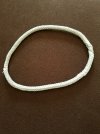
I crew on a sailboat (and do tree work) and the owner of the sailboat showed me a small continuous loop of dyneema that he paid $75 for. I looked at it and said "I can do that for you". Mouth first before checking things out is never a good plan.

I had some 3/16" Amsteel and gave it a try using the procedure in
. It took me forever (6+ hours) to do one, and with all the milking and pulling my hands won't be the same for a couple of days. The rebraid was easier and quicker than I thought, but I didn't follow exactly what was being done for the "first few" braids of the rebraid. I gave it a shot but not really liking the result of that part. Since this was a "test case" it doesn't matter. It's just a little loose for the tiny bit that's exposed.

Have any of you done this splice? I'm curious if it's easier with bigger diameter Dyneema. I know some splices are much easier with larger diameter rope. The end result of what I did looks and feels good. No lumps or distortions. The diameter feels pretty constant. I'm not sure where to use it in tree work, but it was an interesting project.
1630073675814.jpeg
 
I've made my own speeding slings from 12 strand exactly how he said wouldn't work. I've been using them for about two years now with no problem. I think what he doesn't take into consideration when he pulls it apart is that the ends would be buried.

Choking the sling on a limb and not in a straight pull probably also helps splices stay together, but I haven't seen any of mine trying to come out.


I will add, I didn't watch the entire video, just skipped to the crossover to see if it was how I did mine.
 
Doesn’t seem like the locked brummel is necessary with the 72 diameters of bury, only needed when less than ideal bury lengths are possible.
 
  • Like
Reactions: evo
Doesn’t seem like the locked brummel is necessary with the 72 diameters of bury, only needed when less than ideal bury lengths are possible.
Yes. I think he said that in the video. He was trying to make a smaller diameter loop. I think a 72 diameter bury, where the buries don't cross over each other, would be way easier to do. Would you do a single brummel and then bury the two tails?
 
I think the standard is 72 dia. for standing rigging and 60 dia. for running rigging, depends on intended use. One rigger on the Cruiser’s forum says he only does a 45 dia. bury, any more doesn’t increase break strength much.
Crossovers don’t seem to be a concern if a smaller loop is needed, the tapering happened after bury.
A negative for the above splice is the strength loss of a rebraid compared to a normal locked brummel. I’ve been getting about an increase of 15% loss with the rebraids. They break at the second “pass”, where the braiding starts.
I would follow Samson’s end to end splice and not do a brummel if a secure enough bury can be done, it would disturb the rope and not have much, if any benefit.

Another method of grommet making I tried is to take one end of rope and bury into other end, taking the tail up to where it started, carefully easing the blunt cut end into itself. This gives a uniform diameter loop, some crude testing with a larger ratchet strap cranking as much as possible and it held.

One more method is numerous small diameter cord loops done in a cover, something like 2mm dyneema lashing line. It goes around and round and finally is end to end spliced. Somebody makes them, called the Loup. I’ve used the same technique to make double eye hitch cords, they stay flexible up to the eyes so they can be made shorter, resulting in minimal hitch legs.
 

New threads New posts

Back
Top Bottom