












Navigation
Install the app
How to install the app on iOS
Follow along with the video below to see how to install our site as a web app on your home screen.
Note: This feature may not be available in some browsers.
More options
You are using an out of date browser. It may not display this or other websites correctly.
You should upgrade or use an alternative browser.
You should upgrade or use an alternative browser.
Double wrapping the lanyard
- Thread starter Marc_H
- Start date
- Location
- Ankara, Turkey
[ QUOTE ]
[ QUOTE ]
Visor down Pete!
[/ QUOTE ]
I was waiting for that!

[/ QUOTE ]
I guessed you were

Do you always tie in side d to side d when using your lanyard or do you ever switch the whole system to the bridge or a front d?
[ QUOTE ]
Visor down Pete!
[/ QUOTE ]
I was waiting for that!
[/ QUOTE ]
I guessed you were
Do you always tie in side d to side d when using your lanyard or do you ever switch the whole system to the bridge or a front d?
The only time I switch to putting my lanyard on the bridge, is If I percieve a risk of the stem splitting. If it split then my ribs and body etc would not be compressed by the stem seperating causing potentially serious or fatal injury and/or suffocation. Ok I would be stuck but that's not a real consideration compared to the other option.
- Location
- Ankara, Turkey
The point you make is an important one.
Remember that this stem splitting scenario can also apply to large horizontal limbs, the same injuries will occur if the large branch splits and pulls you in, maybe break your spine or end up with you needing a colostomy bag for life.
I am almost always on my front Ds when pruning or distmantling a tree. Until I get to the spar stage.
I think that the side D to side D connection is a problem, if you step up into a crotch when tied side D to side D and then suddenly slip your gonna shock load your spine! this is the reason I do not like Gibbs, Gri Gri, Grillon, Trango Cinch, Micrograb etc because they are almost always too fixed to that side D so you are less inclined to switch to the front D or bridge, when you really should.
I just dont like the feeling of being tied in side D to side D, even as a secondary tie in point, say on a large branch walk, to stop you swinging back into the stem.
But I think I am in the minority as many climbers like the side D to side D connection for their lanyard.
Your photos should be embedded in the text so that people can see them Pete.
Remember that this stem splitting scenario can also apply to large horizontal limbs, the same injuries will occur if the large branch splits and pulls you in, maybe break your spine or end up with you needing a colostomy bag for life.
I am almost always on my front Ds when pruning or distmantling a tree. Until I get to the spar stage.
I think that the side D to side D connection is a problem, if you step up into a crotch when tied side D to side D and then suddenly slip your gonna shock load your spine! this is the reason I do not like Gibbs, Gri Gri, Grillon, Trango Cinch, Micrograb etc because they are almost always too fixed to that side D so you are less inclined to switch to the front D or bridge, when you really should.
I just dont like the feeling of being tied in side D to side D, even as a secondary tie in point, say on a large branch walk, to stop you swinging back into the stem.
But I think I am in the minority as many climbers like the side D to side D connection for their lanyard.
Your photos should be embedded in the text so that people can see them Pete.

- Location
- St. Paul, MN
Iorek,
Yes, the VT keeps me further from the spar. When I need to get close, I cinch up my lanyard (whether side-D to side-D or SRT) and let the friction saver hang slack. I'm still tied in twice and the FS is readily available should I need it. It'll grab 'round the spar immediately once my weight comes on again. I like your wrapping opposite technique. Simple. Less rope.
Mahk,
I just felt like trying something different with the Klem. Haven't used it in this application yet.
Yes, the VT keeps me further from the spar. When I need to get close, I cinch up my lanyard (whether side-D to side-D or SRT) and let the friction saver hang slack. I'm still tied in twice and the FS is readily available should I need it. It'll grab 'round the spar immediately once my weight comes on again. I like your wrapping opposite technique. Simple. Less rope.
Mahk,
I just felt like trying something different with the Klem. Haven't used it in this application yet.
- Location
- Ankara, Turkey
[ QUOTE ]
I like your wrapping opposite technique. Simple. Less rope.
[/ QUOTE ]
It works well on a vertical spar, but I would not use it in the situation in pete mctree's first photo about 5 posts ago. check it out. the double wrap in that situation is much better.
I like your wrapping opposite technique. Simple. Less rope.
[/ QUOTE ]
It works well on a vertical spar, but I would not use it in the situation in pete mctree's first photo about 5 posts ago. check it out. the double wrap in that situation is much better.
- Location
- St. Paul, MN
I agree. I still prefer to choke my lanyard and use it SRT in these situations. This offers more freedom of movement than double wrapping D to D, IMO. However, I suppose double wrapping and attaching both terminations to the bridge might offer close to the same mobility.
- Location
- Ankara, Turkey
[ QUOTE ]
I agree. I still prefer to choke my lanyard and use it SRT in these situations. This offers more freedom of movement than double wrapping D to D, IMO.
[/ QUOTE ]
Yes but watch out for that friction hitch if it ever breaks and becomes slack.
I've taken a small fall due to the fact my friction hitch unset itself when I unclipped up my other rope to move down the stem, I sat back expecting to be held as normal by my friction hitch and I just went airbornefor about 9ft onto the ground below. I did not have a back up at that time. Friction hitches on SRT even with a figure 8 or italian hitch back up are unpredictable. They can move fast and slow.
I agree. I still prefer to choke my lanyard and use it SRT in these situations. This offers more freedom of movement than double wrapping D to D, IMO.
[/ QUOTE ]
Yes but watch out for that friction hitch if it ever breaks and becomes slack.
I've taken a small fall due to the fact my friction hitch unset itself when I unclipped up my other rope to move down the stem, I sat back expecting to be held as normal by my friction hitch and I just went airbornefor about 9ft onto the ground below. I did not have a back up at that time. Friction hitches on SRT even with a figure 8 or italian hitch back up are unpredictable. They can move fast and slow.
- Location
- Ankara, Turkey
[ QUOTE ]
However, I suppose double wrapping and attaching both terminations to the bridge might offer close to the same mobility.
[/ QUOTE ]
Yes but your bridge or front Ds are going to start looking that awful busy way. When biners get jammed together on top of each other then you need to undo one and switch it to the other side.
Yeah i like your SRT system
However, I suppose double wrapping and attaching both terminations to the bridge might offer close to the same mobility.
[/ QUOTE ]
Yes but your bridge or front Ds are going to start looking that awful busy way. When biners get jammed together on top of each other then you need to undo one and switch it to the other side.
Yeah i like your SRT system
- Location
- St. Paul, MN
I clip D to D as much as possible because, like you mention, it's easier to retrieve. However, I find myself using the SRT method more often because of the increased stability -stays put, you can set it up to accomodate lean-, and mobility -one attachment point on harness-.
- Location
- Ankara, Turkey
I'm not so sure about your increased stability theory, surely when tied side d to side d then round the branch(not double wrapped) you are creating a triangle, which is far more stable than one point of attachment with the srt system? Unless your talking about heavy leaner situations.
- Location
- St. Paul, MN
When talking stability I am refering to the "rolling" around the spar or limb that occurs when tied D to D. Like on a leaner, as you mention.
I will use a dbl wrap in the same situations as notahacker and Tom.
It really comes down to a positioning and balance thing for me.
I like the Simon Murphy quote!
It really comes down to a positioning and balance thing for me.
I like the Simon Murphy quote!

RogerM
Carpal tunnel level member
- Location
- Louisville,KY USA
what cord do you use on your modified 3wrap TLH? What diameter is it? And thanks for the pics.
- Location
- St. Paul, MN
Roger,
The grey cord in the close-up pic is light accessory. I only used it for the illustration. On my lanyard is New England "Tech Cord", 5mm 5000lb tensile.
The grey cord in the close-up pic is light accessory. I only used it for the illustration. On my lanyard is New England "Tech Cord", 5mm 5000lb tensile.
RogerM
Carpal tunnel level member
- Location
- Louisville,KY USA
Thanks for answering my question. I ruined an aluminum snap
by just girthing it around the limb, weird load angles and such(I somehow compressed the latch to where it wouldn't always close). So, thanks for showing that and giving credit where credit was due. The aluminum snap still serves as a tie down in the back of my truck, but will never support me again.
by just girthing it around the limb, weird load angles and such(I somehow compressed the latch to where it wouldn't always close). So, thanks for showing that and giving credit where credit was due. The aluminum snap still serves as a tie down in the back of my truck, but will never support me again.

TreeCo
Carpal tunnel level member
[ QUOTE ]
I clip D to D as much as possible because, like you mention, it's easier to retrieve. However, I find myself using the SRT method more often because of the increased stability -stays put, you can set it up to accomodate lean-, and mobility -one attachment point on harness-.
[/ QUOTE ]
Very interesting lanyarding TLHamel.
This is the first time I've been exposed to such a lanyard system. I really like it. That three wrap prusic and the way it is tied in and held snug by the double fishermans loop on the lanyard looks quite innovative.
How would you use it as an srt lanyard on a 4 inch diameter limb....like if you were on the outer canopy wanting to prevent a swing in? How would you snug it up around the limb? (pardon me if you've already shown this).
Thanks,
Dan
I clip D to D as much as possible because, like you mention, it's easier to retrieve. However, I find myself using the SRT method more often because of the increased stability -stays put, you can set it up to accomodate lean-, and mobility -one attachment point on harness-.
[/ QUOTE ]
Very interesting lanyarding TLHamel.
This is the first time I've been exposed to such a lanyard system. I really like it. That three wrap prusic and the way it is tied in and held snug by the double fishermans loop on the lanyard looks quite innovative.
How would you use it as an srt lanyard on a 4 inch diameter limb....like if you were on the outer canopy wanting to prevent a swing in? How would you snug it up around the limb? (pardon me if you've already shown this).
Thanks,
Dan
TreeCo
Carpal tunnel level member
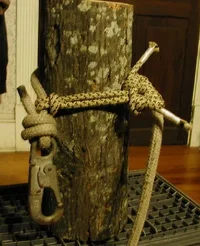
Here is a way I thought may work for snugging up around a small spar or limb. Take the 3 wrap prusic and girth hitch it around the lanyard right at the snap. The snap acts as the stopper knot. Is this taught using the lanyard system you are showing?
The girth hitch at the snap avoids side loading the snap like what would happen if were just attached back to the lanyard and can be tightened up snuggly around the limb(which would be hard to do with a loop in the lanyard big enough to not side load the snap).

The girth hitch at the snap avoids side loading the snap like what would happen if were just attached back to the lanyard and can be tightened up snuggly around the limb(which would be hard to do with a loop in the lanyard big enough to not side load the snap).
Attachments
- Location
- St. Paul, MN
TreeCo,
I like that girth hitch idea. Sort of a pseudo-choker. Personally, I like to keep the loop in my prussik as small as possible. To use that technique, one would need a loop large enough to slip over the snap/biner after forming the girth hitch (as in your photo). On horizontal limbs or in cases where I can pass my lanyard through a crotch, I will clip into the prussik ( as illustrated in one of my photos). If I need to choke the lanyard, on a limb with a steep angle or a spar, I will use a timber hitch or choke against the carabiner (if I feel that side loading or gate loading will be minimal -such as a large diameter spars-). Your girth hitch idea is a good balance between the two. Not quite a "choker", but stays put better than the open loop. This prussik-on-the-lanyard-technique I learned at one of the Treemagineers demos in Mpls. The mod. prussik is my interpretation of Strasser's hitch in the Sherrill catalog.
I like that girth hitch idea. Sort of a pseudo-choker. Personally, I like to keep the loop in my prussik as small as possible. To use that technique, one would need a loop large enough to slip over the snap/biner after forming the girth hitch (as in your photo). On horizontal limbs or in cases where I can pass my lanyard through a crotch, I will clip into the prussik ( as illustrated in one of my photos). If I need to choke the lanyard, on a limb with a steep angle or a spar, I will use a timber hitch or choke against the carabiner (if I feel that side loading or gate loading will be minimal -such as a large diameter spars-). Your girth hitch idea is a good balance between the two. Not quite a "choker", but stays put better than the open loop. This prussik-on-the-lanyard-technique I learned at one of the Treemagineers demos in Mpls. The mod. prussik is my interpretation of Strasser's hitch in the Sherrill catalog.












New threads New posts
-
test
-

-
-
-
-
 Light 14 or 16" narrow kerf bar for 200t or 201t
- Started by southsoundtree
- Replies: 9
-








