Decoding Patterns of Forces

Thanx, here is how i laid it out/logic of
find co-efficient (CoF) of mated materials
to find 'radial CoF' multiply mated material's CoF by PI (4 contact sides - corners = 3.14..)
use Euler's magic number as base for compounding growth/decline progression
>>raised to the power of the 'radial co-efficient' x radian half circle arcs applied
= ratio of input force to output force
>>as a leveraged brake device hold reduced output side to have leverage hold over greater input force side.
.
rope-brake-capstan-equation.png

.
Euler's number works cuz is close to logarithm of 1.
Same number is used for compound interest, population growth rates, disease spread etc.
 
Capstan equation for brake force has more to do with using as pipe wrench against radial resistance than as windlass were a pipe would be more of just take up reel for linear lift resistance. Same tools against different points of resistance of different types change the machine were force input 'voltage' into same leverage multiplier forcing same lacing onto same host; force just terminates against different load types.
.

rope-and-board-windlass-lift-and-pipe-wrench.png

.
Dry ashes can help grip also. Pipe etc. can get rope burns from fight to turn if lots of resistance. Sliced inner tube /rubber flexible sheet can give better grip than ashes and some surface protection against marring if issue.
 
Last edited:
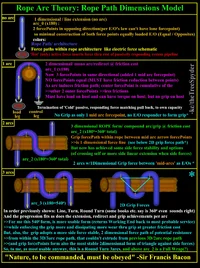
Dimensions of Arcs model theory of knotting on capstans etc. but w/o maths to show why 3arc Round Turn type based hold against side forces even as lengthwise pulls on host mount by force dimensions. For us pertains very much to friction hitches and mounting Porty to take massive forces not properly at right angle to host but lengthwise along host mount length (be it tree or rope etc.). Also, more examination of why i maintain that Round Turn (RT) is 540degrees/3 x 180arcs, and 360degrees/2 x 180 arcs is less usable 'Full Wrap' as distinction, tho, both are round and full!
.
ABoK specifically states not to use Timber Hitch on lengthwise pull, to use Killick and not expect miracles! Other ways to go, but not with just a single 180 arc on the support unless perpendicular pull across support, NOT along host length..
.
The rope is a form-able mechanical tool that you load to forge as structure; instead of heat, hammer or nail etc. But still must follow the rules of loading, and inline is always and always best against linear load force, and right angle of pull is just to opposite extreme the same worst angle. Rope forms so magically easily, it doesn't remind us it is subject to same laws when loaded when we are building like rigid device structure elements may hint. Each can be a lesson of the other etc., because live by same laws/forces, giving different facet of view to same gem center.
.
rope-arc-theory-rope-path-dimensions-model.png
 
Last edited:
It makes sense that when the rope makes a 540 degree wrap around the object it's more stable laterally than a 360 degree wrap because there's more friction involved. Friction simply acts opposite the direction of motion or impending motion regradless of what direction the motion is. If pulling on the end of the rope, the friction force is inline with the rope. If the object is pushed through the wraps of rope, then the friction force is acting inline with the object.

In other words, it's simply a matter of the total amount of friction in the system that leads to it's lateral stability rather then the geometry of it. After considering it a little further and looking at the derivation of the capstan equation in a statics book, I went back and deleted the equation I posted a few posts earlier. Accounting for the angle of pull as I did would be correct if looking at the amount of torque applied to the capstan or something of that nature but it wouldn't apply to the tension in the line because the capstan equation is just a derivation of the basic friction force equation, Friction Force = Friction Coefficient * Normal Force.
 
Part of this was to old argument as sometimes 360 is referred to as "Round Turn".
.
...
In other words, it's simply a matter of the total amount of friction in the system that leads to it's lateral stability rather then the geometry of it...
i think in bigger pond engulfing this, that is true nowhere else; that geometry of forces is a ruling factor in all; and anytime replacing geometry with shear force can be very costly force wise.
.
So, basically believe that in 1 or 2 arcs on support/host mount whose CoF mating to collectively match that of 3arcs (2 scenarios of different material pairs) would NOT give the same stability of positive mechanix of the (venerable) triangle force pattern giving most 2D stability form w/fewest joints(as shown in 3 arcs); even when it is invisible force pattern and not visible strictly in form of rope itself, but rather points created from. This would show more/be expressed more in rope/rope lower CoF ranges. But once traced to legitimately, would accept as part of general formulae for all, as friction is in formulae; has a position in formulae, just set to different value each. If is as 2 ruling factors in friction hitches etc. would look to be the 2 (changing)unequal halves to the whole of support in such builds i'd think.

Will also say, this is all theoretical; but what i believe i have witnessed, even many times felt within own bod and how defined, models groomed to for best result and how same pattern shows is just part of larger domain as same in parallel examples, this math etc .
 
Last edited:

New threads New posts

Kask Stihl NORTHEASTERN Arborists Wesspur TreeStuff.com Teufelberger Westminster X-Rigging Teufelberger
Back
Top Bottom