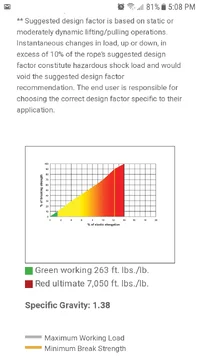
Now I’m not trying to debate whether or not one type of rope versus the other is better or worse. Most of the arguments I’ve seen come up on this issue seems as though it comes down to personal preference.
However, a thought occurred to me. To preface, this may be more of a question for a material engineer, but I was thinking about why manufacturers may not advertise lines like the Yale 11.7 for Srt if they do work so well for some people (after the break in period of course).
The first thing to come to mind is that there may be a safety aspect. So there’s a break in period to get all of the stretch out of a 24 strand Yale 11.7, if you’re using that on ddrt, you’re using the rope on a 2:1 system, therefore, in theory, it would take the rope twice as long (if there is even enough force to push it to its limit) to stretch to its max limit than if you’re using the rope on a 1:1 system.
If you’re using this on an srt system you’re working on it 1:1 so you’re taking a rope that’s designed to be used on a 2:1 system and putting twice as much strain on the line.
The questions are;
a) with this all in mind, is the integrity of the rope deteriorating quicker being used as an Srt line when it Is designed and sold exclusively for the purpose of ddrt?
B) if you take all of the elasticity out of a ddrt line, will the cover and the core still be sharing the proper amounts force when loaded?
C) there are lines specifically designed for both srt and ddrt, and the changes in the designs of the rope are pretty distinct, it’s not like they’re making one small change to the line and then marketing it as a new hybrid line, so what makes those better?
D) is it safe to climb on a ddrt line at 1:1 ratio after one has taken as much elasticity out of it as possible? Does it change the properties of the rope? Should you retire it twice as soon as you normally would retire that specific rope when used as ddrt?
E) does none of it matter cuz we’re tree climbers and do everything to ropes that we shouldn’t be doing anyway
However, a thought occurred to me. To preface, this may be more of a question for a material engineer, but I was thinking about why manufacturers may not advertise lines like the Yale 11.7 for Srt if they do work so well for some people (after the break in period of course).
The first thing to come to mind is that there may be a safety aspect. So there’s a break in period to get all of the stretch out of a 24 strand Yale 11.7, if you’re using that on ddrt, you’re using the rope on a 2:1 system, therefore, in theory, it would take the rope twice as long (if there is even enough force to push it to its limit) to stretch to its max limit than if you’re using the rope on a 1:1 system.
If you’re using this on an srt system you’re working on it 1:1 so you’re taking a rope that’s designed to be used on a 2:1 system and putting twice as much strain on the line.
The questions are;
a) with this all in mind, is the integrity of the rope deteriorating quicker being used as an Srt line when it Is designed and sold exclusively for the purpose of ddrt?
B) if you take all of the elasticity out of a ddrt line, will the cover and the core still be sharing the proper amounts force when loaded?
C) there are lines specifically designed for both srt and ddrt, and the changes in the designs of the rope are pretty distinct, it’s not like they’re making one small change to the line and then marketing it as a new hybrid line, so what makes those better?
D) is it safe to climb on a ddrt line at 1:1 ratio after one has taken as much elasticity out of it as possible? Does it change the properties of the rope? Should you retire it twice as soon as you normally would retire that specific rope when used as ddrt?
E) does none of it matter cuz we’re tree climbers and do everything to ropes that we shouldn’t be doing anyway