Crown lift too high?

[ QUOTE ]
If the client insisted on half the branches being removed, the client was dumb.

[/ QUOTE ]

Wrong,

I dislike your extremist language Guy, who the hell are you? Mr Arbor Taliban?

These people own these trees, they can paint them blue if they want, it does not make them dumb.

If you want to reach out to people and help them understand trees better, try and temper your emotionally charged militant tendency to put trees above people.

Arboriculture is 90% about people and 10% about trees.
 
I don't believe there is much in the way of math that could prove the trees would be more "top heavy" if more limbs were removed by raising the crown.

As a matter of math, physics and stats, if lower limbs were raised, the trees should hold up to wind much better - that's excluding any thought about health in the next few years, or future stability.

Too many people getted mixed up about the concept of "top heavy" and whether its applicable or not. Trees are not like an SUV that needs a lower center of gravity, because SUVs are not anchored. Trees are anchored, and any removal of limbs for any reason, makes the top less heavy in the "short-run" no matter how we look at it.

"Top heavy" is best discussed as a matter of a too much foliage developing in the upper crown, in relation to too little stem growth or too little root growth (or, deteriorating roots).

In fact, the weight at top would be the same. If anything, they could be called "bottom light".

But it is doubtful that any more limb removal could be beneficial to trees with as little foliage as those have for all that trunk. So if you didn't think raising was useful - I'd agree with you there.

Maybe related, or not, but tree in forests - especially pines and conifers like Douglas fir - raise their own crowns naturally as foliage dies beneath in the shade. And many like that grow marvelously.

Except.... that kind of situation is among groves where the trees are not exposed to the same wind conditions, or the same kind of direct sun on the bark.

Excessive crown raising could be viewed as a giant size version of lion tailing. In lion tailing, the ends of the limbs don't become more "end heavy" because no weight was glued or added on. But the ratio of living foliage and twigs to the size of the limb becomes unhealthy and rediculuous.

Likewise with trunks and crowns.
 
[ QUOTE ]
[ QUOTE ]
If the client insisted on half the branches being removed, the client was dumb.

[/ QUOTE ]
Wrong,
I dislike your extremist language Guy, who the hell are you? Mr Arbor Taliban?

[/ QUOTE ]1000 pardons memsahib; the people were not dumb. They were underinformed. I'm sorry that bluntness offends you; you're not the first, and I do what I can to temper it.[ QUOTE ]

Arboriculture is 90% about people and 10% about trees.

[/ QUOTE ]I'd flip those around, generally. Maybe 70% trees, 30% people. I won't apologize for taking an arborcentric view. I'm an arborist, after all, and I work for people that value trees and do not expect me to kiss their aspirations for meeting unrealistic landscape goals. Just like you did not take on that raising job.

Tali what? To paraphrase Barry G., Extremism in the defense of growing trees is no vice.

Mario, the trees are indeed topheavy now, or bottom light if you prefer, and will be a much higher risk to fail if they survive and keep growing. But who knows, the trees may be standing longer than we are. In which case the people will who ordered the raising are geniuses, and tocmal and I both idiots!

grin.gif
 
[ QUOTE ]
I'd flip those around, generally. Maybe 70% trees, 30% people. I won't apologize for taking an arborcentric view.

[/ QUOTE ]

Lets see you give 70% of your income to tree-planting programs in Africa.

Arboriculture is a western luxury not a way of life.
smirk.gif


[ QUOTE ]

Tali what? To paraphrase Barry G., Extremism in the defense of growing trees is no vice.


[/ QUOTE ]

Guy,

I certainly wouldn't be quoting Barry Gibbs from the BeeGees!!! WTF did he know about trees?
grin.gif


Incidently why is the palm of his left hand made of plastic??
shocked.gif
nice teeth.

barry%20gibb.jpg
 
Sure...

I like the "bottom light" for now (1st year anyway
smirk.gif
).

Mainly because the upper trunk is bearing the same identical load immediately after the weight removal, and the entire trunk - right after removal - is bearing quite a bit less weight.

The initial stage is entirely weight loss.

But in the long-run, that kind of skin-the-cat or lion-tailing can cause some real issues.
grin.gif
 
[ QUOTE ]
As a matter of math, physics and stats, if lower limbs were raised, the trees should hold up to wind much better

[/ QUOTE ]

I don't see your logic?

Surely if the tree has an even frequency of branches all the way up the stem it is more likely to dissipate the force of the wind throughout the entire length of the stem rather than the specific critical point of bending where the severely crown lifted tree would orientate its wind absorbtion/dampening forces?

These trees are severely lifted, and what this has created is an increased risk of stem snap at a higher point where the trees have not been growing and adding secondary thickening to prepare for the unseen event of being crown lifted. This is how I understand Mattheck's 'Axiom of Uniform Stress'

91058-crownlift2.JPG
 
[ QUOTE ]
[ QUOTE ]

Arboriculture is a western luxury not a way of life.

[/ QUOTE ]Arboriculture has been practiced since ancient times in many cultures. It may not be your way of life but it is mine.

I don't know how Barry's hand melted. Maybe some gold water will cure him.
santa.gif


Mario I do not know what will cure your denial of leverage.
tongue.gif
 
There will forever be some customers that insist on having things done the way they want - NO MATTER WHAT. We've walked away from countless situations like this and inevitably another company ends up doing the job.
P.S. Those are some real nice looking Pom Poms
 
[ QUOTE ]
[ QUOTE ]
As a matter of math, physics and stats, if lower limbs were raised, the trees should hold up to wind much better

[/ QUOTE ]

I don't see your logic?

Surely if the tree has an even frequency of branches all the way up the stem it is more likely to dissipate the force of the wind throughout the entire length of the stem rather than the specific critical point of bending where the severely crown lifted tree would orientate its wind absorbtion/dampening forces?


[/ QUOTE ]

The reason that you don't see my logic, is that you are discussing "frequency" or frequencies. That's more a matter of timing, or radio signal stuff.

If wind strikes a tree, wind is striking the entire tree.

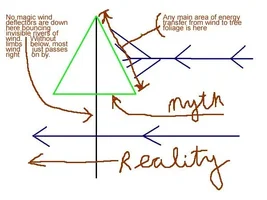
If we remove some of the limbs - like below - the tree is not even going to be impacted by that zone of wind anymore: its just going to pass right on by.

The upper portion will still receive the same amount force - very close to the same.

So the removal of foliage, whether sections, or an evenly pruned-out 1 out of 4 branches - the force of the wind on the entire trunk is going to be reduced, not increased.

97920-untitledcopy.jpg


Removal of the lower limbs - initially - does not suck strength out of the trunk, does not shrink the trunk.

Removal of lower limbs - allowing all the wind to just zip-on-by - does not produce some magic energy transfer as if we were talking about electric current loads or hydraulics.

Someday, the tree may weaken and take damage. But on the actual day of crown raising, if there was a storm that night, the trunk will be under less of a load as long as other trees were not removed. In fact, its rather opposite of what you indicated.

Because the lower region will not be taking energy since the lower foliage is missing, the lower trunk will be even more capable of handling the energy acquired at the upper canopy. And its virtually only the upper canopy which will acquire energy. Whatever wind impacts the bare lower trunk will be nearly inconsequential compared to the massive energy it could acquire when limbs were there to block the force of the wind.
 

Attachments

  • 97920-untitledcopy.webp
    97920-untitledcopy.webp
    28.7 KB · Views: 27
thats natural target pruning, if your target is to prune too high, naturally!
one of the biggest drawbacks to that type of pruning (besides over-camphor stimulation of auxins and similiar chemical response) is that it leaves little option for the professional arborist except for SRT to access the tree in the event of aerial rescue or scion collection, either of which, in my opinion, is a very real issue that could be complex at the time it comes to hand.

Climb high, climb fast, climb safe! SRT
 
This may sound like a silly, but do you think that because they removed all of the weight from the lower part of the tree, the tree becomes more suseptible to wind because it takes less wind to move the tree because of all the weight lost?? I am just thinking when I remove big White Spruce trees and the more of the branches you remove, the more and more the tree will move in the wind. Not sure if the extra movement will put much more stress on the trunk.
 
[ QUOTE ]

Because the lower region will not be taking energy since the lower foliage is missing, the lower trunk will be even more capable of handling the energy acquired at the upper canopy. And its virtually only the upper canopy which will acquire energy. Whatever wind impacts the bare lower trunk will be nearly inconsequential compared to the massive energy it could acquire when limbs were there to block the force of the wind.


[/ QUOTE ]

Is this some kind of joke mvaden?

By removing the lower limbs you have raised the centre of gravity considerably, the wind only affects the top of tree pushing it out further than before due to the higher centre of gravity and the lack of lower limbs, thereby increasing the risk of windthrow.

Your diagram is interesting thanks, but your conclusions are bizarre to say the least.
 
If we take any device; and raise the CG; we must then widen the base to have the same ratio of stability. Of curse this tree was not/ could not be given that. In fact, in time; due to less nutritional disbursemeant needs to the lower branchings(that don't exist) and likewise less mechanical support needs to same; there will be a comparative taper loss to what it would have been. And rootwise as well.

Just like a short splice compared to a long splice; the more sudden the change in taper; the more impacting the forces are; and there is comparative weakness.

This is compounded by more sail in the top; so as to make sharper/ less spread out forced bending in winds. Trees in woods are different scenario; in that they all block wind and provide upper support to each other.

But, in these urban/seperate trees that doesn't happen. Also, the roots of these trees will not spread out increasingly further to chase their life giving water. The water can deliver to the trunk. More spread out rooting gives more leveraged hold by this distance, as well as binding more soil mass/weight for increased anchoring. In fact with less green to transpirate water, less water will be pulled and less roots will be 'kept'.
 
winters coming on, right? Why dont we all make a date to be back here 1 year from the date and post some updated pics.

Too much, too high, i think, but I'll bet the trees are still standing a year from now. Probably ten years from now.
 
[ QUOTE ]
[ QUOTE ]

Because the lower region will not be taking energy since the lower foliage is missing, the lower trunk will be even more capable of handling the energy acquired at the upper canopy. And its virtually only the upper canopy which will acquire energy. Whatever wind impacts the bare lower trunk will be nearly inconsequential compared to the massive energy it could acquire when limbs were there to block the force of the wind.


[/ QUOTE ]

Is this some kind of joke mvaden?

By removing the lower limbs you have raised the centre of gravity considerably, the wind only affects the top of tree pushing it out further than before due to the higher centre of gravity and the lack of lower limbs, thereby increasing the risk of windthrow.

Your diagram is interesting thanks, but your conclusions are bizarre to say the least.

[/ QUOTE ]

It's not like a fan blade or machine part that has a pivotal pin in the center. And it can't be confused with a car's center of gravity - that concept - as the tree is anchored into the ground, whereas a vehicle is not. The relevant part is trunk diameter, strength of wood and tree health.

To repeat the lesson, if the lower foliage is removed, the size and strength of the trunk remains virtually the same. Except that instead of bearing the full load of foliage, its only bearing a lesser load of foliage.

That doesn't mean that health issues won't develop in time, but at the immediate moment of removal, its the trunk that bears the load of upper limbs, not the lower limbs.

A tree could become top-heavy later on in the future due to deteriorated wood and roots in relation to the foliage above, but thats a separate condition and issue.

In simplest terms:

If you remove a bunch of weight off the bottom of a tree, the trunk is no less strong at all, and can support the weight even better intially, due to the reduced load.

Lower limbs can dampen wind, only if they receive the energy. And the transfer is then sent to the trunk. If lower limbs are gone, they are not there to receive the energy, nor will they then transfer it to the trunk. Because the wind just blows right through.

<font color="blue"> I think what we need to do, is send Tokmal on a long hike for a lesson...

Strap a 100 pound pack on his back and shoulders. Then strap another 100 pound waist pack on his hips.

Let him hike around and learn that when he takes off the 100 pounds from his waist, it doesn't make him any weaker, and that the "top-heavy" aspect is dust in the wind.

</font>

That's about how rediculous it is to talk about a tree being top-heavy at the moment of crown raising. Sure, whatever weight it has is higher, but nobody injected a magic liquid into the trunk that made it melt.

Otherwise, start writing to the owners of the space-needle in Seattle, and tell them that they need to weld on weight at the middle of the supports equivalent to the structure's top, to make it less top heavy, and stronger....

They would laugh you to scorn...

Think of it like a flag pole if needed. If a flagpole is erected that's engineered to hold two big flags in the wind, one at the top, and one at the middle, removing the lower flag does not make the pole any less strong, but puts it under less of a load.

Can you see somebody yelling at the guys who remove the flags "hey, don't take that lower flag off, you'll make the flagpole top heavy !!"

<font color="brown"> The guys with the flags would just shake their heads in wonder. </font>

Edit Extra thought...

It came to mind today, for those getting wrapped-up in the center of gravity, that if you include the weight of the root system into the equation, it may be possible to lower the center of gravity by crown raising on some particular trees, rather than raising it. Just depends on how much and on what kind of tree.

That's because the roots and lower trunk, will now be a larger percentage of overall tree weight, than previously.

So for anyone willing to take a hike down the center of gravity trail, remember that a tree's weight does not start from the soil line and upward. a tree's weight included the entire tree.

Go figure that one...
 
[quote
<font color="blue"> I think what we need to do, is send Tokmal on a long hike for a lesson...

Strap a 100 pound pack on his back and shoulders. Then strap another 100 pound waist pack on his hips.

Let him hike around and learn that when he takes off the 100 pounds from his waist, it doesn't make him any weaker, and that the "top-heavy" aspect is dust in the wind.
</font>


[/ QUOTE ]

I still don't agree Mr Vaden.

I think your view of the world may be warped.

The heavily crown lifted tree is more not less prone to windthrow.

The centre of gravity has been raised, thereby increasing the risk of windthrow. I'm talking about trees which have been lifted but still have a large amount of branches and foliage up top.

I never said they were top-heavy.
 
I agree. With the hiker analogy, I liken it to my old favorite sport of trail running. When you take a corner you are less likely to fall over if you have weight in the middle as well as up high. Same for a vehicle; more tipsy with the roof rack packed.

I think "top-heavy" is a useful concept for hikers as well as trees. But I don't want this poor dead horse to get whupped up on any more either.
 

New threads New posts

Kask Stihl NORTHEASTERN Arborists Wesspur TreeStuff.com Teufelberger Westminster X-Rigging Teufelberger
Back
Top Bottom