












We purchased our own crane recently and have since been getting a lot of inquires to set truss's. I haven't set truss's for 15 years and at that time I certainly wasn't on the crane. Can anyone recommend a good source for a decent spreader bar and an average size/ capacity to use for this? Its obviously not what we will be doing every day but Im definitely not against keeping the crane busy....Thnaks
Navigation
Install the app
How to install the app on iOS
Follow along with the video below to see how to install our site as a web app on your home screen.
Note: This feature may not be available in some browsers.
More options
You are using an out of date browser. It may not display this or other websites correctly.
You should upgrade or use an alternative browser.
You should upgrade or use an alternative browser.
crane spreader bar
- Thread starter Jasonk
- Start date

Caldwell is a very popular name brand. www.uscargocontrol.com/spreader-beam/caldwell

BigWood
Participating member
- Location
- Toronto, Canada
Why do you need a spreader bar for trusses. I do a bunch and use a 2part cable spreader with 20 ft legs and 2 4ft webbing slings to choke the trusses and attach them to the cables.

You haven't set too many seventies or even sixties for two foot centres then, one wrong move or the guy on the tag line jerks too hard and they'll fold up like a wet noodle.Why do you need a spreader bar for trusses. I do a bunch and use a 2part cable spreader with 20 ft legs and 2 4ft webbing slings to choke the trusses and attach them to the cables.
Two of three contractors who asked me to set trusses asked if I had one. I'm guessing they typically use one.Why do you need a spreader bar for trusses. I do a bunch and use a 2part cable spreader with 20 ft legs and 2 4ft webbing slings to choke the trusses and attach them to the cables.

dbl612
Participating member
- Location
- torrington, ct.
it all depends on the shape of the truss and where the panel points are located

allmark
Participating member
I have been using these for trusses for years. Well worth the investment
http://www.gripperhook.com/GripperTrussHook/GripperTrussHook.asp
As for the spreader bar, They are needed for the longer trusses especially since they aren't built well these days. Up to 30' is usually ok without them and sometimes longer but even with the spreader Ive seen quite the bow in flimsy 80' trusses. Having control is very important when worjers are standing on a top plate with no tie in..
There are different types of spreaders. I use 2 types. 1. Hooks directly to the hook with 2 spots on the bottom to attach truss rigging to and 2. has 2 ancorpoits at top for slins to attach to the crane with 2 at the bottom for slins for the truss. This type requires more height above the truss to the hook.
1.http://shop.lkgoodwin.com/product/20-5-10-model-20-low-headroom-mult-spread-lifting-beam/22522
2.http://shop.lkgoodwin.com/product/32c-5-4-6-model-32-adjustable-spreader-beam/23521
http://www.gripperhook.com/GripperTrussHook/GripperTrussHook.asp
As for the spreader bar, They are needed for the longer trusses especially since they aren't built well these days. Up to 30' is usually ok without them and sometimes longer but even with the spreader Ive seen quite the bow in flimsy 80' trusses. Having control is very important when worjers are standing on a top plate with no tie in..
There are different types of spreaders. I use 2 types. 1. Hooks directly to the hook with 2 spots on the bottom to attach truss rigging to and 2. has 2 ancorpoits at top for slins to attach to the crane with 2 at the bottom for slins for the truss. This type requires more height above the truss to the hook.
1.http://shop.lkgoodwin.com/product/20-5-10-model-20-low-headroom-mult-spread-lifting-beam/22522
2.http://shop.lkgoodwin.com/product/32c-5-4-6-model-32-adjustable-spreader-beam/23521
BigWood
Participating member
- Location
- Toronto, Canada
Those grippers are cool.I have been using these for trusses for years. Well worth the investment
http://www.gripperhook.com/GripperTrussHook/GripperTrussHook.asp
As for the spreader bar, They are needed for the longer trusses especially since they aren't built well these days. Up to 30' is usually ok without them and sometimes longer but even with the spreader Ive seen quite the bow in flimsy 80' trusses. Having control is very important when worjers are standing on a top plate with no tie in..
There are different types of spreaders. I use 2 types. 1. Hooks directly to the hook with 2 spots on the bottom to attach truss rigging to and 2. has 2 ancorpoits at top for slins to attach to the crane with 2 at the bottom for slins for the truss. This type requires more height above the truss to the hook.
1.http://shop.lkgoodwin.com/product/20-5-10-model-20-low-headroom-mult-spread-lifting-beam/22522
2.http://shop.lkgoodwin.com/product/32c-5-4-6-model-32-adjustable-spreader-beam/23521
I guess trusses get built different op here for snow load or code. Last ones I did were 70'ers on a barn and they wiggle a bit but that's it. The only problem we've ever had was an 80' broke at a knot when my boss was standing it out of the pile.
Interesting to see how it's done in trump land. I know I'd hade screwing with a spreader bar.
So, query. How many attachment points do you guys use from the bar to the truss? Does it depend on how long the truss is or is it strictly to keep the hook points more vertical?

allmark
Participating member
Usually just 2 points of attachmentThose grippers are cool.
I guess trusses get built different op here for snow load or code. Last ones I did were 70'ers on a barn and they wiggle a bit but that's it. The only problem we've ever had was an 80' broke at a knot when my boss was standing it out of the pile.
Interesting to see how it's done in trump land. I know I'd hade screwing with a spreader bar.
So, query. How many attachment points do you guys use from the bar to the truss? Does it depend on how long the truss is or is it strictly to keep the hook points more vertical?
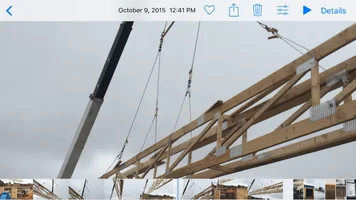
Try to pick these trusses without a spreader bar. The point I'm making is get a couple spreader bars and keep them with you if your going to be setting trusses. I've showed up for what I figured was a simple truss job and there is a half a roof assembled that was maybe 30 x 40 and weighed 5 k.
I live in in the part of Ontario that has one of the heaviest snow loads. Sometimes I can set 60 ft trusses with a simple two parts of line and sometimes I have to rig a spreader, it usually depends on the truss spacing if there two ft centres they won't be as heavy, if they're 32" or 48" they might weigh a hundred pounds more and no spreader is required. Even if you can manage without a spreader a fool on the tag line can fold up a truss by jerking the end of the truss around. There aren't many things in life I'm an expert at but setting trusses is one of them, I am a builder by trade and have sat on the peak setting trusses for everything from custom homes to 15,000 ft dairy barns, and in the last ten years I have ran the crane setting hundreds of sets. So take my word, if you do much truss work sometime you will wish you had a decent spreader and hopefully it won't be after a truss folds up and hurts or kills someone.
Someone asked why a spreader is better than a simple two part. The reason is a two part is always putting inward pressure on the truss where if you use a spreader it will lift vertical or even better you can toe in a bit.
Sorry for rambling but it is important that operators use the proper equipment, and I'm the first to admit my bars stay pinned to the crane unless I really need them because they are a pain from the time you unpin them till they're stowed again. And in the immortal words of forest gump " that's all I've got to say about that"
Thanks, is there a particular spreader bar that you would recommend for the most common simple jobs?View attachment 43360
Try to pick these trusses without a spreader bar. The point I'm making is get a couple spreader bars and keep them with you if your going to be setting trusses. I've showed up for what I figured was a simple truss job and there is a half a roof assembled that was maybe 30 x 40 and weighed 5 k.
I live in in the part of Ontario that has one of the heaviest snow loads. Sometimes I can set 60 ft trusses with a simple two parts of line and sometimes I have to rig a spreader, it usually depends on the truss spacing if there two ft centres they won't be as heavy, if they're 32" or 48" they might weigh a hundred pounds more and no spreader is required. Even if you can manage without a spreader a fool on the tag line can fold up a truss by jerking the end of the truss around. There aren't many things in life I'm an expert at but setting trusses is one of them, I am a builder by trade and have sat on the peak setting trusses for everything from custom homes to 15,000 ft dairy barns, and in the last ten years I have ran the crane setting hundreds of sets. So take my word, if you do much truss work sometime you will wish you had a decent spreader and hopefully it won't be after a truss folds up and hurts or kills someone.
Someone asked why a spreader is better than a simple two part. The reason is a two part is always putting inward pressure on the truss where if you use a spreader it will lift vertical or even better you can toe in a bit.
Sorry for rambling but it is important that operators use the proper equipment, and I'm the first to admit my bars stay pinned to the crane unless I really need them because they are a pain from the time you unpin them till they're stowed again. And in the immortal words of forest gump " that's all I've got to say about that"
I have 3, two adjustable to ten feet rated for 5 ton and one adjustable from 16 to 24 I keep the small one's with me all the time and use them on hvac units, standing wall sections and medium sized trusses .... They're spendy though. I just got mine from the outfit that I buy my rigging from just get on the internet and start comparing price and design and find one that works for you . There's not much to them, your paying for the engineering and inspection, I also have mine certified every year when I get the crane done. Peace of mind ain't cheep, but I don't have to look over my shoulder and the way I look at it if something is broken I want to know. One of the biggest problems I see is if you don't have a good selection of rigging you might be pressured into Jerry rigging something, it doesn't look professional and mistakes in this business can have great consequences. Good luck. It isn't really as scary as I make it sound you just have to be careful.
Last edited:
hseII
Participating member
- Location
- United States
Two of three contractors who asked me to set trusses asked if I had one. I'm guessing they typically use one.
Ask them for specs on what the trusses call for they normally set.
Caldwell is a good name, as mentioned above.
One thin to consider is a larger spreader with movable connection points: basically a Spreader beam with A heavy plate running across the bottom. Holes are In The plate to accommodate different spans.





















