
Could Save My Life Some Day...

rawtree

Participating member
Location
Mid Atlantic
Break-away Pole Strap -

(Note: no matter how you choose to use or modify this technique it is ALWAYS implied that you have a second form of protection attached to an entirely independent anchor point other than what your lanyard is triangulated to!)

Check this out. Takes a while to trust it. Never had one fail, yet. Never tested one to failure; probably should if only for my brain’s sake. This might be the 3rd set of split rings I’ve replaced due to use deformities in 10 years.
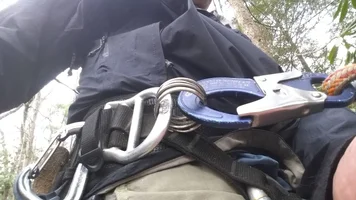
Break-away Lanyard Rings_20150410_183948.webp
 
Last edited:
Are those just key rings? I'm in no way criticizing your use of them. I can't believe I haven't thought of that. I've used small non-rated biners before for the few situations that call for a break-away lanyard
 
Yeah, that stupid/simple. Typically I've swung over to some stone dead and fruiting lead and a lot of times I planned ahead and have my spikes available where I can really get comfortable exactly where I want to be and sit back into that lanyard and go to work. Trust me, the harder I sit back the more often I look down at those cheap ass rings to make sure they're not deforming too much. I think the reason I've never really tested them to failure is cause I always want to be a little scared cause I believe that's what's kept me healthy to this ripe age. That's what I believe...
 
To keep it simple and safe only do this in those questionable scenarios and as mentioned, have an alternate anchor point.

Use a basic lanyard with friction hitch. Make sure there is no stopper knot or spliced eye at the tail end, things go wrong just pull the friction hitch towards you and let the lanyard slide right out of the knot.
 
To keep it simple and safe only do this in those questionable scenarios and as mentioned, have an alternate anchor point.

Use a basic lanyard with friction hitch. Make sure there is no stopper knot or spliced eye at the tail end, things go wrong just pull the friction hitch towards you and let the lanyard slide right out of the knot.
Beware 'just'.
 
If you have a lanyard snapping in like that you’re not on a rated system anymore so it could only ever be a secondary you couldn’t climb on it as your main?
On that note all parts of a climbing system must be rated for 5,000lbs mbs minimum so can that actually count as a second tie in?
What would the ministry say if they saw that on an inspection? You have modified a safety apparatus in an unrated way so I’m wondering if you got hurt are you covered since you intentionally voided a life line? You’d never put that between your fisherman and your biner so why is there ok?

I get the point the circle of death is scary but there are ther ways to mitigate such potential problems
 
Also I tried to dig into this to no real answers yet but tear away rings, lanyards, etc. What is a reasonable weight?

I first wondered this with a chain saw lanyard the first one I was taught to make was simple 3 strand 3/8” yellow poly spliced a loop on one end to cow hitch the saw and a right eye on the other with a brass dog snap on the other. My wonder was if my saw got jammed while I was taking a piece what weight would be actually ok to withstand? But a 300 lbs piece falling 3’ gets to 600lbs fast and these numbers are not out of the question.

Risk makes you wonder
 
No way I would climb on that. Even if I was tied in with another line all the time and the lanyard was a secondary, it’d be unnerving. But what about when you advance your line or position a redirect and the lanyard is your primary? Not for me.
For those sketchy, might break out moments or need to bail.
With a separate primary lifeline SRT tie in, of course.
I’ve used a piece of throwline tied to my side D, then clip the lanyard into that.
The way I do it now is a dmm XSRE biner, clipped to my side D and lanyard snap. I trust it to hold while I work, but in a worst case scenario, I know it will break before my spine
 
Breakaways are accepted as head-slapping brilliant or butt-kicking idiotic.

Given a qualifier or two, like in the first post, why not? This is not primary support. Its a balancing act. Think of the alternative

I always advise having a breakaway on both ends though. Just a little reduction in the possibility of having the snap come whipping back around and knocking teeth out.
 
i'd think should have a known, predictable breaking strength,
even as/ especially as a mechanical overload 'fuse'/breakaway.
.
Looks like a harder/flimsier 'double jointed' target ring to hit with snap.
>>If going this route i'd have intermittent red tape to bind multiple rings to 1 target for snap.
>>intermittent to maintain inspectability
>>also tape to leave distance X of end of ring exposed as a 'creeper' flag
.
1x i wished i had a breakaway on lanyard on split/peel during hinging down a horizontal tied to
>>hand saw cut cleanly thru taut lanyard instantly (few lessons there alone!) got me free and chunk hinged down /dropped ok then.
i was worried cracked some ribs when it caught lanyard and slammed me down against spar that was splitting. Found unexpected rot toward bottom side from old wound that seemed like culprit.
.
Just another reason prefer hinging across for 2 separate /not combined paths of force and movement:
>>Where gravity is pulling down force wise against long axis of hinge length
>>but folds more easily to side across narrow axis of hinge.
vs. folding straight down into harshest gravity pull:
>>Where thickness of hinge is support, but also resistance to fold as an all-in-one
>>can't divide and treat paths with separate leverages.
.
Similarly in felling kinda prefer to not feed into most direct/harshest pull of gravity; but rather to the side some basically for 2 reasons:
>>Stay sharp on skills
>>theoretically softer hit, as not feeding directly into gravity pull, and more of across hit
.
In tree hinging and especially rigging (for less downard pressure on rope and support) stay on plan of some sideways force , to buffer back downward forces.
>>decrease cos (directness of hit column)/increase sin(indirectness, side forces) by changing angle to re-apportion the tree force potential to less direct/some side force added scenario.
 

New threads New posts

Back
Top Bottom