As we often note here, identification of macro-fungi from snapshots is not only questionable, it's often foolish.
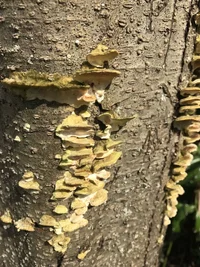
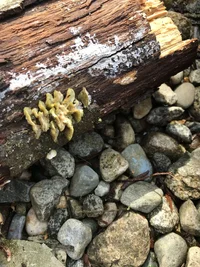
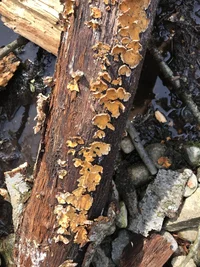
That being said, it's also safe to say that what you have here is a Stereum. I say that because (1) the brackets are partially lying flat on the wood (resupinate) and partially off the wood (effused-reflexed) and (2)when I zoom in on the underside of the little brackets in image 7754, I see no pores.
So which Stereum? Accurate, precise identification, even a field naturalist's ID, should involve a magnifying glass. I don't think it oyster-like enough to be S. ostreatus and not orange enough and the brackets are too separated for S. complicatum. So maybe S. ochraceoflavum or S. hirsutum. We see a lot of the latter in the northeast. Both occur in the northwest US.
Generally regarded as saprophytes and not as pathogens. As with pretty much all fungi it seems, new genera and species continue to be proposed. These few seem pretty stable in nomenclature.