Compaction zone

I am running intoo a problem at the campus where I work with all the construction going on. The problem is that they are bringing in heavy equipment all over. They are runing over areas right near trees. I recently put up an orange fence as a border around an Acer saccharum for root protection. The argument came from the contracter who said that the diameter of the fence was way to large and should be brought in to about 5 from the trunk of the tree. I put the fence 3 foot out from the drip line. My question is how far is would put up fences for construction. To all I did not move the fence to 5 foot from the trunk.
 
6" coarse mulch helps too. Good on you to get a reference to toss into that contractor's face; bunch of idiotic bullies, most of them.

Now if more lower branches are retained, they couldn't get any closer than dripline, could they??
 
And rainwater would be delivered wide(also drawn/siphoned there from other parts s-lightly too i think), to draw roots out wide for better feeding and stability; less water under canapy to prevent root rot and other growth. Less sun on mulch too, so won't dry up, less wind so any dried up stuff won't blow away etc. etc.

That is an excellent link; part of the Urban Tree Risk Guide that i thoguht Tom had something to do with whilst in Minny Soda?
 
The cool thing about this tree is that it has the gears of some of the uppers in the shop thinking about the other trees in the other zones up for construction so still going more figuring out and reading posts to gain more info to come up with a way to set up some regs on campus construction near trees. Please keepem comeing I am reading to all ideas.
 
Get the campus to buy copies of Trees and Development and Reducing Infrastructure Damage. If you're not an ISA member I'll sell you copies for member price plus shipping. Here's a review of it from a few years ago:

LITERAL RESOURCES

After publishing The Evaluation of Hazard Trees in Urban Areas, which was reviewed in the last issue, the International Society of Arboriculture commissioned Nelda Matheny and James Clark to write Trees and Development: A Technical Guide to Preservation of Trees During Land Development.

We’ve all heard the arguments for NOT preserving trees near construction, so in their Introduction the authors provide reasoned responses to make when you hear the following:
“Too Costly!” It’s a trade-off, with costs typically recovered by faster sales, higher prices, and enduring value.
“Over-regulation!” We all have a right to life, and the clean air and water provided by trees are a prerequisite for life. Courts uphold reasonable environmental standards. Where staff is trained to fairly enforce them, needed flexibility can be allowed.
“It’s just a tactic to stop us from building!” If a community holds tree preservation as an important goal and clearly defines its expectations to developers, then tree preservation simply becomes another aspect to project planning. Once a project (and its tree preservation plan) is approved, both development team and public agency staff must act in an honest, cooperative manner.
“We can’t control our subcontractors.” If following a tree preservation program is made a part of a subcontractor’s contract (with penalties for noncompliance), then adherence will follow. For best results, developers should educate subcontractors prior to the start of work.
“It’ll makes our whole community too expensive to develop!” To be practical, projects with mature trees sell quicker at a higher price, and remain more attractive to buyers.
“We don’t know how to preserve trees.” It requires commitment and the application of specialized knowledge, just like engineering and architecture. It is for this reason that a consulting arborist should be a part of the development team.
The next complaint often heard is, “We already pay a landscape designer”. Most landscape architects get no training in tree preservation. At NCSU in particular, how to handle existing trees is not part of the curriculum. LA’s typically have too many other responsibilities to also take on tree preservation.

The rest of the Guide lays out the entire process of preservation in a reader-friendly fashion. It first reviews tree biology and the means and methods of development, then simply, step-by-step, walks the reader through the process of successfully preserving trees. Two tips stand out as especially useful:

“Brush shall be chipped and placed in the tree protection zone to a depth of six inches”
This cheap and easy step can save more trees than any other. Even outside the protection fence, a thick layer of mulch prevents compaction better than any other method. Whether turf or shrubs are going in later, they will be easier to install and need less replacement if the soil is protected. It also retains “an ecologically functional land base capable of growing trees well into the future”.

“Adjust finish grades so that the pavement section is built on top of the natural grade, using a ‘no-dig’ design.” Since roads and sidewalks are safer when water runs off faster, this tip makes sense both for tree survival and safe travel. Use of geotextile fabrics to reduce compaction and prevent the subbase from mixing into the soil also preserves trees.

Tree preservation is a job that everybody wants done, but too often it fails for lack of information. This Guide, available from the ISA, isa@isa-arbor.com, is the best tool for getting the job done, and keeping the canopy over our communities.

 
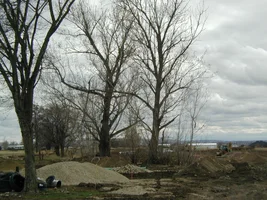
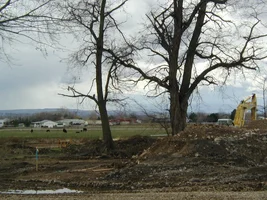
Here is a construction site where it seems that they have left the trees in place to preserve for later but they forgot to call in a consulting arborist. Funny stuff happening around here.
 

Attachments

  • 46056-P3310005.webp
    46056-P3310005.webp
    378.4 KB · Views: 57
My first job to do Tueday morning after Easter weekend is to cut down and chip up a bunch of stuff on a development site .... ASTA LA VISTA BABY

And frankly it was the better thing to do, I have tons of pics and vids on the malpractices in saving trees on development sites, it's crazy.

But when they decide to save them, they better do it right. The latest trend is developer security bonds on the tree/trees, but not here in Brisbane yet, I'm pushing though.

Here's some examples I found and the first one, read this,

"c) If after 40% of the bond is retained, further breaches of the tree protection conditions occur, Council may instigate legal proceedings for the cessation of all works on the site.

d) Death of any protected trees due to non-compliance with tree protection conditions – 100% of total bond for particular trees and possible legal action by Council.

Note: Retention of bonds for twelve (12) months provides for the tree/s to adapt to their altered situation over a full cycle of seasons."


http://www.holroyd.nsw.gov.au/ebp/holrwe...&AutoFramed

Another

http://www.ashfield.nsw.gov.au/policy_pdfs/tree_conservation_on_building_sites.PDF

And here is a Universities Landscape protection guidelines, not bad but can be improved, here's the problem ...
... "Tree Protection Zone
A defined area of ground where no activity is to be undertaken. Unless defined otherwise by the ANU Arborist, this zone will comprise a circular area, with its centre the trunk of the tree, and its outer edge two metres further out from the Drip Line. "
...

Problem is using the drip line of the tree as the Protection Zone guide, broad canopied trees are looked after well but Lord help the columnar trees.

http://www.anu.edu.au/facilities/policies/landscape.html
 
[ QUOTE ]

Note: Retention of bonds for twelve (12) months provides for the tree/s to adapt to their altered situation over a full cycle of seasons."

[/ QUOTE ]

12 months will let a lot off the hook; it takes much longer for construciton damage to show. You gotta push for 3 years.
 
I have the constucton crew under watch, of the tree seeing how they were really pissed to see that fence go up and a sign. I pushed the fence out too 20 feet past the drip zone , seeing the blue prints that was a logical distance seeing that no construction was to be that close, and told them to bring in their trucks another way.
To guymayor I am a ISA member and am seeing more friendlier faces all the time when other arborists talk to me, my buds are all ISA cert. They all say that is the way to go on this career to be more proffesional and have a vioce that the people will listen to, my cert. test date is Dec 2.
 
Power to ya there NY. It sounds like you are well on the way. There is no time to rest while machines are near trees.

Do you know of Dan Marion at Finger Lakes? If I was a young arbo I'd sit at his feet every chance I got and just soak it in. A gifted diagnostician who knows trees well. I followed him around like a puppydog at ISA 2004's lab session and he was click click click spot on every time.

If you can't get your admin to buy the books like Trees and Development (and they should be eager to), buy em yourself. lots of knowledge packed into books like that and Gilman's pruning guide, for the cost of two carabiners.
 
I am on my way to starting a library at my house for all the books that I am going to need and use. I would like for my supervisor to see this fence when he getts back from vactation. He would like to see that the course of one tree could mean the course for all trees near construction site on campus. He is always in battle with contractors about tree damage.
 
I am in the processe of trying to talk to Goerge Good,and Nina Basick. I will look up Frank thank you for the info as I said all is helpfull to try and put up some sortta system of checks and balances on trees to construction zones.
 
Back
Top Bottom