- Location
- Retired in Minneapolis
Rick,
Agreed...tree parts do move apart but not during EVERY load, as you've stated. The karate effect has been used by anti-cabling lecturers as a single dismissive issue. This is what I have an issue with. It doesn't happen every time nor is it the defining criteria for cabling. We're not disagreeing, just fine tuning, on the definition.
" In order to lessen the likelihood of the crotch failure do we want eliminate movement, or merely reduce the extremes of movement, on the crotch?"
With a hybrid system both bases are covered. Codoms and weak unions need additional support to reduce the chance of failure. In addition, reducing end weight is sooooo important.
I've learned so much about cabling/bracing by studying the rigging systems on sail boats, especially 'fighting sail' frigates.
http://www.stvincent.ac.uk/Heritage/1797/Victory/aloft.html
The standing rigging decreases ins size as the size of the structure decreases. Isn't this exactly like trees?
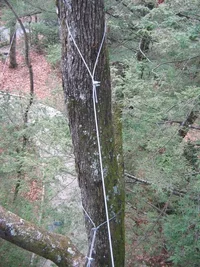
When I first started installing Cobra I always adjusted the size of the eye to consider the diameter increase of the supported part. A fast growing tree would get a bigger eye 'just in case'.
In the A300 Standards there is an accepted life span and maintenance timeline that has been in place prior to dynamic or eye spliced cable systems. One of the loose ends with dynamic is that the reinspection is less likely to take place and the consequences much more severe.
Agreed...tree parts do move apart but not during EVERY load, as you've stated. The karate effect has been used by anti-cabling lecturers as a single dismissive issue. This is what I have an issue with. It doesn't happen every time nor is it the defining criteria for cabling. We're not disagreeing, just fine tuning, on the definition.
" In order to lessen the likelihood of the crotch failure do we want eliminate movement, or merely reduce the extremes of movement, on the crotch?"
With a hybrid system both bases are covered. Codoms and weak unions need additional support to reduce the chance of failure. In addition, reducing end weight is sooooo important.
I've learned so much about cabling/bracing by studying the rigging systems on sail boats, especially 'fighting sail' frigates.
http://www.stvincent.ac.uk/Heritage/1797/Victory/aloft.html
The standing rigging decreases ins size as the size of the structure decreases. Isn't this exactly like trees?
When I first started installing Cobra I always adjusted the size of the eye to consider the diameter increase of the supported part. A fast growing tree would get a bigger eye 'just in case'.
In the A300 Standards there is an accepted life span and maintenance timeline that has been in place prior to dynamic or eye spliced cable systems. One of the loose ends with dynamic is that the reinspection is less likely to take place and the consequences much more severe.