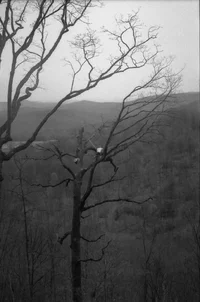
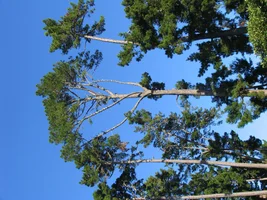
climbing with the wind

I don't like to do much climbing or even bucket work in high winds.

The worst winds I can remember working in, we were chipping and the chips could barely make it out of the chute and into the back of the truck during the gusts without getting blown sideways and everywhere.
 
Beaufort Scale

Beaufort Wind Scale
Windspeed
in MPH Description - Visible Condition
0 Calm smoke rises vertically
1 - 4 Light air direction of wind shown by smoke but not by wind vanes
4 - 7 Light breeze wind felt on face; leaves rustle; ordinary wind vane moved by wind
8 - 12 Gentle breeze leaves and small twigs in constant motion; wind extends light flag
13 - 18 Moderate breeze raises dust and loose paper; small branches are moved
19 - 24 Fresh breeze small trees in leaf begin to sway; crested wavelets form on inland water
25 - 31 Strong breeze large branches in motion; telephone wires whistle; umbrellas used with difficulty
32 - 38 Moderate gale whole trees in motion; inconvenience in walking against wind
39 - 46 Fresh gale breaks twigs off trees; generally impedes progress
47 - 54 Strong gale slight structural damage occurs; chimney pots and slates removed
55 - 63 Whole gale trees uprooted; considerable structural damage occurs
64 - 72 Storm very rarely experienced; accompanied by widespread damage
73+ Hurricane devastation occurs
 
Actually the wind (quite strong) was in our favor today! I've had alot of days when it wasnt and I feel its up to the climbers discression....Too many variables to set standards I.E. Drop zone, Species of tree, integrity of said tree... etc! It can be you're friend or make a seasoned climber nervous!
 
I was digging through old photos last month and found this picture of myself in a big chestnut oak. This was taken probably eighteen years ago, jeez. Note the distinct lack of PPE. At that time I didn't know what PPE was. I didn't know anything. If you look hard you can see my 24 inch Fanno handsaw and the old stihl 020. This was a view job where we were slaughtering all these ancient trees to make a landscape architect happy and create a "filigree" to frame the customers view, whatever that means. I don't want to know how old this tree was. I think I was removing it (don't ask me why it looks like this, like I said, I knew nothing), you can't see but it was actually on the edge of a small cliff. This photo was taken at the end of the second day, we had to finish the next day. It was pretty warm but the next day a cold front came in. I was back up in that tree and the winds were gusting a good seven beaufort-uh, I mean, about sixty mph or 96 kmh, it got really cold and sleety. I was pretty gripped but my boss made us finish. The other climber quit after that day. Luckily it was a chestnut oak with no leaves (or branches after I was through), and probably that was nothing much for that tree in that spot. But I'll just say a bit of wind is fine (depending on the tree and the wind), but after a point it's just stupid to be up there.

 

Attachments

  • 44147-butchery.webp
    44147-butchery.webp
    75.3 KB · Views: 127
This thread has caused me to remember a call out that I would rather forget. In revisiting the "nightmare", I have recalled a couple of questions that I grappled with at the time.
The tree was a 200' plus E. regnans and the root ball had comenced to heave in the ground. The mid crown target was a large kiosk/ tea rooms. The wind was gusting 50 - 60 kts, as recorded in the area. I was called out to solve the problem.
The first priority was to prevent the tree from failure, so I decided to fix a line as high as I dared and load it. With the line at approx. 100' I then realized that if I put too much tention on the line it would prevent the natural bending of the trunk. At this point it would move about 10-15' and well below the first limb. Could the tight line increased the chanc of trunk failure at that point?

When accessing the tree with my spurs, I had a horrible preminission that the extra damage caused, could initiate a failure. What do you think? I did access the tree from the side and down wind side just in case. Where I was lowering the limbs off (160- 180') the violent whipping was sending me about 40' to the side.

My thoughts today would be to leave it alone and video the tea rooms getting squished.
 
[ QUOTE ]
This thread has caused me to remember a call out that I would rather forget. In revisiting the "nightmare", I have recalled a couple of questions that I grappled with at the time.....

My thoughts today would be to leave it alone and video the tea rooms getting squished.

[/ QUOTE ]

Too bad it was not taped then. Well written story...thanks.

I like the last line...its funny how our thinking changes.
 
Sounds like a cowboy moment Graeme. /forum/images/graemlins/grin.gif Did you get any sea sickness? Or did you get your sea legs quick enough? /forum/images/graemlins/smile.gif

I hate working in real bad wind. I used to think that a storm job needed to be done right away. I had to "help" these clients in their time of need. Not any more. Almost everything can wait until tomorrow! Now I'd stabilize a tree and come back after the storm.
 
got any pics? I like the cube theory!

Here is a shot of the trees (hope it works). Not windy this day.

Rimu
 

Attachments

  • 44322-IMG_1626.webp
    44322-IMG_1626.webp
    628.1 KB · Views: 94
Mark, I was feeling too fragile to be having a cowboy moment, too focused on my progress to be sea sick and you can't get sea legs for that much motion.

/forum/images/graemlins/drowninga.gif
 
Yes.

With regard to the spurs causing the probability of failure ... I doubt it. On the species you would only be penetrating the bark, I suppose if you went around in circles too much the bark might blow off but seriously the penetration into the sapwood and heartwood is miniscule ... one of those things in our heads more than anything.

Now with the rope at 100' getting to much tension, I think yes. Similar to the Karate effect on limbs that have rigid cabling the probability of it snapping is increased.

But it's the choice of the two evils, upheaval or snapping.

I'd go with the third option, video the kiosk copping it, it's insured and can be replaced ... you cant be replaced and not worth the risk, no tree is.
 
If i had to guy the tree i would be tempted to use a couple of climbing lines. I have used them in the past as the elastic nature of them helps the tree give a little so more movement in the wind and not be held as fast as with a standard rigging rope.
As for the spus i can see how with the tree being under massive tension and the fibres elongated that they might stick in a bit furthur, but i cannont imagine them being a factor in causing the timber to split and fail.
 
just re read the post. I think that a dynamic type of rope would be most suitable but on that size of tree i think that something more substantial may be required!
 
[ QUOTE ]
Any thoughts on the two questions raised?

[/ QUOTE ]

The first is a tough one. At what point does the "security" of a guy line make things less secure? When I envision your job, I tend to think that a little movement would still be alright, but not too much. Maybe two guys in that tree would be better? If one is at 100' and medium tension, then one at say 30-50' at a higher tension level, it might limit further heaving but still allow natural trunk movement during rigging? I understand what you mean by too much tension in that it reminds me of doing a removal with cement in a trunk hollow. The "karate effect" comes to mind.

As far as the gaffs go, I don't think that I would over step with them. I have often wondered how much I have weakened the smaller stems during climbing just before I hinge them over. Not a nice vision. Still, I have yet to see any tree fail from over agressive gaff work.
 

New threads New posts

Kask Stihl NORTHEASTERN Arborists Wesspur TreeStuff.com Teufelberger Westminster X-Rigging Teufelberger
Back
Top Bottom