Climbing a tall tree with shorter rope(s)…

Don't forget the pee bottles and a snack. And NB don't mix the pee bottle and your water bottle! Did a guided climb to 200' some years ago. Take the opportunity to do the pendulum spin. On about 100' of rope repel outwards, do a 360 rotating the rope and land with your feet right at the takeoff point - happens real slow:) I spent the day, out to site, up, lunch tree boat, pics, down back.
 
My plan for a giant tree is to utilize two or three complete climb systems. If you have enough gear, just leave a system in place at 100' and then install a second completely separate and independent system, and then another. I would leave my zigzag/chicane on the first rope and then use a prusik and wrench on the next line and another on the third. I don't think it should be that big of a deal to clip into each system before unclipping the previous/next one.
 
Did you guys end up using one access line and then branch out on your own systems once you were in the crown? Or did each of you climb from the ground on your own rope? Either works of course. One means less gear to carry. Or maybe there was another strategy.
-AJ
 
Wow, never did a climb like that, but basic too short of a line for me (in DdRT) was grab host can reach, and when get to it, make sure it could not drift up (or to sides) by natural architecture of tree or contrived with sling/carabiner set. As climb with lanyard, every body length or so put in another carabiner/sling and throw lines in; as like imagine mountain pitons strategy to limit fall potential. Meaning might not like all that happens if gets fugly, but shouldn't hit ground.
.
With long l adjustable lanyard (sometimes Dunlap DEDA) at some points could throw it over higher host support, and bring carabiner/sling set (always had many) with, not to have to gather on way back down. Always double tied when cutting, and connive to lock position, sometimes using carabiner/sling set as anti sway. Sometimes more stable if legs of line split to only 1 in carabiner/sling set if sets them apart appreciably.
.
Another trick used was with adjustable lanyard would be to tighten to waist under you (best with suspenders) with knees bent, tighten legs rigid against rope constraint. High fatigue, clock ticking in head strained position; but can make big difference; if orchestrated cleanly for single activity (set line, cut etc.).
 
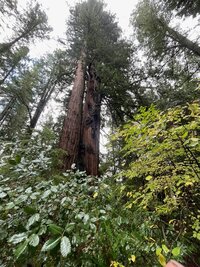
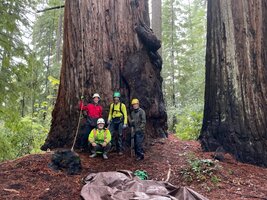
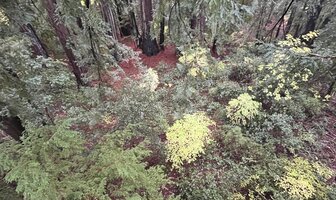
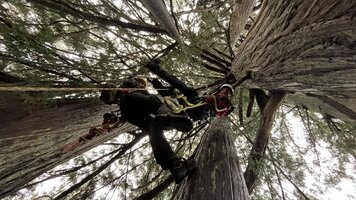
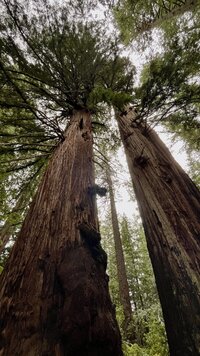
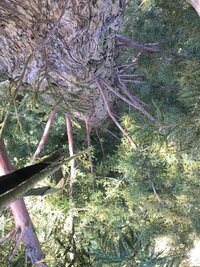
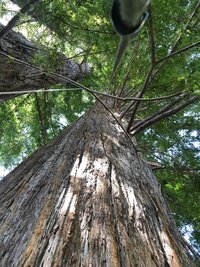
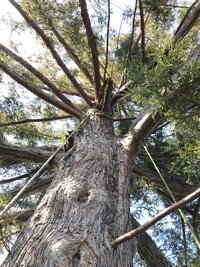
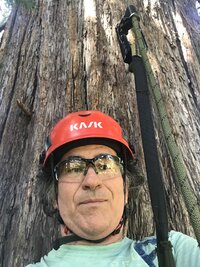
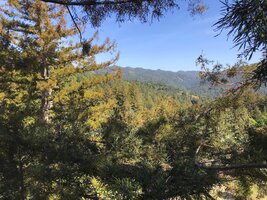
Here's one way it can be done... when Tim Kovar and Tree Climbing Planet hosted their guided climb near SantaCruz in spring 2022, he installed his 11mm SRT lines this way. (pictured)
Fixed loop choke w/something like a grapevine backup, and some elements of a constrictor hitch. These lines were de-installed as soon as the event was over.

Funny tho, when I talked to his partner, Hannah, she explained that some ropes were long enough to reach the top and back down, and were anchored @ the TIP in such a way that their very long length draped down both 'sides' of the tree, effectively creating two working ends on one rope.

But the tree I was climbing in, this was obviously not the case.
 

Attachments

  • TCP22APRIL_DOWN44_RS.jpeg
    TCP22APRIL_DOWN44_RS.jpeg
    998.7 KB · Views: 28
  • TCP22APRIL_UP13RS.jpg
    TCP22APRIL_UP13RS.jpg
    1 MB · Views: 26
  • TCP22APRIL_TIP.JPG
    TCP22APRIL_TIP.JPG
    1.2 MB · Views: 27
  • TCP22APRIL_MIKORS.jpg
    TCP22APRIL_MIKORS.jpg
    377.3 KB · Views: 28
  • TCP22APRIL_OUTRS.jpg
    TCP22APRIL_OUTRS.jpg
    1 MB · Views: 28
Did you guys end up using one access line and then branch out on your own systems once you were in the crown? Or did each of you climb from the ground on your own rope? Either works of course. One means less gear to carry. Or maybe there was another strategy.
-AJ
Good morning, Moss.

The way this climb rolled out was shooting a couple throw lines into the tree… 150 feet up or so (not really sure of the height). Ropes were hauled up and over, secured with a basal anchors. We then climbed up SRT on those ropes. Unfortunately before we could reach our destination, rain, thunder, and lightning decided to pay us a visit. Being the highest point in the forest, “we headed for the woods”….or out of them in this case!

The next day, some of the group returned to advance the tie in point further up the tree. In the end, they made it 3/4 of the way up the tree, before it was time to pack it in and head home. It’s an outstanding environment in which to climb. We’ll be back!
 
Where
Here's one way it can be done... when Tim Kovar and Tree Climbing Planet hosted their guided climb near SantaCruz in spring 2022, he installed his 11mm SRT lines this way. (pictured)
Fixed loop choke w/something like a grapevine backup, and some elements of a constrictor hitch. These lines were de-installed as soon as the event was over.

Funny tho, when I talked to his partner, Hannah, she explained that some ropes were long enough to reach the top and back down, and were anchored @ the TIP in such a way that their very long length draped down both 'sides' of the tree, effectively creating two working ends on one rope.

But the tree I was climbing in, this was obviously not the case.
where in the Santa Cruz mountains was this climB?
 
When I went up a tip with pulley was installed on a previous climb (repeated commercial climbs there plus science equipment monitoring) a paracord was left installed, that was used to pull up the end of a 600' line up and back through the pulley, then that rope was connected to the midpoint of another 600', didn't see exactly how, and that midpoint was hauled up to the tip pulley and the haul rope base tied. Voila two 200' SRT lines side by each.

My photos didn't turn out well. Just looked like tree trunk shots and branch shots. I tried for a perspective shot showing how teeny the base of the tree looked from height.

Must have been some grunting hauling up the climb ropes over natural bark! Did you encounter bugs, critters and ahem;) moss up at height? badumpbump;) There were tiny inch worm caterpillars landing on me.
 
To the point of how to access tall conifers and what rope strategies to use...

In the eastern U.S. white pine offers similar challenges, on a smaller scale but the principals are the same. For this baby hawk renest in spring '23 I tied some extra line to a 150' to give me a basal anchored ascent access. I never advanced that line, it stayed in place with rope wrench in place. Tailed a 85' line, also carried my 15' lanyard and my Captain Hook with a 55' 9mm line. 85' of 7mm (gold-colored) accessory cord is carried in a small bag on the back of my harness, I use that as a pulldown for my 85' line after it is eventually anchored at the top of the tree.

If I was in the PNW old-growth I'd be using a 200' 11mm static as an access line, 120' line for advancing above the initial access TIP and my short lanyard would be 20'. That's solo, in a team climb more lines in the mix but the fundamental setup per climber the same. Multicender would be left at the top of the initial access line after climbers progressed higher. That way it's a quick and easy switchover to get to the ground from the top in an emergency escape scenario. Everybody has their way, this has worked well for me in many tall woods conifer climbs.

Note: tree was more like 115', not 90' ;-) Hilltop tree so quite exposed.

-AJ

 
To the point of how to access tall conifers and what rope strategies to use...

In the eastern U.S. white pine offers similar challenges, on a smaller scale but the principals are the same. For this baby hawk renest in spring '23 I tied some extra line to a 150' to give me a basal anchored ascent access. I never advanced that line, it stayed in place with rope wrench in place. Tailed a 85' line, also carried my 15' lanyard and my Captain Hook with a 55' 9mm line. 85' of 7mm (gold-colored) accessory cord is carried in a small bag on the back of my harness, I use that as a pulldown for my 85' line after it is eventually anchored at the top of the tree.

If I was in the PNW old-growth I'd be using a 200' 11mm static as an access line, 120' line for advancing above the initial access TIP and my short lanyard would be 20'. That's solo, in a team climb more lines in the mix but the fundamental setup per climber the same. Multicender would be left at the top of the initial access line after climbers progressed higher. That way it's a quick and easy switchover to get to the ground from the top in an emergency escape scenario. Everybody has their way, this has worked well for me in many tall woods conifer climbs.

Note: tree was more like 115', not 90' ;-) Hilltop tree so quite exposed.

-AJ

That's basically the setup I keep with me at work. I've not gotten to do anything over 135' so I haven't had to multi pitch it, but I would ultimately set up a ground retrievable descent line from the top with a couple of ropes together. Once positioned for it, and to offer friends a more straightforward climb.
 
I've done it also. It's a few miles east of Highway 17, in an area called The Willows, east of Glenwood.
Stetson Road off of Old San Jose Rd in the hills above Soquel Village. Know the area well as I smashed a lot of timber and skidded a lot of logs in that area back in my youth.

I grew up in the Santa Cruz Mountains just down the road from Big basin State Park where some of the biggest timber left on gods green earth resides...Spurred up my first tree, made my first undercut, set my first chocker, blew my first top, drank my first beer, and smoked my first joint in those hills.

They believe that the first redwood tree to be seen by a white man took place in the Santa Cruz Mountains in 1769 near Corralitos Creek
 
To the point of how to access tall conifers and what rope strategies to use...

In the eastern U.S. white pine offers similar challenges, on a smaller scale but the principals are the same. For this baby hawk renest in spring '23 I tied some extra line to a 150' to give me a basal anchored ascent access. I never advanced that line, it stayed in place with rope wrench in place. Tailed a 85' line, also carried my 15' lanyard and my Captain Hook with a 55' 9mm line. 85' of 7mm (gold-colored) accessory cord is carried in a small bag on the back of my harness, I use that as a pulldown for my 85' line after it is eventually anchored at the top of the tree.

If I was in the PNW old-growth I'd be using a 200' 11mm static as an access line, 120' line for advancing above the initial access TIP and my short lanyard would be 20'. That's solo, in a team climb more lines in the mix but the fundamental setup per climber the same. Multicender would be left at the top of the initial access line after climbers progressed higher. That way it's a quick and easy switchover to get to the ground from the top in an emergency escape scenario. Everybody has their way, this has worked well for me in many tall woods conifer climbs.

Note: tree was more like 115', not 90' ;-) Hilltop tree so quite exposed.

-AJ

Moss, This was totally cool to watch. The engagement with the parents was fantastic! I’ve tried to connect with our local bird rescue organization, but they haven’t responded. I believe they already have climbers in their “rolodex.”
 

Attachments

  • IMG_0147.png
    IMG_0147.png
    32 KB · Views: 7

New threads New posts

Kask Stihl NORTHEASTERN Arborists Wesspur TreeStuff.com Teufelberger Westminster X-Rigging Teufelberger
Back
Top Bottom