Climbing a tall tree with shorter rope(s)…

Zebco Kid

Branched out member
Location
Ashland, Oregon
Good morning, All.

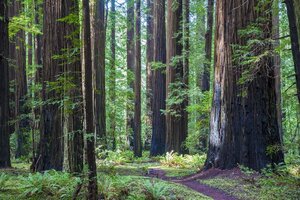
In a couple weeks I’m heading off to the real Northern California to climb an old growth Redwood. I am expecting the tree to be about 300 feet. I have ropes, but none of them are going to be long enough.

So…my question is…is it possible/proper to connect ropes together and transfer from one to another as I make my way up? I will ascend using SRT.

If it’s a practice that is recognized as safe at commonly deployed, can you share the technique of both rope connecting knots, as well as best practices for transferring from one rope to another as I move past the aforementioned connection? Perhaps there’s an instructional video out there. I did some searching, but I couldn’t find anything on “The Google”.

Thank you.
 
Last edited:
Order longer rope. Not trying to be curt, just the best advice I can offer. We don't have super tall trees here. I can only assume that that kind of height changes things. having to switch over or carry additional gear to transfer to a new system might not be ideal in "new" territory. There are plenty of ways to connect rope together but switching to another system, at height, could present challenges, even for seasoned climbers. Honestly, I would invest in the length I needed. .02. There are folks on here that can give you way better, from experience, advice. sounds like a great opportunity.
 
Passing a knot is problematic.

Two weeks is a very short lead time for you to learn about passing knots. By now you should be fluid in using your system not changing it.

How do you plan on setting a rope for ascent?

How do you plan on advancing your rope when you climb to your first TIP?

The rope you choose may not be your favorite. Some light weight ropes have annoying characteristics that are tolerated in order to cut weight. Do these light ropes work with your ascent/descent tools/system? Two weeks is a short time to dial-in.
 
I'm with @RogerM, order a 600' reel of the rope you are already comfortable using. Get ready for some bounce you are not familiar with. That will be enough NEW to deal with.
If you are bent on tying two ropes together, watch this video:
How you plan on passing the knots I will leave in your hands.
 
Thanks Tom.

I am now "fluid" in using my system. That being said, there's so much more to learn. Just yesterday I was playing with redirects on a bite (Mumford). Totally new to me, but a cool technique.

I've climbed Redwoods in the past. One time, ropes were already installed by others (which has it's own irksome nature). The trees we're on private property, and anchored in the canopy.

Another time I climbed redwoods where we shot a line using a big shot and tied a basal anchor.

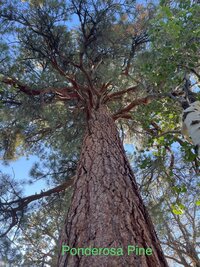
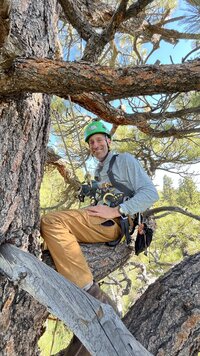
I am not clear of my approach as of yet for the coming opportunity. I would thoroughly enjoy making my way up the tree limb by limb if that approach is available. I recently climbed a Ponderosa Pine in the Eastern Sierras. That was the way up, and it was a good deal of fun (pictured).

And Shadowscape...I'm not "bent" on anything. I'm attempting to prepare...and TreeBuzz is my best source for experienced opinions.

Based on the replies already, there will be no rope tying or passing knots. This is why I asked.

I'm really grateful for the input.

Thank you.

David

D1206942-D72A-4F41-B691-C38884402E54_1_105_c.jpegA7B7D07A-9A04-478C-BB9D-D1FC1A638EF2_1_201_a.jpeg
245AB79F-BB91-4515-A90E-C9F9B0A13E7A_1_105_c.jpeg


64C6DC3A-3A4B-46D9-B2B5-4CBC4E57B584_1_105_c.jpeg8A21B1E6-3787-4C57-984C-86337ADC0984_1_105_c.jpeg
 
My day to day climbing lines are 300-350 ft, but anytime I get into timber over 225 ft I pull out the 600 spools. Once you get over 200 ft everything gets heavy and difficult to deal with, so whether you are setting up a basal anchor or some sort of MRS floating crotch you want it to be as clean as possible, and you want to have quick egress to the ground at all times. As such, cobbling together shorter section of rope is a recipe for disaster if your game plan changes mid climB, or something unexpected happens while aloft.
 
when i went conepicking and we had some larger than usual (for us) douglas firs, we installed our access-lines (tied together, but the knot was on the base-tie-side) and than went further up with a 150‘ rope. so we had to transition to come down but felt safe enough… i‘m a fan of short ropes…

edit: definitly listen to rico
 
Last edited:

If knoting two climbing ropes, I tend to do so at the anchor point, whether it's a basal or canopy tie. This way there is no knot to pass on the climb leg.

Sent from my SM-S908U1 using Tapatalk
 
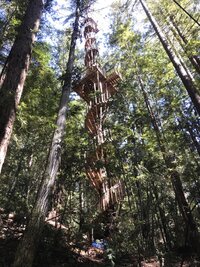
That spiral staircase is amazing? did you take the stairs?
I did. This was the property owner's COVID project. He worked on it every day for a year. What's really cool is he used some sort of system that would allow for the tree to grow and expand, and not compromise the integrity of the staircase. He said it is in some sort of running for Guinness Book status. Something about the tallest spiral on a tree....etc.
 
If for some reason you must pass a knot on your ascent side, I would simply tie on a prusik and carabiner just above the knot before you pull it up. That way it is waiting for you when you get there. As usual, put tension into the device above the knot before you disconnect from the system below the knot. Carry 2 systems in addition to the prusik above the knot so you can set up your above knot system without unclipping your below knot system just in case. Leave the below knot system there for your descent. Always put tension into your new system prior to slacking your existing system. So you will have 3 attachments to the rope at certain points in time. This is harder than buying a longer rope so just buy the rope. You live in California!
 
I’ve tied two 200’s together for access on PNW old-growth. Basal anchored, the join is on the leg you’re not climbing. I tail up a “long lanyard” (60’ minimum rope length) and a “short lanyard” (18-20’ minimum) and alt lanyard to advance from there. This is rec not work climbing, “Rico’s Rules” apply most definitely for running saws in big trees. Access rope left in position. Except. In a team climb (should be ideally) lead climber ties in and requests that the base anchor be released. Separate the two 200’s, advance, choke one of the 200’s higher in the tree (needs to reach the ground), “basal anchor” the second 200 on the same limb the first one is choked on and advance and redirect the second 200 as high as you want so the the second climber in can tie in to upper 200’ line when they reach the top of the first choked access line. Elevator to the upper crown.

This is not rocket science but there needs to be a strong plan. A two person team can carry two 200’s and their own “short” lines for advancing in the crown to make it all happen.

Practice access like this in “smaller” conifers (140-180’ trees) before attempting the big stuff. Goes without saying but has to be said.
-AJ
 
By the way. Whoever your team is, practice together on smaller stuff first. You need to be able to work very well together. When you’re in the big trees it is not the place to find out you don’t work well together. This is serious stuff, you have to be able to collaborate very well, proven by experience trust. Otherwise no go.
-AJ
 

New threads New posts

Kask Stihl NORTHEASTERN Arborists Wesspur TreeStuff.com Teufelberger Westminster X-Rigging Teufelberger
Back
Top Bottom