Chip Stove for floor heat systems

OasisTree

Branched out member
Location
Central Missouri
Hi, I thought I could give a little info on the way we heat our 5,000 sq. ft. shop/house combo.

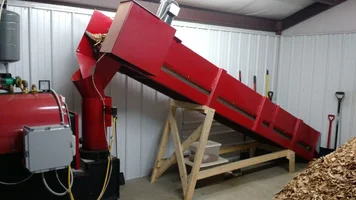
I have a chip stove set up with a self- feeding conveyor, and burn green wood chips. I use the wood chips straight out of my Bandit 1090.
The stove does the best at around 50% moisture, as it is designed to burn the methane gas off of the chips. It is able to accomplish that by getting the stove temperature much hotter than traditional stoves.

I heat treated water in the stove, and run that water in the loop to the house. There the heat is transferred to my shop hot water system thru a plate converter. Then it goes to 2 holding tanks upstairs where it feeds my domestic hot water needs, and also my floor heat system.
I have 3 zones that are thermostatically controlled, but the pump runs continuously. All the thermostats do is open the valve to let more hot water in when it is calling for more heat. That way I can run my shop temps cooler than my house. I have the loops in the floor at 1 ft. spacing in my house and workshop side, and at 2 ft. spacing in the side where i park the equipment. I do not use supplement heat in my house when i am using the stove, and it keeps up just fine. I keep the shop around 55 degrees all winter.
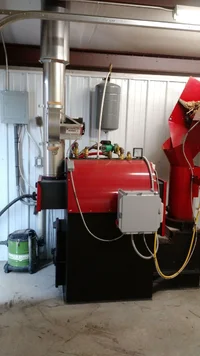
I will post pics of the stove/conveyor system.
 
Very cool.

So it uses a tjernlund exhaust fan to pull in combustion air ?
What happens when the electricity go out ?

Manufacturer of the other components ?

"Higher temps" eliminate creosote in the chimney ?

Ash clean-out ?
 
When the electricity goes out it will burn the chips that are in the tube and go out.

The conveyor system is custom built by the dealer of the stoves, and he also builds the electrical system. The stove brand is Conifer, and i believe this model is their smallest one.

The stove burns clean. Exhaust temps are between 200 and 500 degrees, and with this type of system when the exhaust fan is on there is no smoke so therefore no creosote.

I knock the ash off of the back grate every day, and I haul out ashes about every 10 days or so.
 
When the exhaust temp gets above 400 degrees that tells me that it is time to clean the ash out of the tubes, and the stove is not getting the heat out of it like it should.

So if you keep an eye on the temp gauge it should never get that hot.
 
Just the stove and conveyor was around $14000 new, and then the building, concrete, piping, and pumps was on top of that.

That is really cool. We heart our 8000 Sq foot shop with natural gas. Our most recent bill for electric and heat was about $350. And it was a really cold month. Usually it's closer to $215 or so. If we had (3) $350 dollar bills it would take 13 years to make that investment worth it.

I personally would invest that $14000 in solar panels. We have our roof positioned perfectly for it. Plus I think that would be a quicker return on investment with a longer future insight. I'm curious what the "shelf life" on that unit is.

I'm really impressed with that unit you have though. That is really cool. A truck load of chips lasting you 2 weeks is really impressive.


Sent from my iPhone using Tapatalk
 
That's really cool. I am interested in more pictures. Where does it get woodchips from.? Do you know how many btu's it is?
 
I love the idea of burning what ya got!

So if the exhaust overheats does it shut off or slow the conveyor?

Also, if you forget to feed it, how hard is it to get things rolling again? I would imagine you need some other fuel to ignite the first chips, and a delay before the conveyor starts dumping more in.

Notice both my questions come from a lack of consistency when maintaining equipment.
 
I have never had a problem with the exhaust overheating.

Lighting it is easy. I turn the stove on, and it fills the tube with chips. Then I turn the exhaust fan on, and place a small butane torch at the back of the stove directly on the green chips. It doesnt take more than 5 min to get it going.
 
You stated that it burns best w/ chips at 50% moisture. (50% of wood wt; or 50% of green capacity; other ?)
Do you bother to measure ?
Do you bother to be choosy about the wood type ?
What happens w/ more, or less moisture ?

You have a "backup" heating system ?
 
And because taking wild shots at solving my own questions before waiting for an answer is my style...

I wonder if you could install a scraper inside the tubes that goes through a cleaning cycle and spits out the ash anytime a threshold temperature is met in the vent.

And it would be great to have natural gas backup in this thing so that anytime the chips run out, or needs to cold start, it would just keep pumping out heat.

Sorry, I tend to overthink systems and I really like what you have going here.
 
You stated that it burns best w/ chips at 50% moisture. (50% of wood wt; or 50% of green capacity; other ?)
Do you bother to measure ?
Do you bother to be choosy about the wood type ?
What happens w/ more, or less moisture ?

You have a "backup" heating system ?

I do like to chip bigger wood, as the more bark you have the more ash you have. Other than that, i just make sure that it is green. I cant tell alot of difference in hardwood or softwood, but we have mostly hardwood here so that is the majority of what i use.
Dry wood is a problem tho...It tends to back burn up the tube when the stove isnt under load.
 
And because taking wild shots at solving my own questions before waiting for an answer is my style...

I wonder if you could install a scraper inside the tubes that goes through a cleaning cycle and spits out the ash anytime a threshold temperature is met in the vent.

And it would be great to have natural gas backup in this thing so that anytime the chips run out, or needs to cold start, it would just keep pumping out heat.

Sorry, I tend to overthink systems and I really like what you have going here.

The stove burns too hot for any mechanized system inside of the stove.

The floor heat system is its own backup, as the heat sink you have in the floor will last several days.

Radiant heat is an even heat from the ground up, unlike forced air heat which goes to the top of the building.

I do have a heat pump central air system in my house as backup in the spring and fall when i am not running my stove.
 
The stove burns too hot for any mechanized system inside of the stove.

The floor heat system is its own backup, as the heat sink you have in the floor will last several days.

Radiant heat is an even heat from the ground up, unlike forced air heat which goes to the top of the building.

I do have a heat pump central air system in my house as backup in the spring and fall when i am not running my stove.

Nice.
 
And because taking wild shots at solving my own questions before waiting for an answer is my style...

I wonder if you could install a scraper inside the tubes that goes through a cleaning cycle and spits out the ash anytime a threshold temperature is met in the vent.

And it would be great to have natural gas backup in this thing so that anytime the chips run out, or needs to cold start, it would just keep pumping out heat.

Sorry, I tend to overthink systems and I really like what you have going here.
Great system you have Oasis. Freefallin, there is a system like you describe called a Hargassner wood chip burner, which self cleans and than packs the ash in a bin.
 
My back up plan would be a generator. Large enough to provide power for the essentials in your house, power the shop (keeps your business alive during storm emergencies), and of course power the boiler.
Very sweet setup. When I read your first post I was expecting to see a much larger boiler for that much sq footage. But then again you do have the water storage and concrete ''heat sinks.''
 

New threads New posts

Back
Top Bottom