snunyabizness
New member
- Location
- portland, oregon
Several months ago I stumbled across the twin rope climbing technique (TRT) and wanted to master some of the concepts using the gear I already own without purchasing any specialized equipment, so that I would have effective methods to work certain scenarios (like failed or dead trees), but using only the gear I already pack around daily. I typically climb on an akimbo or a basic prussik and my style is to descend wide open.
Mechanical devices are mostly designed for 1/2" rope and I don't have or want 300' of 8mm rope. Dual rope wrenches seemed like a viable option, but that was just pure frustration. This led to a distraction searching for SRT capable climbing hitches and a seemingly endless rabbit hole trying to develop an understanding of how/why textile hitches work on DDRT but not SRT. I found some purist hitches that use cordage only and technically can be used to ascend/descend a static rope for tree hunting or mountaineering, but impractical for continuous/extended use in the context tree work. I found a couple of hitches that combine cordage & rigging rings but are difficult to tend, twist up twin ropes into hockles, and burn up prussik cords.
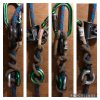
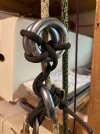
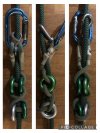
With some experimentation, I found a configuration that seems to work OK.. not perfect or ideal, but usable. Not totally certain, but I think this is unique and so wanted to share with the community. In my limited testing climbing for a few hours SRT in the backyard elm, it seems to be usable using 11.7mm yale blue moon, 30" epicord 8mm, hitch climber eccentric, a carabiner, and two 28mm dmm alloy rings.
This hitch is inspired by https://www.treebuzz.com/forum/threads/sticht-hitch.40355/ and https://www.treebuzz.com/forum/threads/the-hrk.12240/ and the bachmann hitch. Huge shout out to @Brocky for the wealth of information shared, you are THE MAN.
I'm in the PNW and so figured naming it the chinook hitch would be appropriate. Please set me straight if this name has been used or this hitch has been done before.
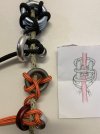
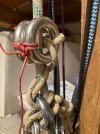
It starts with a clove hitch through the rings with one leg of the prussik passing in front of the climb line and one behind, followed by an immediate reverse and sort of a vt braid around the line ending with an overhand. The hitch climber spine is necessary to keep the sewn eyes oriented and preventing an untwisting effect as it sets in under weight. This causes the rings to clamp down on the rope and there is minimal wear on the prussic far as I can observer during my afternoon of testing. The anodizing on the rings has worn off a bit. I weigh 185lbs with no gear and can freefall bomb on it and it grabs every time, and it tends alright. I have no idea how to tune it, maybe longer prussik core or different size rings. Enjoy.
Mechanical devices are mostly designed for 1/2" rope and I don't have or want 300' of 8mm rope. Dual rope wrenches seemed like a viable option, but that was just pure frustration. This led to a distraction searching for SRT capable climbing hitches and a seemingly endless rabbit hole trying to develop an understanding of how/why textile hitches work on DDRT but not SRT. I found some purist hitches that use cordage only and technically can be used to ascend/descend a static rope for tree hunting or mountaineering, but impractical for continuous/extended use in the context tree work. I found a couple of hitches that combine cordage & rigging rings but are difficult to tend, twist up twin ropes into hockles, and burn up prussik cords.
With some experimentation, I found a configuration that seems to work OK.. not perfect or ideal, but usable. Not totally certain, but I think this is unique and so wanted to share with the community. In my limited testing climbing for a few hours SRT in the backyard elm, it seems to be usable using 11.7mm yale blue moon, 30" epicord 8mm, hitch climber eccentric, a carabiner, and two 28mm dmm alloy rings.
This hitch is inspired by https://www.treebuzz.com/forum/threads/sticht-hitch.40355/ and https://www.treebuzz.com/forum/threads/the-hrk.12240/ and the bachmann hitch. Huge shout out to @Brocky for the wealth of information shared, you are THE MAN.
I'm in the PNW and so figured naming it the chinook hitch would be appropriate. Please set me straight if this name has been used or this hitch has been done before.
It starts with a clove hitch through the rings with one leg of the prussik passing in front of the climb line and one behind, followed by an immediate reverse and sort of a vt braid around the line ending with an overhand. The hitch climber spine is necessary to keep the sewn eyes oriented and preventing an untwisting effect as it sets in under weight. This causes the rings to clamp down on the rope and there is minimal wear on the prussic far as I can observer during my afternoon of testing. The anodizing on the rings has worn off a bit. I weigh 185lbs with no gear and can freefall bomb on it and it grabs every time, and it tends alright. I have no idea how to tune it, maybe longer prussik core or different size rings. Enjoy.