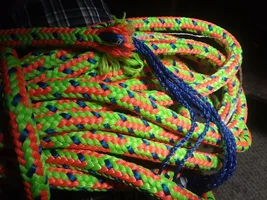
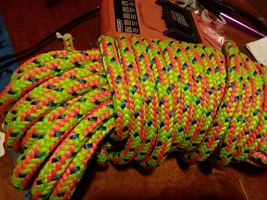
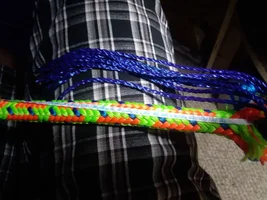
Check out this rope score!!

Daveyface

New member
Location
pittsburgh
I found this online. Its some new pattern of new england safety blue....super-Vee???? Anyoneseen it before??
 

Attachments

  • 20180903_013346.webp
    20180903_013346.webp
    394.8 KB · Views: 71
  • 20180902_210634.webp
    20180902_210634.webp
    418.1 KB · Views: 70
  • 20180903_013332.webp
    20180903_013332.webp
    296.3 KB · Views: 61
I found this online. Its some new pattern of new england safety blue....super-Vee???? Anyoneseen it before??
Not to sound like an ass, but big whoop! Some score for some un-identifiable rope from a possible shady source. Maybe it's surplus, maybe defect? Maybe? Maybe not? Tie a noose.
 
To be clear i got this from a dealer who sells factory shorts from teufelberger and i get lots of rope from him. So far all good. Perfect quality ropes everytime. . This rope is safety blue, i pulled the id tag out hoping it had the name but all i found was the familiar strip with no specific info. Google found me a 24 strand rope they sell overseas called graviton that looks like its the same colors scheme in 24 strand. Geez im a rope nerd lol
 
Dammit! That's where it went!
I had it in my cart first & Davie Face stole it out from under me!!! Sun of a gun!! ;) J/K Dave

But yeah.. i asked the seller when i first seen it. It's deff a Teufelberger Saftey Blue..

Anyhow.. I incidentally came across this thread on 16 stand scouring this section for threads on comparing the big 3 brands of 16 strand all in one place with a set of specific answers... i didn't find it & didn't want to start a whole new discussion on it. Part of my question includes this rope, so i hope you don't mind Dave..

If these 16 strands are truly cover dependant & typically the same construction with small differences between the cores, what makes one Manufacturers list stronger than the other? Is it the actual construction on these ropes or is it how they are actually testing?

For example- Samson Arbormaster gets 8100lbs Unspliced & 6500lbs Spliced.. Polyester/Nylon

Yale XTC16 gets --????-- Unspliced & 6200lbs Spliced.. Polyester/Polyester

Teufelberger SBB gets 5800lbf Unspliced & 5400lbf Spliced.. Polyester/Polyolephin

Curve ball here -
HOWEVER... Treestuff, Bartlett & numerous.. numerous others sites list the Safety Blue at 7000lb tensile, which i would want to believe is "free/unspliced"...

So.. Three questions here..

First- With the T-Berger, which rating are we using? Am i really to think that the T-Berger is a full 2300lbs weaker?

Second - Does LBF directly equate to LBS? I thought for some reason Lbf had some sort of dynamic movement calculated in. Is that how vendors are coming up with 7000lbs?

Third - Are they realistically pretty much all in the same ballpark, like within a couple hundred pounds & Samson is just getting into semantics or testing different? I can't see Samsons full 13mm size vs the others 12.7mm size being the reason behind a 2300lb difference.. That's a pretty significant difference for a competing rope manufacturer to say "ahh whatever, well just allow ours to be that far off from the competition on the same product".

Now the one thing i did not account for here is differences in elongation as i thought it may confuse the question. Maybe the Strongest has more dynamic stretch so they can get away with more weight?

Just looking for some clarification here, not trying to start a pissing contest. Thanks.. I'll take your responses off the air.. ;)

Sent from my Pixel 2 XL using Tapatalk
 
Last edited:
Good luck getting a straight answer, jimmy.
I've wondered for years and even brought it up here a couple of times. The consensus seems to be "calm down. It's not important."
I think everyone underrates except for Samson. Or magic.
 
Ahhhh.. It's got you wondering too aye? I'm trying to utilize the the 16 strand for rigging, so understanding the actual difference has got me "worked up".. hahahaha..

However if the actual reason the strength ratings are the way you say they are & it's because the others are underrated, then that's good start to understanding it..

The different T-Berg numbers are something I'd like to understand a little more though...(5800 & 7000)

Theres probably a simple explaination for all of it. Think I'm going to shoot a few emails out if this thread don't go no where. I probably should have just started a new one. To be honest, i figured a couple of the guys who posted in here previously would have the answers. JeffGu is pretty handy & helpful with info like that...

Sent from my Pixel 2 XL using Tapatalk
 
...helpful with info like that...

That's because if I can't find it on the interwebs, I pester the shit out of rope companies. I call from multiple phones, so they have a hard time blocking my number.

I can tell you that there is this tradeoff between keeping numbers low for liability reasons, and keeping them high for sales reasons. The folks I've chatted with about it all seem to want to provide the best, most useful information to people like us. The problem is, they have different ideas about how to accomplish this.

I like knowing the tensile strength, as that's really the upper end and gives you an idea of what that loud SNAP! noise is when you actually reach that number. Any given rope from any given production run can vary a lot, so MBS of the unspliced rope tells you what number you can theoretically reach without making that noise. The spliced MBS is the most useful to me, because I either order all my ropes spliced, or do it myself when it comes. Some of the rope OEMs will fudge this number downward, to be extra safe. I think there is a fear that people will have unrealistic expectations from their ropes. From what I've seen, they are justified in that fear.

If you use knots, abuse or shock load the rope a lot, natural crotch them, etc. then all those numbers will be steadily going down... and I don't think everyone really thinks about that, too often. I've read guys bitching because after only 3 months of natural crotching a double-braid 1/2" rope, negative rigging with it like it was a 3/4" rope, and throwing it in the back of a truck that they leave outside... their "practically new" rope breaks. You think? It's not a piece of rebar that you can leave out in the driveway all winter and still expect it to be usable the following spring.

Anyway.. I think that one number that hopefully all of the rope companies will start using is the minimum spliced break strength. One of the companies that does provide this got tired of answering phone calls asking for the info, and figured out that it is a lot easier just to provide the number in the advertising material. I mean really, nobody is going to not buy a rope because that number is lower. Most of us understand that they have to protect their ass about this stuff. If the number is quite a bit lower, I can tell you why that is. It's because they don't know who is going to splice the rope! Luckily, even a not so good looking splice usually doesn't break test out that much lower than a perfect one, so a reasonable number can be given that reflects any splice that is at least done correctly, if not to perfection.
 
the chapter in Don Blair's book, Arborist Equipment has a lot of good information about rope use and care.

Without knowing the expected slam-dunk loads on the rope there's no way to make a good decision about which rope to choose.

The solution is one of two:

Bigger rope
Smaller pieces

What i've found is that any climber who is actually doing rough, rule of thumb, calculations will never break a rope. The level of awareness is higher than the jacklegs who cut bigger pieces until a rope breaks.
 
Well then.. that's quite the post to respond to.. lol. You call from different phone numbers.. that's too funny..

Seeing as you've had many conversations with these companies, what you think would happen in a controlled break test with those three ropes im talking about.

Do you think you would see that 2000lb difference? Or do you think that gap would close up considerably?

Also, do you know the difference between LBF & LB? I tried to look & i may not have put enough effort in, but i didn't find explaination of what i was looking for.. Are they pound for pound equal? Or is there a moving Mass involved in one.

You know who may have some first hand experience with actual number differences with these ropes is, good ole Richard.. I know he recently did some 16 strand strength testing but it was all used.. I'd wager to say he's done some 16 strand testing on his own as i know he has tried different combos with his personal bridge setup. Maybe he's run through all three brands. I know I'd be messing around with that test bed all the time.

Sent from my Pixel 2 XL using Tapatalk
 
...break test with those three ropes...

I think they'd be pretty close, but I think a drop test would provide a lot more interesting and useful information. Who the hell really puts 7000 lb. logs on a 1/2" rope? A safety factor gets you very close to realistic numbers, but I think drop tests at real world weights and heights would tell you more about how the rope construction affects the results. And, you'd still have to consider static performance, too. Most of us would rather not shorten the rope life any more than we have to, and ropes that do well in a drop test aren't going to be the ones that give you the most control in a static rigging scenario. I think @Tom Dunlap hit the nail on the head... you read the data and decide if trying to rush the job is worth the price of a rope failing on the next job.

...difference between LBF & LB?

One is a measurement of force applied (ft-lb) and the other is a measurement of torque (lb-ft) like the Newton meter (or thousands of them, kN) but for the purposes of the pull tests, when you're done doing the algebra the results would be the same, anyway. One term is just more correct for the testing you are doing.

Maybe he's run through all three brands.

I wouldn't be surprised if he has. Now, whether or not he can remember doing it, is another thing.
:inocente:

I've used them all for rigging lines, and they all work great. I really don't think you could go wrong with any of them for that purpose. No idea how they would perform as a bridge.
 
I think they'd be pretty close, but I think a drop test would provide a lot more interesting and useful information. Who the hell really puts 7000 lb. logs on a 1/2" rope? A safety factor gets you very close to realistic numbers, but I think drop tests at real world weights and heights would tell you more about how the rope construction affects the results. And, you'd still have to consider static performance, too. Most of us would rather not shorten the rope life any more than we have to, and ropes that do well in a drop test aren't going to be the ones that give you the most control in a static rigging scenario. I think @Tom Dunlap hit the nail on the head... you read the data and decide if trying to rush the job is worth the price of a rope failing on the next job.


One is a measurement of force applied (ft-lb) and the other is a measurement of torque (lb-ft) like the Newton meter (or thousands of them, kN) but for the purposes of the pull tests, when you're done doing the algebra the results would be the same, anyway. One term is just more correct for the testing you are doing.


I wouldn't be surprised if he has. Now, whether or not he can remember doing it, is another thing.
:inocente:

I've used them all for rigging lines, and they all work great. I really don't think you could go wrong with any of them for that purpose. No idea how they would perform as a bridge.
They wear aluminum faster than the smoother double braids, I guess because they're lumpy, but I loved my arbormaster bridges.
 
Also, do you know the difference between LBF & LB? I tried to look & i may not have put enough effort in, but i didn't find explaination of what i was looking for.. Are they pound for pound equal? Or is there a moving Mass involved in one.

Pounds -force, LBf, is a measurement of force. LB is an abbreviation for LBm, pounds-mass. So one is a measurement of force and the other mass. It's just like newtons and grams in the metric system.
 

New threads New posts

Kask Stihl NORTHEASTERN Arborists Wesspur TreeStuff.com Teufelberger Westminster X-Rigging Teufelberger
Back
Top Bottom