
I'll try to pull a few highlights and add some discussion. First a diagram:
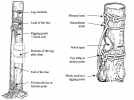
Figure 8.2 Topping down: rigging set-up and terms*
* Drawings by B. Kotwica, reprinted from Donzelli, 2000 and Donzelli, Lilly 2001, courtesy of International Society of Arboriculture, Il, USA
Now a big extract from the text:
The mechanical model behind the calculations in Rigging 1.0 is the same as that used by Peter Donzelli to estimate line forces in his research. The basic assumption is a full energy transfer into the rope. As the log falls from its initial position, until it begins to be slowed down, its potential energy is transformed into kinetic energy (speed). As the log is being stopped by the rope, this model assumes that the full amount of potential energy is being transferred into, and stored in the rope in the form of, strain energy (Donzelli 2000). Therefore, the energy transfer in this simplified model can be expressed by the assumptions made in the following equations:
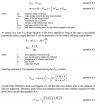
While these simplifications allow for an easy calculation of prospective peak forces, the model neglects a number of important factors. The stem, the anchor slings and the knots are all assumed to be absolutely static and not moving, when in fact they provide a certain amount of flexibility. Friction in the rigging system, slippage of rope and slings, and aerodynamic resistance during the fall, are all neglected, despite the fact that energy is dissipated by these effects. Also the tree, being more or less flexible depending on its slenderness, will damp the forces generated. Therefore, the calculations will always err on the side of caution.
Comparisons of peak forces calculated by Rigging 1.0 with loads measured in drop tests in a realistic rigging scenario, have shown that the load is overrated by a factor ranging from 2 to 3, when using the simple equation above. The same is true for comparisons of drop tests carried out by Donzelli et al (1998) when similar deviations were noted. Such considerable deviations can hardly be accounted for by the factors that are neglected in this simple energy transfer model (some of which are listed in the previous paragraph). Obviously, the mechanical model used by both Peter Donzelli and Rigging 1.0 does not sufficiently match the real kinematical process in rigging operations.
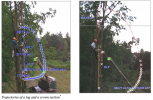
Evaluation of video footage of drop tests carried out by Peter Donzelli and ArborMaster Inc showed significant variations in motion and trajectory (flight path) of logs, as well as a different energy transfer to that presumed by the simple mechanical model. Therefore, Brudi & Partner TreeConsult carried out a pilot study in 2005 to record the kinematics of a standard rigging scenario, and to determine the peak forces and line angles under realistic conditions. Drop tests carried out in the course of the present study were also recorded on video, to enable kinematical studies of actual on-site rigging operations.
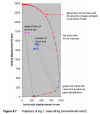
Me again, after all their cool setup and work this came out:
Some more text:
8.3.4 Load angles
The effect that a peak force generated in the line will have on the rigging and tree, depends considerably on the angle at which the load acts. In the tests carried out during the present study, the angle formed by the two legs of the lowering line was fairly constant. It ranged between 32 and 42° from the vertical. Due to the effect of friction in the block, the force is not disseminated evenly between the lead and the fall of the line. The actual resultant force acting on the anchor point also depends on the friction in the block.
Donzelli studied the friction properties of four arborist rigging blocks (Donzelli 1999b). He determined that static friction (the force required to start movement) is always significantly greater than the dynamic friction (the force resisting the moving load). For loads greater than 100 kg, the friction effort* ranged between 5 and 20% for the blocks studied. Donzelli stated that the friction properties depended on the diameter of the sheave, with greater diameters generating less friction.
From data for other pulleys (Sheehan 2004), and given the fact that the rope wraps around the sheave by less than 180° (i.e. not an entire half turn) at the time the peak force occurs, it seems reasonable to assume that dynamic friction in a typical arborist block amounts to roughly 10%. This leads to a reaction force of 1.8 times the tension in the lead end of the line, acting at an angle that is slightly greater than the bisector (i.e. 19.5° from vertical for a rope angle of 37°).
Me again, a takeaway from this is that tip force x sin 19.5 deg is hitting the trunk sideways, or tip force x 33% ! Surprise. Pretty big. Here's a nice diagram:
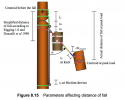
There's a real comprehensive equation to go with it. I think in these guy's work they account for the block sling grinding down the trunk, knots and friction device slippage, getting lower due to rope stretch and noting the 19.5 degree vector of the force at the tip.
more extracted text:
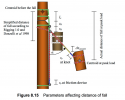
Cutting smaller sections of wood is a very efficient way of reducing the peak forces generated in a worst-case scenario. Detter et al (2005) described the centre of gravity as being closer to the pivot point in shorter logs (i.e. the distance to the block’s axis is smaller). Therefore, besides the obvious reduction in weight, the distance of fall also decreases. Cutting a log to half the length of another will reduce the eventual peak force to much less than half, usually to about one-third.
The distance of fall is not measured from the attachment of the rope, but from the log’s centre of gravity (centroid). In a mostly cylindrical section, the centroid is located in the middle of the log’s length. Therefore, it does not matter where the rope is attached, as long as it is located below the centre of gravity so that the log does not flip over (cf Donzelli 1999a).
extract about rope:
Static rope has a high rope modulus, expressed by a steep gradient of the load vs elongation curve and illustrated in purple in the graph below. Dynamic ropes show a flatter line (blue in the graph). The elastic energy stored in the ropes is depicted by the coloured triangles. At low force levels, little energy is stored in the rigid rope (yellow triangle). To take up as much energy as the flexible rope at the same load (green and red triangle having the same area), the rigid rope must be loaded with much greater force.
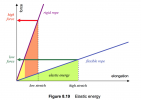
me again - There was a thread somewhere where it was noted one rope mfr (Samson?) actually rated their ropes based on this elastic energy triangle which is just a secondary offshoot of elasticity and load capability. I don't believe there was explicit mention of damping factor of the rope, but there is some. Makes life even more complicated than just elasticity. The report gets more detailed with energy balance analysis and calculation of resonant structures like the trunk, but the next paragraph segues into my 5 cents:
extract - This phenomenon is more easily described by the gradual deceleration of the log. The rate at which the speed decreases is responsible for the lower forces generated when letting the log run. Remember, force is defined as mass times acceleration. Acceleration is the change of momentum of an object, or the change in its speed over time. Acceleration is great if the speed changes quickly. It is low if the speed alters more slowly and the change happens over a longer period of time (cf Bacon 2002). Since mass remains constant at the speeds being considered, it becomes clear that the forces generated are lower when a body is decelerated more slowly, even though the total energy turnover may be greater.
So, in other threads I've put out a simple analysis to figure out trunk rigging forces I guess using a Donelli model. Except I didn't identify the contribution of the sling/tether to the block adding free faff distance. I also left out the 19.5 degree vector at the tip and left out block friction. Here's a recent one:
"Punch line on dynamics was with 2 G's on the line you stop as fast as you fall and that leads to 4x log load on the tip, if using a pulley. Work outwards from that baseline. 2 G's on the line means log falls (accelerates) for 10 ft, you slow it down in the next 10 ft of "run". If you have overhead friction, the non-log side sees less tension and the tip sees less than 4x the log weight. Let it run 20 feet to stop might be 1 1/2 G's so only 3x the log weight at the tip. etc Run it only 5 feet might be 3 G's (not the exact answer) and you could be at 6x log weight at the tip.
That all ignores rope stretch/shock absorbing which can apparently be very effective."
Figure 8.2 Topping down: rigging set-up and terms*
* Drawings by B. Kotwica, reprinted from Donzelli, 2000 and Donzelli, Lilly 2001, courtesy of International Society of Arboriculture, Il, USA
Now a big extract from the text:
The mechanical model behind the calculations in Rigging 1.0 is the same as that used by Peter Donzelli to estimate line forces in his research. The basic assumption is a full energy transfer into the rope. As the log falls from its initial position, until it begins to be slowed down, its potential energy is transformed into kinetic energy (speed). As the log is being stopped by the rope, this model assumes that the full amount of potential energy is being transferred into, and stored in the rope in the form of, strain energy (Donzelli 2000). Therefore, the energy transfer in this simplified model can be expressed by the assumptions made in the following equations:
While these simplifications allow for an easy calculation of prospective peak forces, the model neglects a number of important factors. The stem, the anchor slings and the knots are all assumed to be absolutely static and not moving, when in fact they provide a certain amount of flexibility. Friction in the rigging system, slippage of rope and slings, and aerodynamic resistance during the fall, are all neglected, despite the fact that energy is dissipated by these effects. Also the tree, being more or less flexible depending on its slenderness, will damp the forces generated. Therefore, the calculations will always err on the side of caution.
Comparisons of peak forces calculated by Rigging 1.0 with loads measured in drop tests in a realistic rigging scenario, have shown that the load is overrated by a factor ranging from 2 to 3, when using the simple equation above. The same is true for comparisons of drop tests carried out by Donzelli et al (1998) when similar deviations were noted. Such considerable deviations can hardly be accounted for by the factors that are neglected in this simple energy transfer model (some of which are listed in the previous paragraph). Obviously, the mechanical model used by both Peter Donzelli and Rigging 1.0 does not sufficiently match the real kinematical process in rigging operations.
Evaluation of video footage of drop tests carried out by Peter Donzelli and ArborMaster Inc showed significant variations in motion and trajectory (flight path) of logs, as well as a different energy transfer to that presumed by the simple mechanical model. Therefore, Brudi & Partner TreeConsult carried out a pilot study in 2005 to record the kinematics of a standard rigging scenario, and to determine the peak forces and line angles under realistic conditions. Drop tests carried out in the course of the present study were also recorded on video, to enable kinematical studies of actual on-site rigging operations.
Me again, after all their cool setup and work this came out:
Some more text:
8.3.4 Load angles
The effect that a peak force generated in the line will have on the rigging and tree, depends considerably on the angle at which the load acts. In the tests carried out during the present study, the angle formed by the two legs of the lowering line was fairly constant. It ranged between 32 and 42° from the vertical. Due to the effect of friction in the block, the force is not disseminated evenly between the lead and the fall of the line. The actual resultant force acting on the anchor point also depends on the friction in the block.
Donzelli studied the friction properties of four arborist rigging blocks (Donzelli 1999b). He determined that static friction (the force required to start movement) is always significantly greater than the dynamic friction (the force resisting the moving load). For loads greater than 100 kg, the friction effort* ranged between 5 and 20% for the blocks studied. Donzelli stated that the friction properties depended on the diameter of the sheave, with greater diameters generating less friction.
From data for other pulleys (Sheehan 2004), and given the fact that the rope wraps around the sheave by less than 180° (i.e. not an entire half turn) at the time the peak force occurs, it seems reasonable to assume that dynamic friction in a typical arborist block amounts to roughly 10%. This leads to a reaction force of 1.8 times the tension in the lead end of the line, acting at an angle that is slightly greater than the bisector (i.e. 19.5° from vertical for a rope angle of 37°).
Me again, a takeaway from this is that tip force x sin 19.5 deg is hitting the trunk sideways, or tip force x 33% ! Surprise. Pretty big. Here's a nice diagram:
There's a real comprehensive equation to go with it. I think in these guy's work they account for the block sling grinding down the trunk, knots and friction device slippage, getting lower due to rope stretch and noting the 19.5 degree vector of the force at the tip.
more extracted text:
Cutting smaller sections of wood is a very efficient way of reducing the peak forces generated in a worst-case scenario. Detter et al (2005) described the centre of gravity as being closer to the pivot point in shorter logs (i.e. the distance to the block’s axis is smaller). Therefore, besides the obvious reduction in weight, the distance of fall also decreases. Cutting a log to half the length of another will reduce the eventual peak force to much less than half, usually to about one-third.
The distance of fall is not measured from the attachment of the rope, but from the log’s centre of gravity (centroid). In a mostly cylindrical section, the centroid is located in the middle of the log’s length. Therefore, it does not matter where the rope is attached, as long as it is located below the centre of gravity so that the log does not flip over (cf Donzelli 1999a).
extract about rope:
Static rope has a high rope modulus, expressed by a steep gradient of the load vs elongation curve and illustrated in purple in the graph below. Dynamic ropes show a flatter line (blue in the graph). The elastic energy stored in the ropes is depicted by the coloured triangles. At low force levels, little energy is stored in the rigid rope (yellow triangle). To take up as much energy as the flexible rope at the same load (green and red triangle having the same area), the rigid rope must be loaded with much greater force.
me again - There was a thread somewhere where it was noted one rope mfr (Samson?) actually rated their ropes based on this elastic energy triangle which is just a secondary offshoot of elasticity and load capability. I don't believe there was explicit mention of damping factor of the rope, but there is some. Makes life even more complicated than just elasticity. The report gets more detailed with energy balance analysis and calculation of resonant structures like the trunk, but the next paragraph segues into my 5 cents:
extract - This phenomenon is more easily described by the gradual deceleration of the log. The rate at which the speed decreases is responsible for the lower forces generated when letting the log run. Remember, force is defined as mass times acceleration. Acceleration is the change of momentum of an object, or the change in its speed over time. Acceleration is great if the speed changes quickly. It is low if the speed alters more slowly and the change happens over a longer period of time (cf Bacon 2002). Since mass remains constant at the speeds being considered, it becomes clear that the forces generated are lower when a body is decelerated more slowly, even though the total energy turnover may be greater.
So, in other threads I've put out a simple analysis to figure out trunk rigging forces I guess using a Donelli model. Except I didn't identify the contribution of the sling/tether to the block adding free faff distance. I also left out the 19.5 degree vector at the tip and left out block friction. Here's a recent one:
"Punch line on dynamics was with 2 G's on the line you stop as fast as you fall and that leads to 4x log load on the tip, if using a pulley. Work outwards from that baseline. 2 G's on the line means log falls (accelerates) for 10 ft, you slow it down in the next 10 ft of "run". If you have overhead friction, the non-log side sees less tension and the tip sees less than 4x the log weight. Let it run 20 feet to stop might be 1 1/2 G's so only 3x the log weight at the tip. etc Run it only 5 feet might be 3 G's (not the exact answer) and you could be at 6x log weight at the tip.
That all ignores rope stretch/shock absorbing which can apparently be very effective."
Attachments
Last edited:
 ) If the force reduction is velocity independent, x10 or more would almost remove down line tension but I think the rope's mysteries introduce velocity dependence based on my BMS Belay spool experiences.


