Champion Monterey Cypress?

Gerald_Beranek

New member
Location
Ft. Bragg, Ca.
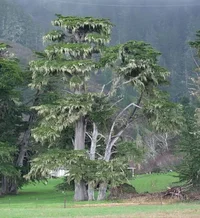
Largest and tallest cypress on the Mendocino coast I've seen in all my years. If it's not a champion it is the prettiest for sure. Have yet to measure the tree, but will have all the numbers by this spring.

She's a beaut.
213353-cypressr.jpg
 

Attachments

  • 213353-cypressr.webp
    213353-cypressr.webp
    69.1 KB · Views: 51
That's a great looking looking tree.

Have you ever stopped by to the the Champion Monterey Cypress, coming into the south side of Brookings, Oregon? It was the national champion like 10 years ago, now just the largest in Oregon. A guess is that California might be where the new largest is located.

The one in your image is a prettier tree than the one up by Brookings. Thanks for the photo.
 
Yeah, Mario, I've been to the cypress in Brookings. Quite large around, not much in height and in a state of decline. It could really use some work.

But even the one next to it is a pretty nice tree.
 
Those are wild looking trees. I'll never forget the pics in your book of the big one you reduced....tiring just imagining all the work it musta took.
 
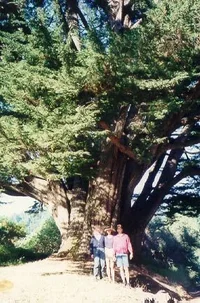
Wow that's a good looking tree. According to American Forests, the current champ is in Pescadero County, California. It's 102 ft tall with a 111 ft average crown spread and DBH of over 14 and a half feet (!) Attached is a photo I pulled off the California Registry of Big Trees webpage.
 

Attachments

  • 213531-Cupressusmacr2.webp
    213531-Cupressusmacr2.webp
    29.9 KB · Views: 99
The cypress in the pic I posted will no doubt fail on points in crown spread, but it is a single tree too. Not a co-dominant like the champ.

The system used for measuring and garnering points for height, spread and girth isn't a very good one. IMO. For one because it fails to mention or make the distinction between single trees and their codominant counterparts. Which are two totally different physical manifestations of the same thing.

And too, taper of the bowl isn't fully appreciated either. A swell butt specimen can garner more points that a full size even tapered trunk that may have three times the volume.

It is what we have to work with I guess.
 
I agree completely: the current champ does look to be more than one stem at ground level. According to the American Forests standards, which the state registries should reflect, one should measure only the largest stem of such trees, not the whole mess. In reality tho, responsibility for the California Registry has changed hands many times in the past decade, and keeping measurement standards consistent over such a large state is hard to begin with.

Still, you should measure and submit that purrty tree: if the current champ dies or is DQ'ed then they'll look to the other nominations for a new champ.
 
The tree is about 30 miles south of my place on Hwy 1. Well, 200 hundred yards east of the highway anyway.

That lichen grows on practically every mature tree near the ocean that is exposed to the northwesterly winds. All the locals just call it Spanish moss, but it does have a botanical name. Of which I don't know.
 
[ QUOTE ]
The tree is about 30 miles south of my place on Hwy 1. Well, 200 hundred yards east of the highway anyway.

That lichen grows on practically every mature tree near the ocean that is exposed to the northwesterly winds. All the locals just call it Spanish moss, but it does have a botanical name. Of which I don't know.

[/ QUOTE ]

Curiousity got me to Googling. I think it may be called Lace Lichen, a real lichen. Spanish Moss back in the SE is a plant in the Bromeliad family.

That lichen really dresses up those old trees nicely.
 
Pretty sure the lichen is an Usnea spp. which around here is called Old Man's Beard. In Oregon we mostly have that at the tops of old growth conifers in the coast range and wetter parts of the cascades.

mdvaden, you're right that it's a true lichen unrelated to spanish moss, which is a bromeliad and a vascular plant. However, the genus name Usnea is a reference to the fact that it looks like spanish moss, which is Tillandsia usneoides.
 
[ QUOTE ]
Pretty sure the lichen is an Usnea spp. which around here is called Old Man's Beard. In Oregon we mostly have that at the tops of old growth conifers in the coast range and wetter parts of the cascades.


[/ QUOTE ]

That Old Man's Beard is sort of looks like nature's tinsel.

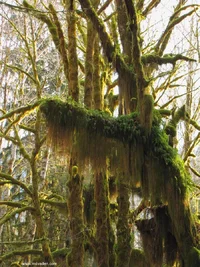
One more natural drapery I enjoy is the plant Oregon Spikemoss. Here's some from near Quinault, last December. Farthest south I've seen it is in Jedediah Smith redwoods. I recall someone saying they saw some near Klamath.

214475-selaginella_700.jpg
 

Attachments

  • 214475-selaginella_700.webp
    214475-selaginella_700.webp
    205.6 KB · Views: 29

New threads New posts

Back
Top Bottom