evo
Been here much more than a while
- Location
- My Island, WA
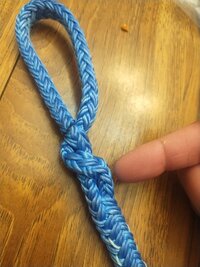
This one has the most bunching at the Brummell?3/8 dead eye with locking brummel from teufelberger t rex instructions
Follow along with the video below to see how to install our site as a web app on your home screen.
Note: This feature may not be available in some browsers.
This one has the most bunching at the Brummell?3/8 dead eye with locking brummel from teufelberger t rex instructions
Can you clarify? Are you talking about just an eye to eye with normal buries? Vs the hollow braid hitch cord splice that retains equal rope diameter?It occurred to me that a better test of the dead eye would be to have a straight pull of opposing, but the same, dead eye construction with space in between the buries.

Yes, an eye and eye with normal buries that allow for full bury and taper that do not overlap.Can you clarify? Are you talking about just an eye to eye with normal buries? Vs the hollow braid hitch cord splice that retains equal rope diameter?
No. That is from jostling around prior to lock stitching and a small amount of the bury working out. I knew about this and sent it anyway to see if it affected the strength.This one has the most bunching at the Brummell?
...forgot to attach thisThis one has the most bunching at the Brummell?
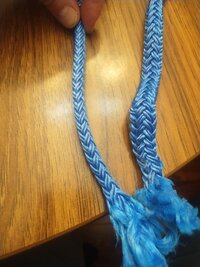
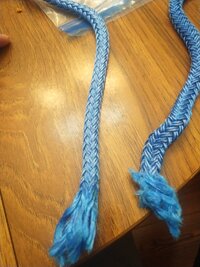
While I had that one out, I am pointing out that it is flat and glazed where I assume it went around the bollard and also broke well below the bury and closer to this point....forgot to attach this
I don't think the dead eye splices were sufficiently tested. I think opposing dead eyes would be a better test.I’m curious on why it broke at the bollard. Bear with me, we have been told that a Brummel reduces the strength but is much better than a knot. A straight bury is stronger but less secure and requires a longer bury.
If your tests are showing consistent breaking at the bollard how can the actual strength of the splice be tested? Other than ‘welp’ it’s stronger than the part of the rope that broke.
I’m curious on how many wraps, how tight the wraps were and if there was any slack left before locking off the tail.
Perhaps it wasn’t milked, or pulled tight, before wrapping around the bollard.I’m curious on why it broke at the bollard. Bear with me, we have been told that a Brummel reduces the strength but is much better than a knot. A straight bury is stronger but less secure and requires a longer bury.
If your tests are showing consistent breaking at the bollard how can the actual strength of the splice be tested? Other than ‘welp’ it’s stronger than the part of the rope that broke.
I’m curious on how many wraps, how tight the wraps were and if there was any slack left before locking off the tail.
These are my thoughts, some type of human testing error?Perhaps it wasn’t milked, or pulled tight, before wrapping around the bollard.
It is 12 strand hollow braid. I think, video may confirm, that there is friction in the strands where the cordage is rounder in free space and flattened on the bollard. This is speculation.Perhaps it wasn’t milked, or pulled tight, before wrapping around the bollard.
I have heard that as the explanation for why they are built with 3 crosses. I made one years ago w 2 that we beat the hell out of, pockets shifting was never an issue.Do you think that the reason for the 3rd brummel is to lock brummel 2 in place in lieu of a bury? It would be interesting.

I have made some in 3/8" with out the 3rd cross through, and they let you know when you have pushed to much weight because the eyes shift a little. it isn't horrible, and would bet that it would break at least 3 times higher force than where I start to percieve some distortion. I did it that way to keep the pockets closer together for a sling that I use with a big Pinto.I have heard that as the explanation for why they are built with 3 crosses. I made one years ago w 2 that we beat the hell out of, pockets shifting was never an issue.
I wonder if having the pockets not locked could equalize load better? It just seems unnecessary to do the 3 crosses, but I'd be curious to see numbers on it