
Borer ID

marlinspiker

Participating member
Location
Pennsyltucky
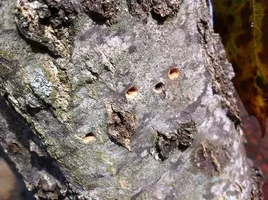
I have a property of Red Oaks and Pink Oaks that have these borer exits all over the place. Some of the Red Oaks appear to be checking out and could possibly have BLS. The holes are minute measuring in the millimeters. attached is an image. any help would be much appreciated.
 

Attachments

  • 299258-borers.webp
    299258-borers.webp
    135 KB · Views: 133
I can't find a clear match in any of my books and I don't know the species in your area.

These small girdling holes look like they are possibly a Scolytid beetle of some type. |It looks a lot like the ash bark beetle we have here. But, if this is a scolytid, probably a different species. Debark a dead section and look at the pattern of the galleries beneath.

There are some Scolytids, genus Xylosandrus (Ambrosia beetles)that damage oak.

You might want to start there. These are just ideas. I have little clue about your region. Just wasting bandwidth here really...
 
tyk01_sapsucker.jpg
 
Well you have solved something I was looking into, can the ambrosia beetle eat any hardwood tree? This tree also had wounds like that, but it was insanely dead. I thought it was more likely a wood pecker was going after them s.o.b.s.
 
but could what they are after be affecting the overall canopy health? i.e. ambrosia beetle. I guess I should go back and disect some of the cambium layer.
 
"bacterial leaf scorch."

thanks MS, it came to me after I posted the post.


"but could what they are after be affecting the overall canopy health? i.e. ambrosia beetle."

The birds are definitely going after some borer. When attacked by bark beetles, trees emit ethanol to attract woodpeckers (could be some symbiosis going on there).
 

New threads New posts

Back
Top Bottom