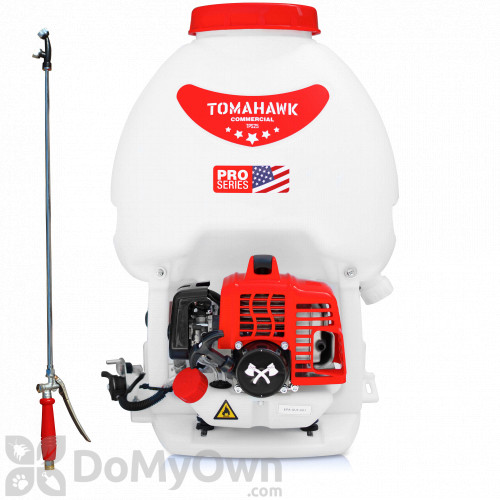
I usually spray in natural areas. I like battery power for high % cover treatments in natural areas, and for spraying 15-25 foot-high vines. Hand pump sprayers are better for low % cover at about twice my head height or lower.
I have a bunch of Milwaukee M18 Fuel battery powered tools, so I'll be trying out their backpack sprayer system next time I need one. The tanks switch out, so you can buy extra tanks if you want to streamline your mixing efficiency.
Last time I used battery sprayers was a few years ago and the company - Fastpac - sold. They were the only company in the market at the time and the units performed well.
I can usually rely on Solo to make a good sprayer.
Lastly, you probably know this - application rates vary greatly between applicators and are the largest factor influencing how much pesticide gets to the target. I feel like a battery-powered sprayer is probably going to lay down 2-4 times more spray, and the awareness of the applicator will determine whether it is closer to 2x or 4x. I consider myself aware, but I think I still get into that 2x area. I accidentally sprayed 1% triclopyr once, on blackberries bordering a 6-acre farm parcel. I was using a 50-gallon gas-powered tank sprayer. I was trying to apply 2.0% to compensate from the 2.5% that I would have applied with a hand pump sprayer. For ease of calculation I calculated everything for 1% with the intention of doubling it, but I forgot to double it... In part, I forgot because this really chatty neighbor kid was in my ear and there was a storm predicted to roll in later in the day, so I rushed. I remembered later that night and agreed with the property owner to wait and see if the treatment worked, then apply again if necessary. There was still very complete kill. It may be that blackberries die easily - I don't spray them often enough to know. But I never spray anything with that low a rate of triclopyr.
I have a bunch of Milwaukee M18 Fuel battery powered tools, so I'll be trying out their backpack sprayer system next time I need one. The tanks switch out, so you can buy extra tanks if you want to streamline your mixing efficiency.
Last time I used battery sprayers was a few years ago and the company - Fastpac - sold. They were the only company in the market at the time and the units performed well.
I can usually rely on Solo to make a good sprayer.
Lastly, you probably know this - application rates vary greatly between applicators and are the largest factor influencing how much pesticide gets to the target. I feel like a battery-powered sprayer is probably going to lay down 2-4 times more spray, and the awareness of the applicator will determine whether it is closer to 2x or 4x. I consider myself aware, but I think I still get into that 2x area. I accidentally sprayed 1% triclopyr once, on blackberries bordering a 6-acre farm parcel. I was using a 50-gallon gas-powered tank sprayer. I was trying to apply 2.0% to compensate from the 2.5% that I would have applied with a hand pump sprayer. For ease of calculation I calculated everything for 1% with the intention of doubling it, but I forgot to double it... In part, I forgot because this really chatty neighbor kid was in my ear and there was a storm predicted to roll in later in the day, so I rushed. I remembered later that night and agreed with the property owner to wait and see if the treatment worked, then apply again if necessary. There was still very complete kill. It may be that blackberries die easily - I don't spray them often enough to know. But I never spray anything with that low a rate of triclopyr.