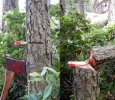
Back cut first

Basswood

Carpal tunnel level member
Location
Long island
I’ve seen a few guys (insta hero’s) put in their back cuts, wedge it and then face cut last. Is there any practicality to this?
 
It can work on smaller diameter trees with a slight back lean where the saw could get pinched and there's not enough room to put a wedge in with the saw in the kerf. I've done it a few times, but it's not something I rely on. Would much rather just toss a rope in the tree.
 
I’ve seen a few guys (insta hero’s) put in their back cuts, wedge it and then face cut last. Is there any practicality to this?
The back-cut first technique can be very useful when wedging over back leaners big or small.. Very similar to the back cut first routine when jacking over back leaners.
 
Regularly use with skinny spruce. Letter box is nice too. Caveat is we work in the woods a bunch where practice is lower stakes. Rope or climb when needed.
 
Last edited:
Interesting, I can certainly see how it works. What’s the biggest you guys will make this kind of cut?
Really any size will work, but on bigger diameter trees you typically have enough room to put a wedge with the saw in the kerf.

Three big factors to consider are:

-Degree of lean. Some trees just can't be wedged over if they're leaning hard enough.
-Proximity to targets. If there is anything of value in the direction of lean, don't just rely on wedges, put a rope in it.
-Cutting ability. You have to get your notch bang on the first time as you won't have room to correct it after.
 
I’ve seen a few guys (insta hero’s) put in their back cuts, wedge it and then face cut last. Is there any practicality to this?
Hugely and it’s nothing new. It works great where there is wiggle room for the lay, on small diameter stuff that’s too big to push and too small for a wedge following the bar in the back cut.
Not to be used around targets, and just for the luxury of getting the tree to go the direction you want
 
I saw Inbred Jed do it on a backleaner towards a property, backcut, wedge it hard, then facecut, worked great.

I would not have the stones.
 
Love me some Jed. Genuinely nice human being and a great tree man.. The back cut first method works great around structures as long a you have the experience and understand what you can get away with when wedging over back leaners...It also works well on larger trees (I have personally use the method on over 5ft dbh trees).
 
Thoughts on back cut first vs letterbox @southsoundtree ?
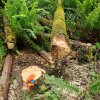
Rico is the local authority on backleaners. I've pounded over many back-leaners, live and dead.

In my world, Letterbox just means gutting the hinge/ cutting the middle, leaving strong corners. This is Brit speak for mail slot (like houses' front doors used to have instead of a mail box). This is Basically like felling a hollow tree.

This can reduce barberchair risk in a full- width hinge, severing fibers that are then under less to no strain by the hinge. Less, as I postulate there is some lateral transfer of strain from the corners toward the middle.


I will gut the hinge from the rear when I've tipped a tree on wedges, but it isn't ready to fall as the hinge's resistance to bending is greater than gravity's pull. If the tree tips with you bar through, especially if you've used a facecut other than standard conventional, your bar tip and chain are going to to be reshaped. Might catapult your saw...idk.

I will typically, if safe footing allows, "tickle the hinge" on the front with the bar tip from the side, not right in front, removing some of the center hinge. Again, good awareness not to get a trapped bar tip and lose your saw.

The letter box/ gutting from the front toward the rear allows 2, 3, Maybe 4 (never tried, probably won't) wedges to be stacked with wood between them, with the additional wedge slots bore-cut lower than the first, from the rear. 20220610_124032.jpg
This was last week with a tall, backleaning, forest Red Alder.
Setting a line would have been a rear chore (I like "lazy" treework, along with "boring" treework... @ClimberClyde can attest).

(Side note: shaving the bark off the hinge lets you see the wood, and if you are starting to fracture the wood and/ or rotate the tree about the hinge)


This allows 3 to be stacked, and prevents excess sideways movement of the wedges, as they are corralled in the bore-cut slots.
Space the slots to allow the wedges not to touch on the flat end.
When the wedges are driven hard, compressing the wood, the sawyer finishes the appropriate level of backcut on both sides (always the top, so far IME), and pounds the tree over.

(Side note: wedging is part finesse, part power.)


Nylon plates (amongst other spacers) can be stacked with one wedge to allow more lift without fighting spitting out wedges one a single layer of wedge(s) is driven, opening the backcut, partially tipping the tree.

On the TH, Stig, a highly experienced, graybeard Danish logger, who had also worked in Switzerland, says he has never stacked wedges in about 40 years. He introduced the stacking plates. I've bandsawn a kitchen cutting board for some plates. I could use more and thicker plates. Need to source some 1/2"+ sheet nylon ir similar. Probably could use a an appropriately- chosen wooden board, but that will absorb water. Mind the grain and defects.


Small trees can generally be face-cutand then wedged by cutting the left or right half of the back cut, driving a fast-tapering wedge, then complete the backcut, insert a second wedge in the second half of the backcut, and drive them both, tipping the tree.
Some call that "1/4 cutting".


A letter box, all the way through, also allows you to insert and drive a wedge, finish the two sides of the back cut without sitback and then pound it over, possibly with stacked wedges or wedge and plates.
 
Love me some Jed. Genuinely nice human being and a great tree man.. The back cut first method works great around structures as long a you have the experience and understand what you can get away with when wedging over back leaners...It also works well on larger trees (I have personally use the method on over 5ft dbh trees).
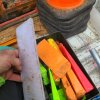
Do you find that backleaning trees will sit back to some degree no matter what amount of wedging is done?
Is it due to softer wood?

I use a bunch of wedges...many hands makes light work. Guys I've worked with would use a pair where I'd use 4-5+ in a big tree, and as many a possible if sap-rot is present, or terribly hollow.


I'd love some time in CA cutting with you. I could learn a lot from your wealth of knowledge.

I'll bring my own springboard.
 
Back cut first yesterday, made me think of this tread. Skinny fir needed a wedge, no room to follow the bar obviously and it would have sat back and trapped the saw if you'd tried to face and put in the back cut second. This is the primary situation I use the technique and one I find myself in a lot in our crowded forest. 5.5" wedge for scale.

00 back cut first.jpg
 

New threads New posts

Kask Stihl NORTHEASTERN Arborists Wesspur TreeStuff.com Teufelberger Westminster X-Rigging Teufelberger
Back
Top Bottom