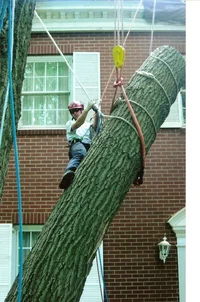
Another thinker

You gotta love included bark!
smirk.gif
Job security for us.
pbj.gif
 
I would have considered wedging the back cut and boring from the back.
If the tree comes ahead, your saw is on the wrong side not to mention yourself.
If you weaken the hinge by boring, the tree comes ahead and pinches the bar then you release tension on the tree to free the bar the now weaker hinge could break leaving you without any control.
If nothing else it would at least reduce the risk to you and the saw.
 
Ah, that makes sense of the photo now. Did you release some of the tension on the pulling line to prevent the stem moving forward and pinching the bar when boring the hinge?
 
[ QUOTE ]
Ah, that makes sense of the photo now. Did you release some of the tension on the pulling line to prevent the stem moving forward and pinching the bar when boring the hinge?

[/ QUOTE ]

Yes, the tension was released. There was absolutely no way the spar was going to fell without MA. I don't even think single wedges woulda brought it over. Maybe double (stacking).
It had to be a pretty accurate fell (between the drive end and the utility wires). We wanted to leave as much 'live' hingewood as possible. Plowing out the center is a better option than 'thinning' the hinge.
 
The reason I asked was that you said the grcs had a hard time picking it up. What I invisioned was using 4 regular blocks, essentially having a "double" DWT. Do you see any possible problems with that?


WP
 
We did the same idea on a large red oak stem(whole tree) using the GRCS and pullies. Worked great had to put a second line to hold the stem while I moved the raising rig down. Then I would take a chunck off with the second rope.
 

Attachments

  • 91312-redoak.webp
    91312-redoak.webp
    196.4 KB · Views: 111
I don't disagree that double sheave pullies would make it easier and faster to set-up. I was thinking since Norm decided on using 3/4" rope, I'm guessing most of us wouldn't have suitable sized double sheave pullies for this application.

Just a thought.


WP
 
I think he said that the sling was 3/4" DB


[ QUOTE ]
The block is anchored with a cow hitch using a 3/4" BD.

[/ QUOTE ]


and the rope was 9/16" DB


[ QUOTE ]
...we set up a DWT using a 9/16's poly/dyneema DB.

[/ QUOTE ]


But you're right, most people would not have double-sheave pullys of that size.
 
[ QUOTE ]
[ QUOTE ]
We wanted to leave as much 'live' hingewood as possible. Plowing out the center is a better option than 'thinning' the hinge.

[/ QUOTE ]

True, Norm. And when felling a normal stick there's less need to have full width holding wood, so boring the center is always a good idea. In both cases, it allows for thicker hinge width which is easier to work with.

Yesterday, I was dropping 10 foot doug fir sections. Last cut before felling a 25-30 foot spar was a 30 inch cut...I had my 7900 with 32 inch bar on, and it was a mighty delicate maneuver to center bore the hinge with all that bulk....no desire to have a kickback!!!

This video is of felling the butt, which was simple..though it was a 44 inch cut....
http://www.youtube.com/watch?v=ZsE50_i03n0
 
You're illustration would create a 4 to 1 MA. There is, however, a more efficient system. It only requires 3 single pulleys. You will need 2 different ropes. It's called the 'piggyback' system. We have used it in combination with a port-a-wrap for lifting when we didn't have the GRCS with us.

See attachment
 

Attachments

[ QUOTE ]
You're illustration would create a 4 to 1 MA. There is, however, a more efficient system. It only requires 3 single pulleys. You will need 2 different ropes. It's called the 'piggyback' system. We have used it in combination with a port-a-wrap for lifting when we didn't have the GRCS with us.

[/ QUOTE ]
But note two concerns with this piggyback system:
1) you're limited in range of movement (if H is the reach to the redirection pulley,
you move the object H/2; and
2) the green rope must now bear 1/2 the load (since it is doubled), as must
its block.

In the original, the 4 strands of rope all led to the object, and its resistance was
thus distributed over them.
But I think that THAT system would be more efficient were the haul line led to
the higher point, hauling on the farther end of the object, opposite to the drawing.

*kN*

 

New threads New posts

Kask Stihl NORTHEASTERN Arborists Wesspur TreeStuff.com Teufelberger Westminster X-Rigging Teufelberger
Back
Top Bottom