Another home made lowering device

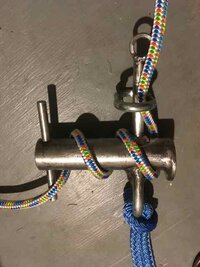
Hi all, I'm new here, but have been gleaning knowledge from the forum for awhile. I just finished this miniature version of a RC-type porty (I know the welds aren't pretty, but I have confidence in them). I have seen many home made devices on the internet, but not of this style and small size. I made it with 1 1/2" steel pipe, so it is 1.9" diameter, the same as the buckingham small porty. 1/2" seems to run well on it.

I have some questions after making this thing. I have not used a port a wrap before, but have plenty of experience with lines on bollards and capstans.

What opinions do you have about suitable cylinder diameters for different sizes of rigging lines?

Is a longer than absolutely necessary cylinder a benefit?

I have never seen or heard of a portawrap breaking. Does this ever happen?

Thanks!


porty 1.jpg
 
That's pretty nice looking. Great job on the build.

I have a Stein portawrap that took a hit from a log and bent the upper fairleads together. Still haven't tried to fix it yet.

I would say that a larger diameter pipe would give a stronger bend radius for larger diameter lines.
 
I like larger diameter tubes better than smaller.
And yes they can break. I have seen a pic of one that was squeezed to death using large diameter dyneema line and a forestry feller buncher.
 
Thanks, I see that Buckingham recommends up to 5/8 rope with their small porty, which has very similar dimensions to this one, 1.9" cylinder and that seems really big, does this actually work well on loads that you would need 5/8 for? I think the Stein RC-2000 has a 3" cylinder and is rated up to 5/8 rope, which seems reasonable.

This one is going to be for 1/2" only, the fairlead is even a tight fit on 1/2" line.

How do you like the looks of that Sterling Element 16 strand? I don't really care for the colors, but it was dirt cheap and seems top quality.
 
Thanks, I see that Buckingham recommends up to 5/8 rope with their small porty, which has very similar dimensions to this one, 1.9" cylinder and that seems really big, does this actually work well on loads that you would need 5/8 for? I think the Stein RC-2000 has a 3" cylinder and is rated up to 5/8 rope, which seems reasonable.

This one is going to be for 1/2" only, the fairlead is even a tight fit on 1/2" line.

How do you like the looks of that Sterling Element 16 strand? I don't really care for the colors, but it was dirt cheap and seems top quality.
i own the large buckingham portawrap and wouldnt want to use my 5/8“ lines on anything smaller.

i also own the mini buckingham porti, its not „broken“ but bent. buckingham is grinding away to much material were they are welding the attachment loop back together, creating a weak spot.

i used to use homemade lowering devices and people would tell me that its not a good idea… liabilities. since moving to store bought LD‘s, i broke two. on both ocassions the manufacturers told me that i had exceeded mbs of the device and they could‘nt do anything for me…
 
Thanks for the feedback Friedrich. I see that buckingham lists the large diameter at 2.4" OD.

I can understand the part about liability using homemade equipment, but as you pointed out, the manufacturer can claim overload and the user cant prove anything. In another industry I had a homemade lifting hook that straightened out when being misused with disastrous results. This has made me very cautious about my own creations.

I like making things like this, but if I don't set up a better place to weld, and practice my welding more, Ill probably just buy one if I ever need a large model.
 
Thanks for the feedback Friedrich. I see that buckingham lists the large diameter at 2.4" OD.

I can understand the part about liability using homemade equipment, but as you pointed out, the manufacturer can claim overload and the user cant prove anything. In another industry I had a homemade lifting hook that straightened out when being misused with disastrous results. This has made me very cautious about my own creations.

I like making things like this, but if I don't set up a better place to weld, and practice my welding more, Ill probably just buy one if I ever need a large model.
The smaller barrel will lead to more hockeling / add more twists to your rigging line as you go. Looks great for a half inch line. Nice work
 
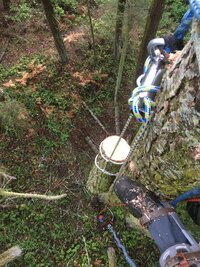
I tested it out on a spar and it works. Set up like this, the rope around the cylinder rubs on bark, creating unpredictable friction. I plan on correcting this by adding horizontal fairleads alongside the vertical ones, and adding some kind of protrusion to the back to hold the cylinder off the bark.

I'm working on gathering the gear I need to double whip down a 100'+ tree by myself with out too much descending.
LD22.jpg
 
I have not used a port a wrap before
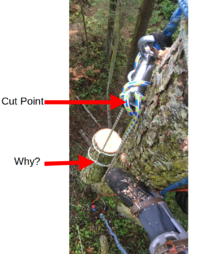
While this industry is like the wild west in the sense no one can tell you what to do or how to do it, your second picture looks like you are using your version of the portawrap as a primary rigging point. While it may work in that application to a certain degree, there are way better/safer tools to use to manage rigging forces. Using the portwrap as a primary rigging point is not ideal. Cons of using the portawrap as a primary rigging point:
  • Slack is introduced as a piece free falls before being caught which could lead to rope coming off the bollard and changing your planned friction
  • the coils on the barrel can overlap if enough slack is introduced before tension is applied when the piece gets caught. this can lock the rope on the barrel
  • you either have to lock the piece off or rush to stow your saw so you get hands on the rope to manage a controlled "let it run" descent.
  • Locking the piece off will always shock load your gear and the tree
  • if you try to catch the rope to control the lowering and miss, you have rope ripping up the tree at you and your hands are right next to the device. There's potential to lose fingers.
  • The rope on bark issue as you have already mentioned.
These were the concerns off the top of my head. Again, not saying you can't do it, but don't set yourself up for failure by having this setup being the only method in your tool box. There's a reason professionals do not use the portwarap in this situation.

Also, concerns as pointed out in the picture. Maybe this was staged for the pic but the rope passing over the bottom of the barrel edge could be a cut point if force is applied. I don't get why the rope is passing through the spliced eye? Seems cumbersome to do that. Or maybe I'm not seeing it correctly?
2022-12-29_18h16_55.png


Attached are two different portawrap mauals. If you've read through them, great. If not, maybe they'll help you better understand the device and help with the crafting of yours.
 

Attachments

Last edited:
Thanks for your post Phil. Some of your points have crossed my mind concerning what bad things might happen between when the wood breaks free and when the rope begins to catch it. I’ve seen some videos of lowering devices anchored at the base do some wild gymnastics during this time period as well. I’ll do some more research on other methods before I add more gadgets to the lowering device that should work better right side up. What method do you think would work best for lowering from aloft?

The picture on the spar is of about a 150 lb piece I snap cut, so I was able to hang my saw before I broke it off when I had the rigging line in one hand. It took some line on impact, but the bark friction stopped it quicker than intended. The rope passing over the sharpish edge of the barrel was just done to seize it for the picture, and I intend to weld a washer on there and round the edges. What looks like a spliced eye is a running bowline.

My statement about solo rigging a tree might seem overly ambitious for someone with my level of experience, but I’m not in a hurry.

Thanks again for the feedback and constructive criticism.
 
Solo rigging big pieces is dangerous even with a good amount of experience, in a hurry or not without a lot of experience it could end extremely badly especially if you don't have anyone else on-site watching you, which defeats the purpose of solo rigging.
 
That was a good idea to practice somewhere where property damage wasn't a consideration. It looks like you were in a wooded area.

I'll throw out one technique I picked up on the 'Buzz for your consideration - a vertical speedline. It keeps pieces from bouncing/rolling where you don't want them to go. If you have brush and limbs to pad the landing zone, you probably won't make any craters. Easy to execute solo, since you can just let pieces drop down the speedline. If you have plenty of slings, not a lot of up and down. It may be a decent substitute for lowering pieces in some situations.

I'm conservative and would not feel comfortable making the cut so close to my rigging on the piece. Looks like about an inch away in the photo. A little slip or shift and that half hitch loop could be gone. Unlikely to be catastrophic, but I don't like surprises.
 
Hi Dan, thanks for the smart alternative. I can see how that could be a good option for most situations. I have a bunch of 24kN aluminum non locking carabiners and I imagine they would be adequate for pieces of spar in vertical speedlining. As far as bombing log size, what would others be comfortable with on aluminum carabiners, nylon web slings, and 1/2 line?

That half hitch got my attention too, it slid too close to the edge. My second try I gave it more room, and the whole process worked better, but the bark on the barrel was unavoidable. I really can't think of a good solution to the bark problem that would work on small diameter spars. Plus trying that same method with a top is not something I'm willing to do.

I also just ordered a heavily discounted ISC rigging wrench, should be fun.

Thanks again
 
Hi Dan, thanks for the smart alternative. I can see how that could be a good option for most situations. I have a bunch of 24kN aluminum non locking carabiners and I imagine they would be adequate for pieces of spar in vertical speedlining. As far as bombing log size, what would others be comfortable with on aluminum carabiners, nylon web slings, and 1/2 line?

That half hitch got my attention too, it slid too close to the edge. My second try I gave it more room, and the whole process worked better, but the bark on the barrel was unavoidable. I really can't think of a good solution to the bark problem that would work on small diameter spars. Plus trying that same method with a top is not something I'm willing to do.

I also just ordered a heavily discounted ISC rigging wrench, should be fun.

Thanks again
with the rigging wrench and double whip tackle you can lower some decent weights.

i own a mini portawrap but use it only when i want to lock off loads (butt line) or when there is no fork/branches (driftline for stemwood)

otherwise i self rig a lot with natural crotch wraps. it will always raise some eyebrows.
there is a very good 2 part video on youtube by graeme mcmahon/ sherbrooke treeservice.

a problem with self rigging is the short amount of rope in the system potentually getting shockloaded.
 
... As far as bombing log size, what would others be comfortable with on aluminum carabiners, nylon web slings, and 1/2 line?
I like steel screw links for applications where the connector gets abused. Cheap and strong. The 1/2" size has a 9/16" gate opening. If they turn easily so you can roll the nut by swiping your gloved hand across it, they're pretty quick.

Tip - If a screw link turns stiffly, put a dab of lapping compound on the threads and run the nut back and forth until it loosens up.
 

New threads New posts

Kask Stihl NORTHEASTERN Arborists Wesspur TreeStuff.com Teufelberger Westminster X-Rigging Teufelberger
Back
Top Bottom