[ QUOTE ]
Tom,
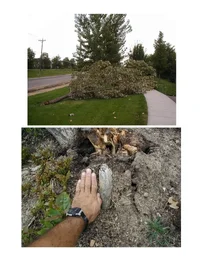
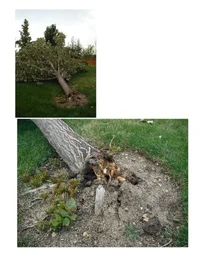
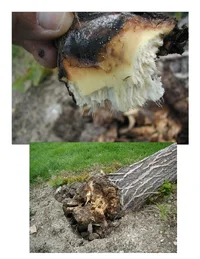
I am gonna take a shot in the dark here and say that your girdling root theory would most likely be cause by planting too deep. It looks like a younger tree and I don't see much if any root flair to it. It has that telephone pole look to it.
[/ QUOTE ]
Being buried too deep and girdling roots are usually the same kind of problem. Sometimes trees balled and burlaped are done so several times and you see more girdling roots.
This is so because every time they b and b a tree it pushes more dirt onto the stem, just as a function of the tree spades.
Even trees that are B and B only once can see roots curling up and back towards the stem before the burlap is broken down in the soil, particularly red maples around here. It's even worse with the synthetic material they sometimes use, because that doesn't break down at all.
You are right as well with the fact a tree buried too deep will form girdling roots, these type of roots usually form above the root flare if they are young. Older trees tend not to develop many adventitous roots above the flare, from what I have experienced. Maybe others have seen otherwise though.
It could be someone regraded after the tree had been planted causing girdiling roots to form. The tree seems pretty young so it might not be in this case. Another thing it could have caused failure is the use of synthetic twine when it was b and b causing the same effect.
Prior to the tree failing, say a year maybe two, I think a root crown excavation would probably not have saved this particular tree.
Steve





























 Free CEUs: February 05 & March 05 - 'Urban Forestry Today' Webcasts @ Noon (Eastern)








