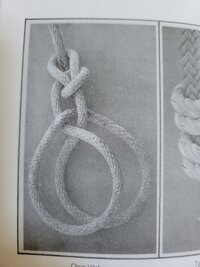
Short answer: Running DBY with a pre-fix of a Half Hitch, sometimes several Halfs in weak piece to spread out stress and better chance of keeping if piece starts to crush or crumble during lowering. Side forces are real on target, shipyards would put a 'spanner board' across top of crate lowered by sling on hook so the weight of the load x angle to hook did not crush crate on lift. i talk here about 2 forms of Half Hitch: terminating stopper Hitch vs. as a pre-fix like more of a Bend, continuing not terminating force flow. Also to other side of puzzle have placed noches in target at opposing arc points to bed rope into..
.
To be clear please, are we saying Clove unrolled/spun from Half Hitches around Standing Part or free ranging in tail?
>>Did Halfs come undone like from tail or Clove walk over leaving them?
.
Of course Half's need set harder to seat in stiffer line, Half's should have some tail after and be end to end train. knudeNoggin has related to me that fig8 free ranging in tail is better than Half Hitch by some tests. Clove is best as right angle pull on host, in fixed anchor position like most, so lengthwise pull/parallel to host already requires more care. Backwards pull on 2 cloves is what i like for lengthwise pull of throw line to real line tho as a greater pressure with like some Awning spice*. A pre-fix of spaced Half Hitch(continuous type) should resolve most issues. Half Hitch pre-fix spaced to running DBY in just rope. Or evolved to baby sling**, sometimes with the pre-fix of Half Hitch for larger or more unwieldy, as better capture. Hitching close to CoG thus might be problem in short stubby rollouts, where is a right angle pull as prescribed for anchor position, but perhaps less so for unfixed/free ranging position of load.
Reading between lines of comprehensive ABok for consistent princi-pals as sound wide base, is best i think. So much revealed, some passing comments seem innocuous on first tour, are missed golden nuggets later in context of examples, and so then that next lesson not seen quite as well. To me, Clove 'organically' wants to pull form side crossing, need to force to pull from close face already a downgrade to more pull open. To opposing face crossing(top in a downward pull) need to force and then further balance end pulls to keep position or crossing wants to go to most organic side crossing model, never naturally floating to load pull side/spin. Halfs made around Standing Part keeping forced position, but not in side position of cranking. A downside to massive ABoK, is teñd to see how many can tie and miss the connecting nuances in classic journey vs. destination form.
.
ABoK Lesson# 480/481/pg.077: 2/2 Taut & Open Prussic
i cut my teeth in our land on a doubled Cove of 2/2 Tautline even that that walks w/o fig8. limiter. Under hard use it would walk to limiter. Reverse top tier to be still 2/2 but as Open Prussic now gives counter torque of much less walk, if any, but religiously backup in lifeline use as part of whole mantra unbroken. i only look to crossings off host,against Standing Part/Backhands to give counter torque.
Side Note:
ABoK Lesson# 311/pg.1857: If the Half Hitch is reversed most of the torsion is eliminated and there is little tendency for the knot to twist.
.
Best science on a lengthwise pull, of standard lowering not at CoG, a Half Hitch(now talking about continuous Half Hitch type as if a pre-fix as if a Bend, not Termination Half Hitch as stopper) shown
ABoK Lesson# 1733+/pg.298+: CHAPTER 22: HITCHES TO MASTS, RIGGING,
AND CABLE (Lengthwise Pull) as VERY key to directionality of pulls, (classically leaving Timber behind for Killik).
ABoK Lesson# 1662+/pg.290+: CHAPTER 21: HITCHES TO SPAR AND RAIL
(RIGHT-ANGLE PULL) really starts the discussion with the simpler/cleaner forms of right angle to host . Timber starts as extended Terminating Half Hitch, always noting best to cross over not under to start as in ABoK Lesson# 1668/pg.290 Fig8 style. i do still require at least 3 tucks, and build to finish at opposing side of host(for greatest seating nip) than the pull source(load), preceding twirls just spacers to this highesest intensity position of nip.
.
Continuous Half Hitch pre-fix should resolve most issues.
Never have had problem with running DBY; if read rope in hand as compliant to arc around self, a first test for me on any rope. Real stiff ropes bring things more towards the no-go of monofilament for Bowline. I do pre-fix w/HH on a lengthwise/parallel to host pull. Switch to baby slings to always carry a top upgrade in utility to expansion, but ever so, so much more to realizing system as modular components , each then availed to own study. eye2eye sling choked , not as good as is note micro exactly immediately self adjusting. Even then may pre-fix w/HH on target and baby sling choked may be inline to small branch, pre-fix moderating hit to less output, giving proper inline pull on target, and another grab.
.
i have commented a fair amount of times about Ken/Rip showing Clove on load for lowering(for Clove and no HH pre-fix), but respect their works that i L-earned much from. Greater bark texture/CoF helps stop walk too, jam under branch as like Awning's lock also doable.
.
* I do prefer 2 spaced Cloves , in throw line around real rope as host, each pulled backwards (input after output so has to cross self). i find no greater profile problem on drag thru tree, and more self locking Awning Knot type forces brought into play, as tighter/more positive grab.
ABoK Lesson#1854/pg.310: Awning Knot(nice hold properly set and correct kick to release) ABoK . Lengthwise pull on Clove to opposing direction/not crossing self on lengthwise pull; would characterize to opposite somewhat forces of not self lock but trying to pick lock open in my crazy internal cartoon imageries...
.
**Evolved is apt as once committed to carrying carabineer/sling sets anytime went upstairs, understanding s and creativity in rigging advanced greatly. Rigs became component systems and each component got more intense focus/study. Used to increase or decrease frictions, several items at once sometimes, walk a main target to almost fail and hard drop another piece to sharp pull on slanted rig line to shear then main target across off roof etc.
Then there is this preserved jewel: