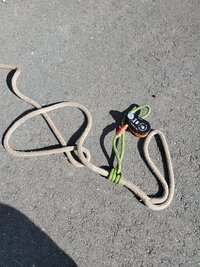
You can work backwards from max breaking strength. x5 or x10 recommended for working load, then rigging catch type (log or branch top) 5G's if typical, subtract out any aerial friction (even a bit in a normal block) then sling arrangement single "link" load focus or double/half due to basket or similar arrangement. You should be nowhere near breaking load territory. There's your desired log/top weight. You can size both sling and rigging rope. Pushing it hard is when bad things happen. Letting it run lowers the 5 G's portion to maybe 2 or 3 G's.
I think all plastics, nylon, spectra, polyester, vectran dislike temperature except kevlar - and it's unfavourable for slings due to its wear out characteristics too. So limiting sliding energy goes across the board for all the common materials.
I watched a bunch of Yale test video once. Unsettling that the tech is quoting tensions in units of either work ft lbs or torque ft lbs. Then does an energy calc for the drop but neglects to reveal the tension the rope broke at. Or whether the measuring equipment is capable of accurately recording the short sharp tension spike. In another video when they were about to reveal the meaning of life with absorbed drop energies it didn't work out and the analysis just fizzled and ended. I recommend reading the HSE report, ponder some, and re-read the parts that seem difficult to follow. Took me several tries.