TreeCo
Carpal tunnel level member
Re: 10 to 1 fiddleblock set
[ QUOTE ]
Wow! Where's the hauling line?
You're using the wrong term. Each block has 5 <u>SHEAVES</u>.
from http://members.aol.com/donnl/gloss.html
reeving: A term used to describe the path of the wire rope through a system of blocks. A reeving diagram is a pictorial rendering of the desired path for the wire rope.
Your photo shows the "natural" instinct to have all of the rope runs parallel and the two pulley axles parallel. I've never used more than 2 double pulleys in a MA system, but as I understand, when using more, the convention is to have the two pulley axles oriented at 90-degrees to each other. I suppose that the reason for that is probably to avoid rope twisting. It's most likely not an issue with us anymore, however, because of the use of braided rather than laid ropes.
[/ QUOTE ]
Thanks for the info on the correct terms and the pdf on reeving. I've only used this system a few times and I'm sure it is going to work better with a modern rope and reeved correctly.
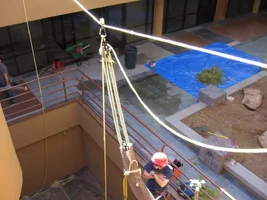
The hauling line is shooting over the right side of the camera. It is tied off to a tree and I've got a block of wood hanging in tongs to keep the ropes straight (not shown in the photo) . The rope is manila 3 strand and does want to twist up with no load. I'm sure the hauling line coming from the middle of the top block Vs. how I have it coming from one side is going to work a lot better.
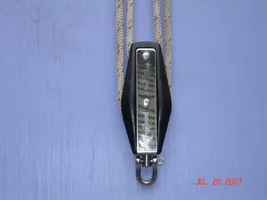
I have no idea how old these blocks are. They look military.
[ QUOTE ]
Wow! Where's the hauling line?
You're using the wrong term. Each block has 5 <u>SHEAVES</u>.
from http://members.aol.com/donnl/gloss.html
reeving: A term used to describe the path of the wire rope through a system of blocks. A reeving diagram is a pictorial rendering of the desired path for the wire rope.
Your photo shows the "natural" instinct to have all of the rope runs parallel and the two pulley axles parallel. I've never used more than 2 double pulleys in a MA system, but as I understand, when using more, the convention is to have the two pulley axles oriented at 90-degrees to each other. I suppose that the reason for that is probably to avoid rope twisting. It's most likely not an issue with us anymore, however, because of the use of braided rather than laid ropes.
[/ QUOTE ]
Thanks for the info on the correct terms and the pdf on reeving. I've only used this system a few times and I'm sure it is going to work better with a modern rope and reeved correctly.
The hauling line is shooting over the right side of the camera. It is tied off to a tree and I've got a block of wood hanging in tongs to keep the ropes straight (not shown in the photo) . The rope is manila 3 strand and does want to twist up with no load. I'm sure the hauling line coming from the middle of the top block Vs. how I have it coming from one side is going to work a lot better.
I have no idea how old these blocks are. They look military.