New device from buckingham

Both of those lines bounced like a bungee cord for me when doing SRS (not using the device discussed here). Not my favorites for climbing.
A whole 'nother discussion that's been had before. Over time a bit of shock absorption/bounce is probably going to be better for climber bodies... knees, shoulders, elbows, forearms, wrists etc. Once a bouncy line is loaded a smoother climbing motion reduces actual bounce. I must be jaded or too old or both. These days I don't care if my line bounces or doesn't ;-) Fly is good SRS, and Yale 11.7mm double-braids (more static) are still the best all-round climbing lines out there. I'm now a retro climber, sad isn't it? ;-)
-AJ
 
No purely Mechanical device will be good with pitch, but some will be less handicapped than others. A hitch device will always adapt better. Pitch sticks to the metal surfaces and stays.

The one advantage the mechanicals have is the pitch can be washed out on site, for some temporary relief. And if the particularly device can be used in MRS, it will ride over the pitch a little easier as the components are producing less bite.

Those cleats or cams at the top of the Buckingham would be a disaster for Pitch. I can say with almost certainly. The rotating bollard at the bottom will help more than a fixed bollard. Grooves are also terrible with pitch and moisture, but useful for dry clean ropes less than 12mm diam, so should be kept short where possible. Like I said, it's a tough balancing act to achieve and tick all the legal boxes. Frightfully expensive too.

Ahh, a breath of reality.

This idea of a mechanical that handles pitch well is a Holy Grail never to be found unless the friction surfaces have built in pitch heaters. Or a mounted rubbing alcohol tank/disperser above the device? Or both, that way the whole thing will turn into a flame thrower!

Certainly gumming up the actual friction points matters, and makes sense that longer friction surfaces are worse but... it's when a climber hits a pitched section of line that's the show stopper. If the line is sufficiently "pitched" in multiple places nothing will go, no matter what. Call for another line and start cleaning (or replacing) your hitch or mechanical in the tree.
-AJ
 
Last edited:
For those interested in Reg's reference to the EN standard (type c)


Like the part about burning down the rope and not having the ascender melt the rope.
 
Last edited:
Ahh, a breath of reality.

This idea of a mechanical that handles pitch well is a Holy Grail never to be found unless the friction surfaces have built in pitch heaters. Or a mounted rubbing alcohol tank/disperser above the device? Or both, that way the whole thing will turn into a flame thrower!

Certainly gumming up the actual friction points matters, and makes sense that longer friction surfaces are worse but... it's when a climber hits a pitched section of line that's the show stopper. If the line is sufficiently "pitched" in multiple places nothing will go, no matter what. Call for another line and start cleaning (or replacing) your hitch or mechanical in the tree.
-AJ
Pitch is literally like glue, when sandwiched between a metal and rope surface. And it just doesn't go away on its own.

For this reason MRS is often the better choice. Thats probably a horrific thought for some, but the internal friction between the rope and components is reduced by 1/2. Which, with technique makes rappelling over contaminated lines more achievable.

Of course you can still persevere on SRT, with the aid of foot ascenders like Sean said. But could you get down to safely in the event of an emergency or injury. That's a basic rule of thumb for me when choosing equipment or technique for a particular job. Would I also choose a rope length that's too short to get me all the way to the ground ? Sure I could stop and re-tie lower down, but that might not be possible under adverse circumstances. The scenarios are not dissimilar. You need to know you can rappel all the way to the ground in an emergency.
 
Solid points.


I rarely have pitch problems, Thankfully! Mostly, I can see them coming.

If I'm on MRS, where falling material could trap my line, preventing an emergency trip to the ground, I'll carry my rope in a bag.


I recently was in a pine. I used a leather, horseshoe-shaped cambium saver (Weaver?) For a basal-tie SRS PSP arrangement. To a choking SRT, and MRS out of the tree.


These leather tubes can be used for rigging, too.


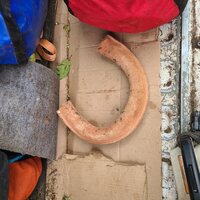
Side note, if you gave a tail gate with a big gap, a little cardboard under my bed mat saves lots of headaches. Wedges and the like hang-up on the hitch.
 

Attachments

  • 17466557650557840954972475072372.jpg
    17466557650557840954972475072372.jpg
    1.1 MB · Views: 14
" but the internal friction between the rope and components is reduced by 1/2"

It's reduced a good bit more than half. If your Mrs. Ddirt :) tip was a pulley the tension ratio between the rope legs would be 1.2 due to losses going around the pulley and the tension ratio goes higher 1.4 IIRC for rope over a branch. Lots of braking contribution from the tip.
 
" but the internal friction between the rope and components is reduced by 1/2"

It's reduced a good bit more than half. If your Mrs. Ddirt :) tip was a pulley the tension ratio between the rope legs would be 1.2 due to losses going around the pulley and the tension ratio goes higher 1.4 IIRC for rope over a branch. Lots of braking contribution from the tip.
I was just generalizing for simplicity, mate. But thanks
 
Many moons ago I cited the extreme example of DRT over a rough bark crotch where you have to increment your hitch and convince the rope to skid over the crotch. Acute honey locust crotch comes to mind. normally doesn't happen but illustrative. hope life is treating you and yours well. A few more years and it's "Cat's in the cradle and a silver spoon, something or other man on the moon, when you coming home? Dad I don't know when...." My son is graduated and working! yeah the kid in the pictures

The 1.2 agreed with Donzelli's research, to my pleasant surprise.

A kick at the math: 1.0/ (1.0 +1.4) = 0.42 of the climber weight on the hitch descending DRT avg bark

SRT the multiscender gets 100% load no helping factors
 
I was just generalizing for simplicity, mate. But thanks
No generalizing with @Bart_ ;-)

Yeah, I did a generally stupid cat rescue in the rain on a white pine a few days ago. Even without cutting anything just a small twig or branch break sends pitch running this time of year.

Being careful enough without trying too hard my main ropes stayed clean enough for me to continue climbing. I utilize my positioning lanyard choked/SRT most of the time, reduces pitch a lot but it will still build up on the first foot and a half of the lanyard. I had to go to the ground anyway to get some different cat capture tools, a few times actually. Each time I was on the ground I applied liberal amounts of rubbing alcohol to the first 2-3' of the lanyard and rubbed it down with a rag. Then ran the lanyard hitch up and down the same area a few times to get any excess pitch off the hitch cord. Only takes a few minutes per cleaning session. Not perfect but everything stayed functional.

Running a saw? Jeezuz. I only work on Pinus strobus in dormant months unless it's an emergency. Then I accept that I'll be doing a lot of pitch remediation before and after the job.

Agree with Reg that MRT/MRS/DdRT (ha! we need more acronyms, not enough) is better generally for pitchy stuff, especially as @southsoundtree mentoned if the climber uses some kind of sleeve style cambium/rope protector. It is almost hilarious when your sleeve gets stuck in a pitchy spot! If you're not crying at the time.

In other words, there are reasons why it's not on the technique or device or hitch to spare a climber problems with pitch.
-AJ
 
I had speculated at one time, assisted by single malt, that it might be possible to come up with a mechanical with longer/ larger friction surfaces or a "pre bent" rope path, but with coated surfaces so pitch wouldn't "stick" as much. The single malt speculated that this might be something like a teflon coating or something (Distel carbon spurs come with teflon coated gaffs). Pitch "slicks" would slide thru at least until part wear. I suppose it depends on how much friction is derived from kinks in the rope path and how much is derived from actual friction on a metal surface(s).
I will have to play around with the idea of "in-tree" rope de-sapping devices, potentially hooked up to a bottle of Everclear (has to be ethanol not isopropanol to be nylon/ poly textile friendly we are told). However there may be other downsides to climbing with Everclear besides just the flammability I suppose.
For real sap fests I now default to a Zillon on the lanyard. Easy to clean.
 
Smaller devices, or those with less points of contact are generally going to fair worse with pitch, grime, moisture etc....and will be less compatible to a variety of ropes and sizes. Too few components doing all the work. Fine if its just a rope grab, but far less forgiving and limited as a rappelling device. Still lots of benefits in other aspects of climbing. One man's trash is another's treasure. The Akimbo, for example, would be too problematic for much of the work I do here. But would've been perfect for places I've lived in the past.
 
All kidding about scotch aside, I have used a scarab now a couple of times on rigging out bits and pieces on less than sap free rigging rope and haven't yet had jogs in the lowering/ friction. Use of a rap rack in my old days on gritted up rope (glacier and caving) didn't give me the impression of jogs and jerky behaviour so much (at least as far as I can remember). Hence the comment about a bendy rope path maybe being less susceptible to junk on the rope textile surface maybe?
Great idea Tom about ceramic or other space age stuff for a friction cam. Of if it's the friction cam giving jerkyness, what about a swappable cam/ friction bit that you could just stop and swap out in-tree, mid way thru a job. I have carried spare prussiks and have swapped out the first one in-tree when it got gooey.
Also thought about a test tube cleaner style brush to get in between the rope and the friction plate/ cam if you unweighted it, but that would require carrying solvent in-tree (as above). But maybe if it was in a tube type vial with the brush inside in a cap (like an capped aluminum cigar tube or something).
And I would bet that some folks would find differences with some mechanicals depending on how they manipulate the device with their hand - i.e a RRP using just the bird v.s. the bird and a hand on the top crook or bend.
Hence my comment about the mfgrs giving instruction on all use cases when they introduce a new thing. Reg I think you did a great job with the two videos on your throwing hook showing it in use, as an example. Same with the Captain and DMM's Kinisi as they rolled it out.
Just my two cents tho. Cheers all.
 
All kidding about scotch aside, I have used a scarab now a couple of times on rigging out bits and pieces on less than sap free rigging rope and haven't yet had jogs in the lowering/ friction. Use of a rap rack in my old days on gritted up rope (glacier and caving) didn't give me the impression of jogs and jerky behaviour so much (at least as far as I can remember). Hence the comment about a bendy rope path maybe being less susceptible to junk on the rope textile surface maybe?
Great idea Tom about ceramic or other space age stuff for a friction cam. Of if it's the friction cam giving jerkyness, what about a swappable cam/ friction bit that you could just stop and swap out in-tree, mid way thru a job. I have carried spare prussiks and have swapped out the first one in-tree when it got gooey.
Also thought about a test tube cleaner style brush to get in between the rope and the friction plate/ cam if you unweighted it, but that would require carrying solvent in-tree (as above). But maybe if it was in a tube type vial with the brush inside in a cap (like an capped aluminum cigar tube or something).
And I would bet that some folks would find differences with some mechanicals depending on how they manipulate the device with their hand - i.e a RRP using just the bird v.s. the bird and a hand on the top crook or bend.
Hence my comment about the mfgrs giving instruction on all use cases when they introduce a new thing. Reg I think you did a great job with the two videos on your throwing hook showing it in use, as an example. Same with the Captain and DMM's Kinisi as they rolled it out.
Just my two cents tho. Cheers all.
If I understand correctly... good point about the Scarab or a rack. The friction surface is only on one side of the line wherever it's contacting the "device". No pinching between opposite friction surfaces and a pitchy line has a chance to fight its way through the device.

The single malt is unlocking a semi-dormant but fighting to get involved backwater of your mind so... listen to it. Cautiously ;-) In the morning it can all seem like crap.
-AJ
 
In a brake bar I think the rope contacts one side on the first bar, then alternates to the other side of the rope on the next and alternates thru the rack. Maybe something in that. Uni alternates too? BDB seems to alternate rope sides as well (don't own one yet).
Whereas at least on the RRP the rope contacts the slick pin and the friction plate both on the same side of the rope - so both might contact a gloop of sap on one side.
Interesting. Relevance - unsure.
Cheers AJ
 
Last edited:

New threads New posts

Kask Stihl NORTHEASTERN Arborists Wesspur TreeStuff.com Teufelberger Westminster X-Rigging Teufelberger
Back
Top Bottom