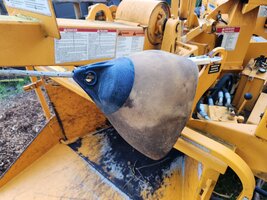
Chipper winch line protection

GreenMntnBoy410

New member
Location
Vermont
I'm wondering if anyone has come up with a creative solution to protecting the first few feet of the chipper winch line. I work for a municipality so we drag a lot of brush/logs across pavement and sidewalks. This results in the line getting frayed relatively quickly and failing. Not a big deal but it'd be nice to avoid. We've tried running different types of hoses over the winch line, which work fine for protection but aren't very pliable (especially in the winter) and make running the line around material difficult. I had thought about some sort of thicker diameter shrink tubing but what I've looked at doesn't seem like it'd hold up for very long. Thanks for any insight!
 
I like the idea and had considered it but I imagine we'd jacking up peoples driveways, sidewalks, lawns, and the road in the process.
I use a short section of chain with my winch and the lawns suffer but from the load being drug not the chain digging in. You are dragging the load when using a winch so turf impact is going to happen.
 
I use my chipper winch a ton, and basically just consider the last few feet of the winch line a disposable item. When it's looking ragged, cut it off and live with a few less feet. The drum on my Bandit has 200' and most of my pulls are in the 50' range, so doing this won't harm my abilities for quite a long time. And actually the winch gets more powerful the less wraps of line are on the drum, so that's nice.

A skidding cone will largely eliminate abrasion on the ground (on flat ground) and I use one occasionally, but really just to protect the ground from being torn up from the material, or to reduce 'plowing' when winching logs. The other option as people have mentioned is an additional choker. I do use chains and cable chokers in some instances especially in rocky areas. If you don't want metal, you will basically end up having a sacrificial synthetic choker that you just replace every so often to save the winch line itself. Depending on how much you use the winch and the situations, adding that extra step can be an annoyance.
 
Hollow braid is super easy to splice- long straight burry like 15 feet additional dyneema or tenex seems like it would work great-

That said, I haven't bothered on our chipper winch, but very little asphalt around here.
 
I'm wondering if anyone has come up with a creative solution to protecting the first few feet of the chipper winch line. I work for a municipality so we drag a lot of brush/logs across pavement and sidewalks. This results in the line getting frayed relatively quickly and failing. Not a big deal but it'd be nice to avoid. We've tried running different types of hoses over the winch line, which work fine for protection but aren't very pliable (especially in the winter) and make running the line around material difficult. I had thought about some sort of thicker diameter shrink tubing but what I've looked at doesn't seem like it'd hold up for very long. Thanks for any insight!
are you just wrapping the winch line around the materials, and hooking back to the winch line? And it’s getting damaged in that process? If this is the case, create yourself some “choker” style sling to hook to the long line (theses will inevitably get tore up too).
 
Choker chain or even cable.
Chafe sleeve
Dead eye sling disposable
Stack the butts in a ArbTrolly and yard the unit

Basically lots of options but I reach for my choker chain first.
Hooking to a brush pile about 1/3 down from the butts helps quite a bit but make feeding into the chipper harder. When getting close slack the winch and slap a half hitch on to the butts to re orientate, once’s the butts are in the feed tray slip the half hit hitch off pull in till they contact the feed wheels.

A sheet of plywood with a hole works well, and I’ll use this for stacking brush to be hauled with the mini to avoid pinching dirt and rocks..
 
Choker chain or even cable.
Chafe sleeve
Dead eye sling disposable
Stack the butts in a ArbTrolly and yard the unit

Basically lots of options but I reach for my choker chain first.
Hooking to a brush pile about 1/3 down from the butts helps quite a bit but make feeding into the chipper harder. When getting close slack the winch and slap a half hitch on to the butts to re orientate, once’s the butts are in the feed tray slip the half hit hitch off pull in till they contact the feed wheels.

A sheet of plywood with a hole works well, and I’ll use this for stacking brush to be hauled with the mini to avoid pinching dirt and rocks..
I like the idea of a skidding tray! something like an old flat bottom boat hull would be really slick.

just realized that a car hood was mentioned. sounds like something cheap and easy to get from a scrapyard
 
  • Like
Reactions: evo
I like the idea of a skidding tray! something like an old flat bottom boat hull would be really slick.

just realized that a car hood was mentioned. sounds like something cheap and easy to get from a scrapyard
We used some old conveyor belt bolted together into a mat with carriage bolts. The working end length of angle iron and Dee’s welded onto it. Heavy as f but worked well on flat ground. It was worthless around trees and stumps
 
Tubular webbing on the last few feet of line helps, use tiny zip ties through the winch line weave or light cordage to secure. I also employ a 20' or so hank of old climbing rope, which is nice because you can keep your winch line stowed while stacking branches (orient butts 90 degrees to the chipper for the best cinch) on the line, then running bowline around stack and deploy winch line.
 
I make pocket slings out of 1/2" tenex tec. 15' of rope gets me a 7' sling with plenty of pockets. Sling goes around log/branch, hook goes to pocket closest to the log. If we are on pavement, sling goes close to end of log/branch and someone can walk along side it with a scoop shovel under the sling like a sled. Often times the end of the log will stay on the shovel sled by itself, other times the worker just supports the shovel handle. We only mess with the shovel if a particular pull is anticipated to have significant abrasion.
 
Choker chain or even cable.
Chafe sleeve
Dead eye sling disposable
Stack the butts in a ArbTrolly and yard the unit

Basically lots of options but I reach for my choker chain first.
Hooking to a brush pile about 1/3 down from the butts helps quite a bit but make feeding into the chipper harder. When getting close slack the winch and slap a half hitch on to the butts to re orientate, once’s the butts are in the feed tray slip the half hit hitch off pull in till they contact the feed wheels.

A sheet of plywood with a hole works well, and I’ll use this for stacking brush to be hauled with the mini to avoid pinching dirt and rocks..
Can you elaborate about the hole in the plywood, please?
 

New threads New posts

Kask Stihl NORTHEASTERN Arborists Wesspur TreeStuff.com Teufelberger Westminster X-Rigging Teufelberger
Back
Top Bottom