chiselbit
Been here a while
As she disappeared into the gloom cackling hysterically

Follow along with the video below to see how to install our site as a web app on your home screen.
Note: This feature may not be available in some browsers.


Only "Death" maybe if she levitated rather than walked - kinda like Mother Superior at the top of the stairs in the Blues BrothersListened to the book "Stranger in the Woods". He referred to the Lady of the Woods (or was it of the Forest?) as death. Kinda the grim reaper in another manifestation.


Awesome commentI’m not going to take any article too seriously if they call lichens plants
When somebody says "this stuff killed my tree" I can usually find a nearby rock with some lichen or a little patch on the siding of their house and I'll joke "Oh, my - look...it killed that rock too!" (acknowledging that their tree is in decline and yes, they've seen more lichen. They aren't dumb for making that assumption...I just want to point out - leaving no doubt - this is not the cause, so we need to look further to diagnose the real cause).Lichens and mosses are absolutely not harmful to trees. Around New England when non-native blue spruces are dying from fungal degradation the lichens increase. There is more available light, dead and dying conifer limbs are the perfect structure for them to thrive on. Correlation is not cause in this case.
-AJ
Observational Forensics of Sick Shade Trees was an interesting article.
In his never ending list of possible maladies trees can have and their symptoms he had this one that I found rather ridiculous.
“Lichens and mosses can be like the canary in the coal mine for a tree."...

I agree the words themselves are correct, but the author/editor isn’t considering the audience well enough. I think a few more sentence doing a better job describing would be better.I do think the author could have described the situation more clearly in this section but to be fair, he never said or even alluded to lichens and mosses killing trees. Just as the canary doesn't cause a gas leak, it does signal a possibility of one. A possible sign of decline, nothing more.
yeah, kinda. If, as a professional, that's what I'm noticing, I'm missing a lot of other things going on (like the thinning canopy itself). I get homeowners notice that more than anything else.I do think the author could have described the situation more clearly in this section but to be fair, he never said or even alluded to lichens and mosses killing trees. Just as the canary doesn't cause a gas leak, it does signal a possibility of one. A possible sign of decline, nothing more.

... As to the analogy of a canary in the coalmine, ironically, that may be the worst part of that break down. As @RyanCafferky noted in the OP, lichens are generally associated with better air quality. Canaries were brought into coalmines to detect bad air quality, so in that regard a lichen plays the polar opposite role.

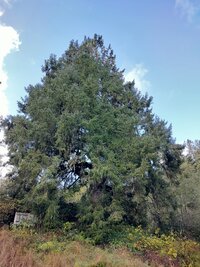
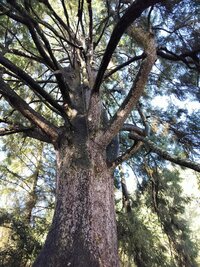
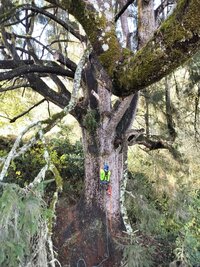
A few weeks ago, I had the pleasure of working on a rather large and old Sitka spruce with a significant amount of lichen in the top 30-40' of the canopy. For context, this tree is the tallest living christmas tree in the country and has been getting lit up with Christmas lights and a large star every holiday season for close to 100 years. An unknown number of years ago, the fire department that was managing the tree at the time had chained the 3 tops together right at the spot where the lichen gets heavy. over the years the tree has swallowed the chains and now has a noticeably sparser canopy above where the girdling occurred. The BCMA I was working with for the project asked me to remove the lichen from the upper crown because she thought that it was blocking photosynthesis in that upper crown. at first, I was hesitant to perform that work on the tree thinking that the lichen can't be having a negative effect on the tree and that removing the lichen wouldn't do anything. However, as I got into that upper canopy and inspected closer, I saw that the lichen was not just growing on dead branches in between clumps , but also completely smothering large amounts of live foliage and not allowing any sunlight at all into the foliage. To me, it appeared that the crown started to die back as a result of the girdling, and the lichen then took over where it now has much more sunlight than it previously had and prevented any chance of the tree top coming back to health. Anyways, I removed the lichen from the top and primed the rest of the tree, so time will tell if the correct decision was made. Anyways, not sure where I was going with this, but I just wanted to share some anecdotal evidence and also show yall a cool tree.


I’m in coastal New England. Lichens are common place on healthy in my area, such as mosses on the North face of lower trunk, and sometimes thinner plate-like Lichens on older leaders/branches.Observational Forensics of Sick Shade Trees was an interesting article.
In his never ending list of possible maladies trees can have and their symptoms he had this one that I found rather ridiculous.
“Lichens and mosses can be like the canary in the coal mine for a tree. With few exceptions (such as the base of aged trees and the limbs of live oaks and maples), this is an indicator of stress in a tree. Healthy trees normally slough off bark before these non parasitic plants can get a foothold. “
Did anyone with any tree knowledge review this article? Lichens and mosses can be pretty ubiquitous in a lot of trees and in my experience have zero negative consequences or zero indication of tree health issues. Lichens are actually a sign of really good air quality and will grow on almost anything given the chance. Here in the northwest we have moss on many species of trees. Sometimes it is inches thick.
Would love to have other people chime in on this one.