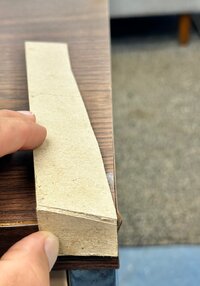
Tilted/angled back (and face) cuts

I’m thinking I need some trees to try this on!

Beranek talks about tilting the cuts to change angle or direction of fall but don’t see it much. I imagine the tree top will do a bit of a 3D arc, could maybe swing around obstacles…in a good holding wood conifer.
 
Not sure if this is what you’re talking about? We sometimes angle the cuts on hard leaners to match the grain and have a square butt when it’s off the stump. This pic is of the first gunning cut
1728304399117.jpeg
 
I’m thinking I need some trees to try this on!

Beranek talks about tilting the cuts to change angle or direction of fall but don’t see it much. I imagine the tree top will do a bit of a 3D arc, could maybe swing around obstacles…in a good holding wood conifer.
Beranek:
"This hinge may be put in at different heights, depths, and angles, making the tree tilt, fall, and swing different ways." (Page 276).
"THE SWINGING FACE At times you will need to swing a tree. To do this, the entire face and back cut is purposely placed in the tree out of pitch or out of level. In many situations it should be accompanied with a wide face. Note when using this cut that the tree will always tend to swing to the high side of the face. The amount of pitch in a straight tree shouldn't exceed more than thirty degrees. After that, you really don't gain much more effect. Trees that lean will have an out-of-pitch trunk anyway. Anytime the falling cut is placed square to the trunk in order to fall a tree sideways to its lean, the resulting face will be out-of-pitch and tend to swing the tree. If you use a Dutchman in the low corner and hold extra wood on the high corner, you can amplify the effect. But always remember that when swinging trees the success and fail rate is about even." (Page 334-335).

For someone like me who mainly works in backyards or near obstacles that last sentence is critical: "when swinging trees the success and fail rate is about even." Don't ever count on it working!!
 
I was holding my tongue, but that was gonna be my comment on this type of thing. I have done it, but had them fail at least as often as they work. I do it to try to save a branch on an oak in the woods, but never anywhere that matters.
 
If I recall correctly the tree in my pic didn’t swing at all. Broke off and went right we’re it was leaning. That tree was in your neck of the woods @Matias , few years ago in the burn off Lumpkin Ridge rd out past feather falls
 
If I recall correctly the tree in my pic didn’t swing at all. Broke off and went right we’re it was leaning. That tree was in your neck of the woods @Matias , few years ago in the burn off Lumpkin Ridge rd out past feather falls
That looked like too much lean to get much off, especially post fire crispy. My buddy's place was 300' INSIDE the edge of that fire, and he lost a crop. His neighbor was totally fine. That was an especially shitty fire; almost got Forbestown too.

My house is riiiight at the bottom of that way in to the hills.
 
@chiselbit yeah, but used as more of a trick or "gimmick" cut on a straight tree. I imagine it doesn't get used a lot because it would leave a goofy stump for a logger and can't be trusted for an arborist.
 
For someone like me who mainly works in backyards or near obstacles that last sentence is critical: "when swinging trees the success and fail rate is about even." Don't ever count on it working!!
We were just chatting on that, had a number of sizwheels on pine engage well in the past 2 weeks, but remebering the past ones that didn’t and some hemlocks that broke 90deg…
 
I know they don't always work, but if you want to see some gnarly swings, check out caveman faller on youtube.

If you're sizzy doesn't hold, try a triple hinge, haha!

I theorize that the most unpredictable trick cut is a dutchman.
 
Even a swingin dutchy works, some to most of the time…
I tend to make my bottom cut where the tree wants to go, then instead of making a perfect apex leave one side tall without a bypass. Takes a bit to make it nice and clean (and knock the face out).
Essentially not far from a block face with a deep snipe. But where on one side of the block hinge it does taper to a apex
 
Even a swingin dutchy works, some to most of the time…
I tend to make my bottom cut where the tree wants to go, then instead of making a perfect apex leave one side tall without a bypass. Takes a bit to make it nice and clean (and knock the face out).
Essentially not far from a block face with a deep snipe. But where on one side of the block hinge it does taper to a apex
Kinda like this? haven't gotten to try it. I now think the compression side of the hinge should be severed when using a dutchman. The dutch is basically there to push that side of the tree up, but it can't if the hinge is holding it. I'd for sure thin the hinge or more likely just leave a large post on the tension side.
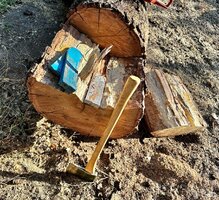

 
Kinda like this? haven't gotten to try it. I now think the compression side of the hinge should be severed when using a dutchman. The dutch is basically there to push that side of the tree up, but it can't if the hinge is holding it. I'd for sure thin the hinge or more likely just leave a large post on the tension side.

Pretty much, but most the time I use its it’s conventional
 
I scratched my head for a while on this one. At first a mid fall swing of the trajectory came to mind with associated extra stress on the hinge (to alter the felling arc) but then I realized the hinge wood could be a piano hinge and thus the spar fell in a straight no deviating fell arc - so no extra stress on the hinge? I think the initial onset of the off =center trajectory tweaks on the hinge at the outset of spar motion vs level hinge - hence a source of failures. Maybe my physics are rusty and extra force is present at the hinge through the whole fell arc. (Remember the famous physics films of brick chimneys snapping in half mid felling arc?) This is different than kicking the fell arc sideways mid trajectory via closing and crunching various bits of hinge wood.

?
 
This is an accidentally tapered Humboldt face, not a tilted cut . The effect is pretty dramatic.


I think a tilted cut in a straight tree would be one of the most reliable non standard cuts, it’s still a normal hinge with normal loads on it.
 

New threads New posts

Kask Stihl NORTHEASTERN Arborists Wesspur TreeStuff.com Teufelberger Westminster X-Rigging Teufelberger
Back
Top Bottom