critical criticism

Daniel

Carpal tunnel level member
it was irrelevant to the outcome so don't take this personally. more of an adademic excercise.

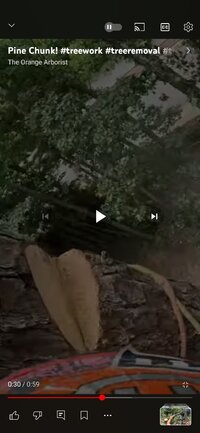
Looks like there was a slight bypass in the two face cuts, which created a unintentionaly bypass dutchman. That looks visible in the video for the moment where you stick your head far forward enough to view the finished notch.

The definite tell on that is when the piece starts to go, then stops, after the back cut opens up just an inch. Then you have to cut through the rest of the hinge before it releases. You can see on the falling log, that the hinge is completely cut. there are no ripped fibers.

There is no conjecture in the above statements. If you know tree work and look carefully at this video, this is 100 % a classic bypass dutchman. In many cases, as in this one, it doesn't matter. But you could end up losing a piece/tree to side weight in a different scenario.

There is definitely more of a tendency to bypass when making the bottom cut of the notch first. ALso take another look at the way you see-saw the bar on the initial bottom cut and you can see that you went a little too far on the far side for a moment. Those kerf cuts can easily fill with sawdust and become invisible. Took me losing a big oak 45 degrees to the side to learn this lesson


Yes... that's what I said... it's a sloppy notch, but it worked. The question is.. does he know it's sloppy and let it slide because it doesn't matter.. or NOT!
I would say he knew it was sloppy but didn’t care, because with a pull-line on a relatively small piece like that its only going one way. A snap cut would have worked just as well, albeit with the possibility of a bit more wobble on the stump.

It was three in the afternoon (according to his watch) he’s on his way down the tree, tired and aching.
I’d wager if that was a big top with an indifferent lean his attention would be more focused.
 
Yes... that's what I said... it's a sloppy notch, but it worked. The question is.. does he know it's sloppy and let it slide because it doesn't matter.. or NOT!
Nothing matters until it does. Whether ignorance, complacency or both is at play all this fella is doing is teaching himself shitty sawmanship. Why not look at ever cut as an opportunity to get a little better?
 
Well aside from the cut, his spar tie off on the climbing line doesn't cut the mustard and the ground crew is helmet less. Sometimes all those factors together indicate the climate of normal operations. IDK. just thinking outloud

I noticed all of those things as well and had the same thought. And I know Dan is here to stir the pot, so I wasn't really interested in playing safety inspector on other guys videos and on this post, but... here I am. (August uses his ZigZag on spars the same way all the time... I use the TreeSqueeze so I'm choked on the stem and always able to DRT to the ground)
 
One of the reasons to practice good cuts on the ground is so that you can trust your life to them in the air.

I like to direct the video and show where improvement can be made, pros and cons, trade offs etc.

There was clearly a bypass Dutchman and with careful observation two bypasses, one on each side of the hinge is almost certainly.

On his first cut, the bottom cut, he see sawed the bar as he finished the cut. Finishing the bottom cut with that motion is going to inevitably lead to an uneven cut that can't be matched. The far side of the hinge has been bypassed with the bottom cut.

Then he bypassed the near side if the hinge with the top cut as seen in the screenshot. The near bypass is clearly visible. He pulled down on the body of the saw as the last motion of the cut.

The top begins to move then stalls early which is a clear sign that the bypass in one or both Dutchmans have closed and the top can't move until the hinge is cut through completely.

Those are the mechanics. And worth showing to a rookie as a teaching piece.

IMO by making the angled top cut first, the cut is prone to bypass. It's much easier to judge the matching second cut and there's better visibility with making the top cut first. Ultimately, it's much easier not to cut a bypass when cutting the top cut first.

So why do it? Which cut do you make first. I was taught to make the bottom cut first and played that game for 20 years. Switched ip in 2002 and will never go back. We could start a conversation about the pros and cons. The only real con I see is that he'd have to make the bottom cut with a pulling chain that would shower his torso with sawdust.

He didn't need precision on this cut, so maybe he was just hurrying through kind of sloppy. Or maybe he doesn't know better and sloppy is his MO.

Either way, it's a good teaching piece
 
One of the reasons to practice good cuts on the ground is so that you can trust your life to them in the air.

I like to direct the video and show where improvement can be made, pros and cons, trade offs etc.

There was clearly a bypass Dutchman and with careful observation two bypasses, one on each side of the hinge is almost certainly.

On his first cut, the bottom cut, he see sawed the bar as he finished the cut. Finishing the bottom cut with that motion is going to inevitably lead to an uneven cut that can't be matched. The far side of the hinge has been bypassed with the bottom cut.

Then he bypassed the near side if the hinge with the top cut as seen in the screenshot. The near bypass is clearly visible. He pulled down on the body of the saw as the last motion of the cut.

The top begins to move then stalls early which is a clear sign that the bypass in one or both Dutchmans have closed and the top can't move until the hinge is cut through completely.

Those are the mechanics. And worth showing to a rookie as a teaching piece.

IMO by making the angled top cut first, the cut is prone to bypass. It's much easier to judge the matching second cut and there's better visibility with making the top cut first. Ultimately, it's much easier not to cut a bypass when cutting the top cut first.

So why do it? Which cut do you make first. I was taught to make the bottom cut first and played that game for 20 years. Switched ip in 2002 and will never go back. We could start a conversation about the pros and cons. The only real con I see is that he'd have to make the bottom cut with a pulling chain that would shower his torso with sawdust.

He didn't need precision on this cut, so maybe he was just hurrying through kind of sloppy. Or maybe he doesn't know better and sloppy is his MO.

Either way, it's a good teaching piece
The recent video you sent of the ash removal over the hickory- you just cut from the back, right? You called it a slash cut? Since we are here analyzing this video out of the blue.. could you tell me why you chose to use that cut and not start with a notch?
 
The recent video you sent of the ash removal over the hickory- you just cut from the back, right? You called it a slash cut? Since we are here analyzing this video out of the blue.. could you tell me why you chose to use that cut and not start with a notch?
I believe I called it a rip cut.

I put out a number of videos recommending the rip cut. It has many advantages over a standard kerf or notch undercut. The only problem is it can kill you if your climbing line or lanyard is under the cut. That's why it's safer used from the bucket
 

New threads New posts

Kask Stihl NORTHEASTERN Arborists Wesspur TreeStuff.com Teufelberger Westminster X-Rigging Teufelberger
Back
Top Bottom