









Physics Question: Basal vs Canopy Anchor Forces

When setting a line in the tree to use to pull it over, what is the difference in forces between a basal or canopy anchor?
In an attempt to be more clear: say you set 2 lines 60 ft up two identical 100 ft trees and then pull on them from 150 ft away one is tied off just above my notch and one just runs up to the union, would I have more pulling force on the ground from the canopy or basal anchor? And why is that?

Thanks for the consideration.
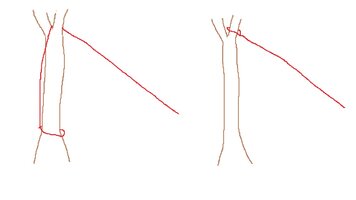
 
If that is the case, the forces on the tree pull would be the same. If you are pulling with 150 lbs force, it is 150 lbs no matter which you use. There is a force on the line that runs vertical from the base to the crotch, but it doesn't affect the pull force.
 
The one just tied to the top will have more force.
XXXXXX
Will add a little more stretch on the base tie for the added length, but the force is 150 lbs no matter what you do. It all goes to the same spot. Force of pull 150 lbs. with each. Height of leverage=same. (Just using 150 lbs as an example.)
 
Last edited:
If that is the case, the forces on the tree pull would be the same. If you are pulling with 150 lbs force, it is 150 lbs no matter which you use. There is a force on the line that runs vertical from the base to the crotch, but it doesn't affect the pull force.
I've always thought of it this way, but a coworker said they got taught that the basal anchor would have more pull, so I figured I'd ask the internet.
 
I changed it from force to persuasion. Force was not the right word for what I meant to convey. Which is that the top tie will convert more of the force in the direction of pull whereas the base tie will lose power because of the redirect in the line.
I think what Shadowscape is saying is right because the force applied to one side of the pulley, or branch, is just mirrored on the other side, or multiplied by a factor. It's not divided and distributed across both sides.
 
I changed it from force to persuasion. Force was not the right word for what I meant to convey. Which is that the top tie will convert more of the force in the direction of pull whereas the base tie will lose power because of the redirect in the line.
XXXXXX
Nothing is moving in the redirect, unless he cuts it off above the base tie.
 
Because the rope is anchored on the opposite side, and the whole rope is experiencing the magnitude of force the the direction of force ends up somewhere in between. I thought this was common knowledge among tree workers?
 
It doesn't matter if its moving or not, the direction of force still changes.
If he pulls with 150 lbs on either, the pull on that spot of the tree will be 150 lbs. Makes no difference where the rope goes after that spot as long as it doesn't move and stays against the stem. Different if it were tied to a neighboring tree or something else. The angle from the base to the crotch will not change. Only the angle from the crotch to the source of the pull changes, and that is the same for both.
 
As I said, the magnitude will be more or less the same but the direction of force will be different.

The ideal is to pull from a top tie, if you want the direction of force to be in line with the rope.
 
The compression force on the crotch won't affect the pull force. There will be 150 lbs pulling, and on the back side of the tree will be (not taking into account friction) XXX lbs of compression force straight up the trunk. Doesn't matter how far you increase the angle of the tree as it goes, the back side isn't moving so your pull is still at the top. The compression force of the rope on the back side will change however, but it is not a player in the game any more than the trunk itself is.
Forget the rope for a moment and think about it this way. You run a steel pipe up the tree from the base to the crotch. The pipe is only anchored at the base. At the top of the pipe you tie the rope. Tie it to the pipe or tie it to the tree. Same forces acting on the pull. With the base tie we are talking about, all we are doing is replacing the pipe with rope.
 
A rope is not a steel pipe... I don't get that analogy...

The force on leg of rope going from redirect to the puller will not change but the total power will be greater since the rope is redirected and the direction of force will change as well, it will not be in line with the rope.
 
I believe that with the basal anchor, the force will be 100% of what is applied on the pull line, plus the cosine of the pulling angle times the pulling force.
 

New threads New posts

Kask Stihl NORTHEASTERN Arborists Wesspur TreeStuff.com Teufelberger Westminster X-Rigging Teufelberger
Back
Top Bottom












